Key Findings
- WhatTheyThink’s 2026 Printing Outlook projects single-digit growth for print service providers in 2026, with revenues up 5.7% (3.3% after inflation), profitability up 5.1% (2.7% after inflation), and jobs and orders up 4.9%.
- Concerns are dominated by the economy, tariff uncertainty, and tariffs, each at 61%. Inflation, political uncertainty, politics, and the war with Iran each register at 47%.
- Diversifying print product and application offerings ranks first on MaxDiff at +42.4%. Adding digital label capabilities ranks last at -41.4%.
- Embellishment was the most important opportunity that 47% of the print service providers survey actually pursued in 2025.
- The gap between digital embellishment as the most-pursued and the most-promising opportunity is a market-education problem, not a technology problem.
- This article charts a credible path to scaling embellishment as a value-priced category.
What Does the 2026 Printing Outlook Show?
WhatTheyThink’s Printing Outlook 2026–27 Report describes a year of single-digit growth held back by continual tariff uncertainty, inflation, and the war with Iran. The 124 print service providers in the survey expect revenues to rise 5.7% on average in 2026 (3.3% after inflation), profitability to rise 5.1% (2.7% after inflation), and jobs and orders to rise 4.9% (p. 14).
Concerns run sharper than the headline forecast suggests. Three items sat at the top of the concerns chart at 61%: the economy, tariff uncertainty, and tariffs. Four items followed at 47%: inflation, political uncertainty, politics, and the war with Iran. Five more clustered at 37%: a downturn in the economy, finding talent, an aging staff, secular print decline, and supply chains (p. 18, N=97).
A note on the sample. The Outlook is a convenience sample of strategically engaged print service providers, not a census of the U.S. printing industry. Question-level bases vary because not every respondent answered every question. The findings describe what strategically significant operators are thinking and are useful precisely for that reason. They are not directly projectable to the industry as a whole.
Where Will Print Service Providers Find Their Next Dollar of Profit?
This year, the Outlook applied MaxDiff scoring to its opportunity and challenge questions for the first time. MaxDiff, also known as best-worst scaling, is a survey method that forces respondents to rank trade-offs rather than tick boxes. The result is a cleaner signal of which opportunities the market actually values relative to others.
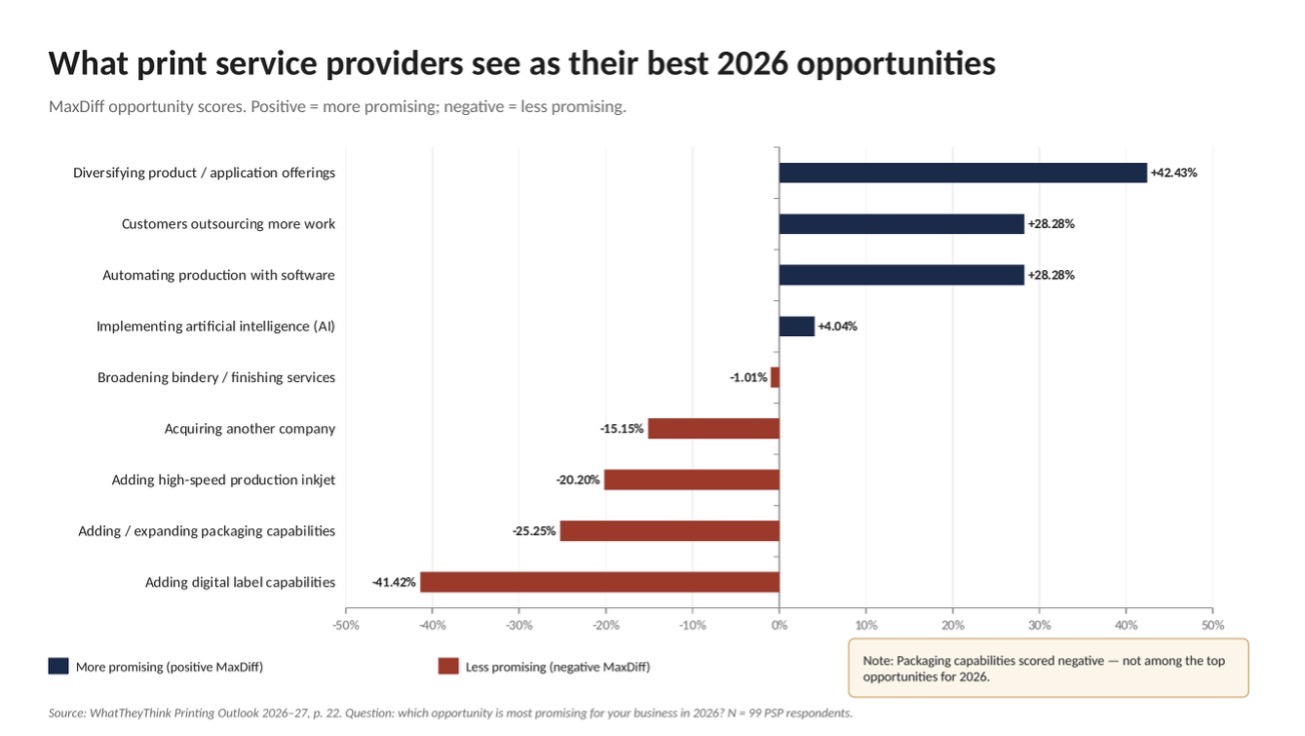
Diversifying print product and application offerings sits at the top at +42.43%. Customers outsourcing more work and automating production with software tie for second at +28.28% each. Implementing artificial intelligence is modest but positive at +4.04%. Four items score negative. Adding or expanding packaging printing capabilities sits at -25.25%. Adding digital label capabilities sits last at -41.42% (p. 22, N=99).
For OEM product managers and brand marketing leads, the negative scores are the headline. Investments that the trade press often portrays as hot do not, in this sample, look hot to the people running printing companies. They look hard.
AI sits earlier in the curve. Of respondents who answered the implementation question, 10% are actively using AI or machine learning, 22% are currently testing or piloting, 9% plan to implement in 2026, and 37% are researching potential applications (p. 32, N=97). Twenty-two percent describe themselves as never-AI-ers. Workflow automation is no longer aspirational. Fifty-nine percent of respondents have implemented automation extensively or partially, and another 9% are currently implementing (p. 31).
Why Did Embellishment Lead the Actual-Investment List But Not the MaxDiff List?
A different question in the same survey produced a compelling insight. When respondents were asked what new business opportunity they actually pursued in 2025, embellishment came out on top, despite far a far more pessimistic outlook for it as an opportunity in last year’s outlook survey.
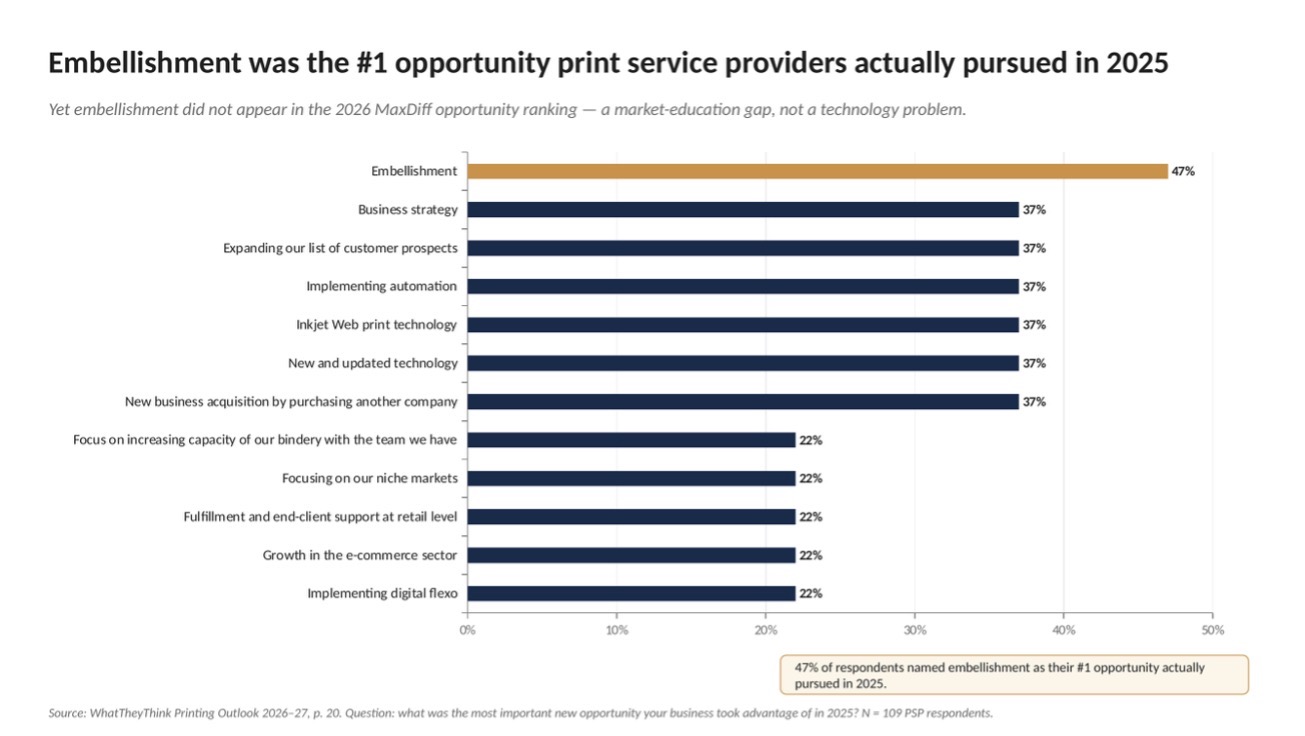
Forty-seven percent named embellishment as the most important opportunity pursued in 2025. Six items tied at 37%: business strategy, expanding the customer prospect list, implementing automation, inkjet web print technology, new and updated technology, and new business acquisition by purchasing another company (p. 20, N=109).
The opportunity that print service providers spent 2025 actually pursuing is not the opportunity they say is most promising for the year ahead. The gap is a market-education problem, not a technology problem. Print service providers know how to embellish. What they cannot easily do is sell embellishment as a sustained, repeatable, value-priced service. Buyers respond to wow samples one project at a time. Without a value proposition, standard’s based specifications, and quantified benefits linked to customer business results, the category is unlikely to scale.
Why Has Digital Embellishment Failed to Scale?
A technical answer matters because it points to a potential fix. ICC v4 is the workhorse of the industry’s color workflows. It is built around tristimulus values fixed to D50 and is colorimetric by design. It cannot predict how gloss, foil, varnish, metallics, pearlescence, or substrate behavior render under different illuminants, viewing geometries, and surface conditions. ICC v4 answers the chromaticity question. It does not answer the question consumers actually ask: “Does this product look like what I expected when I see it in the store, on my phone, in daylight at the curb, at home in my living room?”
That is the appearance management gap. Appearance management is the term emerging in the standards community for color management extended to gloss, foil, varnish, metallics, pearlescence, substrate behavior, and other surface effects. The good news is that a standards-based architecture for it already exists.
iccMAX (ICC.2:2023, also published as ISO 20677) is the ICC standard for spectral and appearance-based color management. It encodes per-pixel spectral and specular data and brings the variables that ICC v4 cannot reach into a measurable, standards-based framework. The standards work is well advanced, however operational adoption is not. Hence the gap.
The reason adoption has stalled is primarily commercial, not technical. Print service providers have had little reason to fund the transition on their own. Brands have often treated appearance control as a production issue rather than a design, commerce, margin, brand, and sustainability issue. The economic pain shows up downstream in returns, rework, markdowns, and waste. The leverage to prevent it is upstream, at design, supply chain specification, and approval.
Returns in appearance-sensitive categories such as apparel, packaging, home goods, décor, and embellished products are often a failure of expectation management. The consumer buys what the screen, package, configurator, sample, or product page appeared to promise. When the delivered product looks materially different under store lighting, daylight, or home lighting, the cost shows up as returns, rework, markdowns, waste, and lost trust. The brand absorbs most of it.
How Do glTF and iccMAX Fit Together?
Brands have already begun investing in a related standards ecosystem. glTF 2.0, also published as ISO/IEC 12113:2022, is the Khronos Group’s runtime 3D asset format. The Khronos 3D Commerce Working Group develops the guidelines and certifications that bring glTF into e-commerce, configurators, augmented reality, and digital merchandising. glTF gives brands a portable way to describe and distribute 3D product assets, including geometry, textures, base color, roughness, and metallic effects.
That is valuable. It is also the limit of the current opportunity. glTF 2.0 can help a brand render a more realistic product online. RGB textures and physically based rendering parameters alone do not prove how expanded gamut or specialty pigments, foil, varnish, embossing, metallic effects, textiles, substrate, or packaging will appear when manufactured and viewed under real illuminants. Without a standards-based connection to measured spectral and specular data, the digital product asset remains partially disconnected from the physical product it is meant to represent.
glTF is not a competitor to iccMAX, but it can be a demand-side adoption engine. glTF is where brands already see commercial value: conversion, engagement, lower production cost, reduced return risk. iccMAX is where that value can be made measurable and print production-relevant.
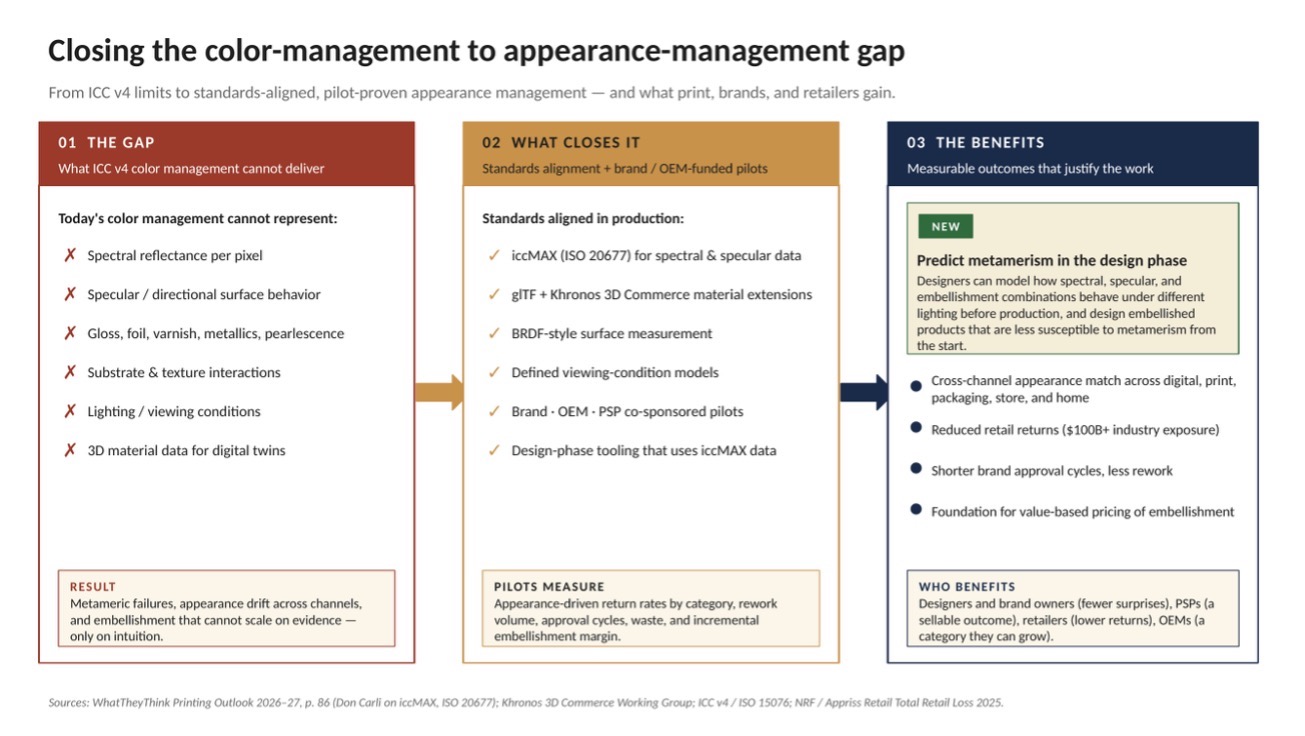
The opportunity for brands and OEMs is to connect the two standards. glTF carries the brand-facing, commerce-facing product representation. iccMAX provides the measurement and transformation architecture that connects that representation to real materials, print processes, embellishment effects, lighting conditions, and viewing environments. Connected, they move embellishment past the question “Did the printer match the proof?” to a more valuable question. “Did the product appearance match the customer’s expectation across the environments where the product was discovered, purchased, received, and used?”
With properly captured spectral and specular data, designers can model metamerism and embellishment behavior before production rather than after a failed press run or a spike in returns. Brands can design products and packaging that are less vulnerable to appearance shifts in the first place. glTF gives brands a standards-based scalable digital product twin. iccMAX gives that twin a standards-based measurement spine for packaging and print production.
Who Should Fund the Pilots, and What Should They Measure?
A single print service provider cannot educate the market alone, nor can a single OEM or brand. The credible path forward is co-sponsorship by brands, retailers, OEMs, and measurement vendors, with print service providers and their associations as operational partners.
Useful pilots would measure four outcomes. The first is the appearance-driven return rate by category and channel, with category baselines drawn from the brand’s own commerce data rather than industry averages. The second is rework volume and approval-cycle time at the design and pre-press stages. The third is diversion of waste from landfill and the associated emissions reductions, which are increasingly material to packaging compliance under the EU Packaging and Packaging Waste Regulation and to U.S. state-level Extended Producer Responsibility reporting. The fourth is incremental margin from embellished work sold on a value basis rather than a per-unit basis. Pilots should replace estimates with data at the SKU and failure-mode levels.
The implication for print service providers is to align with existing ISO appearance standards rather than rely on proprietary tools and work arounds to bridge the gap. The implication for brands and OEMs is to fund pilots in 2026 that produce auditable data, and to use that data to negotiate value-based pricing and category-level investment in 2027.
What This Means for OEM and Brand Product Managers
The 2026 Outlook describes a year of single-digit growth. It also describes a year in which print service providers are unlikely to fund standards adoption on their own. That makes 2026 the right window for brand and OEM product managers to fund credible glTF and iccMAX pilots. The brands and OEMs that produce auditable appearance data this year will set the category terms in 2027. The ones that wait will be price-takers.
Read the full WhatTheyThink Printing Outlook 2026-27 for in depth insights, and contact me at [email protected] or on LinkedIn with comments, questions, or pilot proposals.