When International Paper Company completed the spinoff of its global printing papers business as Sylvamo Corporation in 2021, one question was what would become of IP’s long-running gift to the printing industry: the Pocket Pal, a graphic arts production handbook published in 21 successive editions from 1934 to 2019.
Originally edited by Michael H. Bruno and later by Frank Romano, the Pocket Pal was both a go-to resource and a rite of passage: a quick-reference compendium for veterans and required reading for everyone entering the industry for the first time. Generations of printers, graphic designers, print buyers, and others made it the most famous of all books on the subjects it covered.
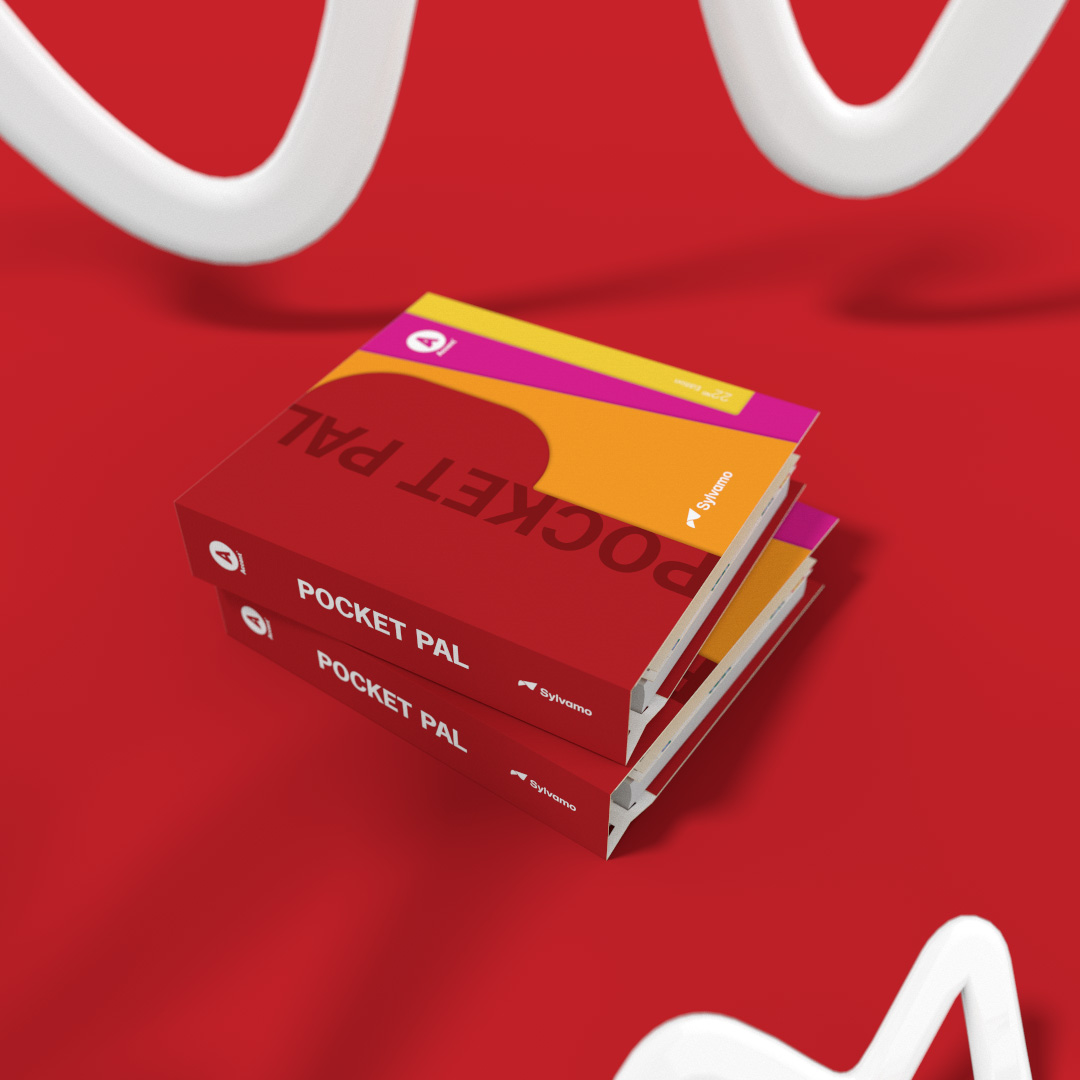
In 2024, Sylvamo brought the Pocket Pal vividly back to life with the Twenty-Second Edition, a complete reimagining of the original work in format, design, and emphasis.
Sylvamo’s objective was not just to update the book in terms of content, but to make it both engaging and useful for a new generation of readers who will have had little or no acquaintance with earlier editions. To achieve this, Sylvamo turned the redesign over to a team of 12 students at Savannah College of Art and Design (SCAD).
From Textbook to Toolbox
Their aim was to pay homage to previous editions while making the next one relevant and accessible to new audiences. This meant rethinking the experience of reading it and finding innovative new ways of presenting its material—goals that have been fully realized in the imaginatively retooled study guide they created.
The original Pocket Pal was a handbook. The new edition is, as it claims to be, a toolbox for inspiring and expediting projects in print. It serves this purpose not just by describing but also by embodying the arts of production in its strong departure from the usual norms of book design.
With the multiple printing and finishing techniques it incorporates, the Twenty-Second Edition showcases as well as explains the subjects it covers—something that its predecessors couldn’t do as effectively.
It starts with the double wire loop binding and the gusseted cover, which let the book lie flat—a very useful feature for quick reference to the pages while something else is being worked on. The older editions, with their stiff perfect binding, didn’t offer this convenience.
Tabbed dividers, organized by color, make the chapters quick to locate and easy to turn to. Foldout pages optimize information delivery by displaying in one unit charts and tables that had to be spread over multiple pages in the original format—for example, cutting charts and paper weights.
A four-panel foldout following the glossary presents a visual timeline of the history of printing and its principal figures. This economically replaces an entire chapter on print history in the earlier books—something that the SCAD creative team felt new readers wouldn’t miss. Another foldout is an end-to-end illustration of a papermaking machine.
Some of the tabbed dividers double as foldouts. The one introducing the chapter on inks, for example, opens out into a handy chart of ink types, their characteristics, and the pros and cons of printing with them.
Ready-Made Gift
In the chapter on paper, Sylvamo rightly uses the opportunity to insert very high quality printed samples of some of its finest papers, displaying images enhanced with spot varnish, embossing, and metallic effects. It’s like getting a designer’s swatch book as a bonus.
All of this makes the Twenty-Second Edition a promotional piece as well as a reference work. It would be perfect as a sales-generating gift for customers—the more they glean from what the book has to teach them, the more printing they’ll be likely to buy from the source that gave it to them.
Needless to say, the content of the Pocket Pal has been thoroughly overhauled—much has happened on the technology front between the publication of the Twenty-Second Edition and the ones that came before it. The new volume retains the same logical order of subject matter as the original books. The chapter organization is roughly the same, with topics such as typography, file preparation, platemaking, and proofing now combined in a single section on prepress.
For all of its new features, the Twenty-Second Edition contains much that will be familiar to fans of the older books. The prepress section, for example, displays many of the same helpful images and diagrams that previous editions used to illustrate the unchanging basic principles of typography, color gamuts, separation, screening, halftones, and imposition. New color images have been added as equally helpful visual aids.
A special vote of thanks goes to the SCAD team for preserving the original pages on proofreading, which include a full set of standard proofreader’s marks—symbols that probably seem almost as undecipherable as hieroglyphics to many of today’s screen-focused digital natives.
One Step Ahead
Obsolescence catches up with every written description of technology—an outdated textbook is the surest sign that the thing it was written about has continued to make progress. The enduring value of the Pocket Pal series was always its ability to stay one step ahead of the march of time by freeze-framing the state of the art in print production at the moment each new edition was published.
As Bruno explained in his foreword to the 50th anniversary edition (Thirteenth, 1983), each successive Pocket Pal “has incorporated the many changes and developments that have occurred since the previous one and has assessed their effects on the future of the industry.” The 50th edition lived up to the responsibility by adding new sections on electronic prepress systems and quality control—groundbreaking advances then, foundational concepts now.
Under the direction of the project’s current editor, Michael Riordan, the Twenty-Second Edition maintains the vitality of the series with content on emergent topics such as workflows, inkjet printing, bindery automation, print enhancement and embellishment, and trends in packaging. There will be reason to expand upon all of them in future editions of the Pocket Pal.
How to Use This Book
The new edition correctly advises, “You do not have to read this book from cover to cover. There is no plot that you’re going to miss by jumping around.” This was never the intent of the original series, which was published not as the final word on the subject, but as a continuous digest of new developments wrapped around a core of print production fundamentals that have applied ever since the first edition was launched in 1934.
More than 90 years later, the Twenty-Second Edition takes the same pragmatic approach to educating its readers in a format that is sure to intrigue them, even if their prior knowledge of printing is scant.
A single copy of the Twenty-Second Edition of the Pocket Pal costs $49.99 and may be ordered from Sylvamo here. (Bulk discounts are available.) The copy examined for this article came wrapped in, appropriately enough, 25 x 38-in. pieces of paper, a common U.S. press sheet size.
“Use this book for inspiration of your printed products,” encourages the SCAD team on an opening page. “Discover the different types of printing processes, inks, finishes and papers that will help you make your production unique and impactful.” This good advice can be followed by placing a copy of the Twenty-Second Edition of the Pocket Pal in the art studio, the prepress department, the customer conference room, or anywhere else a quick check of the facts is needed when inspiration strikes.
Pocket Pal—The Movie
Updating the content of the Twenty-Second Edition of the Pocket Pal meant retiring sections of material on processes that are no longer relevant to print production: mainly analog operations such as stripping and film-based platemaking. These techniques, together with the electronic and computerized solutions that were beginning to replace them, are on view in a 1985 film called Pocket Pal—The Movie, produced by International Paper.
The host is Lee A. Daniels, President of Daniels Printing Company in Boston, whose father printed the first edition of the Pocket Pal in 1934. Daniels leads viewers on a plant tour that traces the production of a brochure from start to finish, using methods that would have marked his company as one of the most technologically progressive commercial printers of its day.
The workflow juxtaposes electronic typesetting consoles with handset type, graphic arts cameras with laser drum scanners, and film stripping with color page assembly systems. Like the book it was inspired by, Pocket Pal—The Movie captures state of the art in print production while giving its antecedent processes the recognition still due to them.