Some days it feels like the printing business is just a big small world. People you know keep turning up and it’s a constant reminder to treat everyone right because yesterday’s employee could be tomorrow’s client.
I had the opportunity to catch up with Mike Zimny who is the Vice President of US Operations at Toppan Merrill. When I last worked for them as a consultant, they were Merrill Corporation, and when I first worked with them, I was the consultant responsible for the outsourcing process for a large international financial services client who was looking to consolidate their outsourcing relationships to reduce the number of suppliers used for transaction, direct mail and financial printing. As Paul Rudd famously said “Look at us. Who’d have thought? Not me.”
As it happens, a year or so after our large mutual client decided that Merrill was the right choice to take on a larger share of their print production, they also decided to more fully embrace print on demand for their retirement services materials. Along with the client, they decided that inkjet was the way to go, and I had the opportunity to work with them on the RFP process for selecting their second production inkjet press in 2013.
Mike and I spent a bit of time reminiscing about the justification for moving those client volumes to inkjet. “When we did the math, we needed to purchase 7 more iGens or [is_not_paid]...
Access to the full story requires membership. Not a member? Register here.[/is_not_paid][is_paid] 1 Ricoh IP5000 to produce the volume,” Mike reminded me. “The IP 5000 could produce the work for half the cost, and the outlay for the 7 iGens was going to be $450k a piece versus the entire IP 5000 line at under $2.5 million.” So, at cheaper up front and one third of the running cost, the financial decision for inkjet was pretty easy. [caption id="attachment_4040" align="aligncenter" width="400"]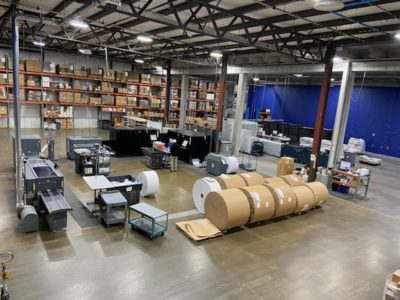 RICOH IP 5000 Inkjet line at Toppan Merrill Sartell MN Operation[/caption]
Having worked on both sides of the client relationship, I can attest to the fact that the customer used to complain about the consistency of the color on the toner devices. Not that iGens can’t hit a great level of color, they can. In the retirement services world you have to deliver a lot of different brand colors and they need to be right every time. But, that generation of iGen was pretty wobbly on color from run to run and even within long runs. They required constant monitoring. On the other hand, once colors were dialed in on the IP 5000, the client had no complaints about color consistency. Mike pointed out that Merrill generally ran the IP 5000 at half speed to deliver the top quality that the device offers and the client was still able to get their jobs done in a fraction of the time it took on toner. Lots has happened since then. More inkjet, new business and becoming part of Toppan, the largest printing company in the world.
Toppan Merrill is a company that I like to keep up with because there is always change going on and new things to learn. When I first worked with Merrill, they produced over 80 percent of their volume on offset devices, less than 5 percent on inkjet and the rest on toner. Predominantly a financial printer, they also had a strong commercial printing business producing marketing and sales collateral for the financial services and insurance business. They had extensive “pick-and-pack” facilities with a large portion of digital print going to stock shelves before assembly – yet in lower quantities than warranted by offset.
Mike filled me in on how a process that was already shifting from printing for inventory to printing for mailing has accelerated due to COVID and how inkjet helps them keep up. “Pick and pack is almost non-existent now because the tradeshows and events that drove that demand are not happening. On the other hand, mailings and notifications related to lending as well as stimulus and regulation are up. With inkjet, we have the flexibility to do the work we have profitably.”
Toppan Merrill still has a solid portfolio of full color toner presses in addition to inkjet, but toner can’t provide the cost flexibility to shift from full color, to “highlight” color to mono when needed. “Color toner devices allow a black only click, but it is still higher than what an image would cost on a mono toner device,” Mike emphasized. “And if the file has any color at all, it is a color click – which has been painful on what we call highlight color applications.” By highlight color, Mike is describing pages that have a logo or the outlines of a form in color, with the rest of the print in black. For a toner device, even if one pixel is printed in color, the “click” is charged at a color rate. By contrast, with inkjet, the price is based on the actual ink that is used. To provide a frame of reference (see table below), producing this type of highlight color work on a color toner press can be 3 or 4 times the cost of inkjet, not to mention slower. “Even our sheet fed inkjet presses are twice the speed of toner,” he added.
|
approximate price per image |
|||
|
Mono Toner Press |
Color Toner Press |
Color Inkjet Press |
|
|
Mono |
1 cent |
2 cents |
<1 cent |
|
Highlight Color |
NA |
4 cents |
@1.25 cents |
|
Full Color |
NA |
4 cents |
2 cents |
With a reduction in demand for marketing material during COVID, and a push on mono and highlight color volumes, Toppan Merrill leveraged their inkjet portfolio to stay nimble. Mike shared that “a lot of 2020 volume was mono, or logo and name only in color. Basically what would have been letter stock with the rest of the content all black. We have used inkjet to respond and shared the savings with our customers.”
As a company previously focused on financial printing, Toppan Merrill’s evolution and their propensity to adapt started well ahead of the pandemic. Regulations making e-delivery of regulated shareholder communications in the U.S. the dominant channel decimated financial printing volumes. Toppan Merrill prepared well and was able to sell much of their offset equipment and transition staff with the sale. They formed a strategic relationship with the company who bought their presses and continues to outsource offset work there. By retaining one offset press, expertise in traditional printing and a strategic offset outsourcing relationship they maintain production flexibility while mitigating risk.
Financial printing is not the only segment experiencing a shift from offset to inkjet; healthcare print production has changed as well. Large volumes of Healthcare Annual Notice of Change (ANOC) documents have shrunk from 200 to 800 pages each down to 24 to 28 pages with the rest of the information available online. ANOCs used to be all offset and are now all produced on inkjet. Mike explains, “This was a huge shift in the business mix. Instead of sending large, poly-bagged materials, it’s going into a 6x9 envelope. We had 3 poly-wrappers that would run for 6 weeks straight. We had a lot of seasonal workers with 1012 people per machine to feed the stations and remove finished material. To adapt, we had to acquire inserters to support the redesigned work, but now 1 inserter operator delivers 7,500 to 8,000 pieces per hour. Before, we could get 5,000 kits per hour using 10 people. We produce the same number of mailers but use completely different processing.” It was good to hear that most of the permanent operators were able to retrain and keep their job, but rather than needing 150 seasonal employees, they now use only 20-30.
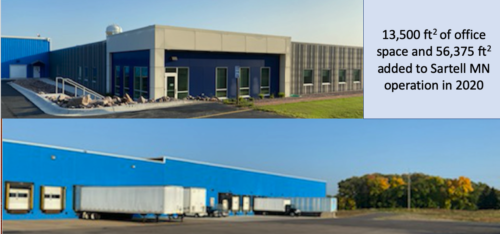
With a reduction in warehouse material in favor of on-demand, fulfillment centers were consolidated. The St. Cloud MN operation was consolidated with the nearby Sartell MN facility. Offset presses were eliminated. Skilled workers are valuable and hard to find, so there has been a push to retain talent. “In Sartell – people who came from St. Cloud were retrained from inserter to print equipment. We didn’t want to lose good people so we did our best to retain as many employees as possible,” Mike told me.
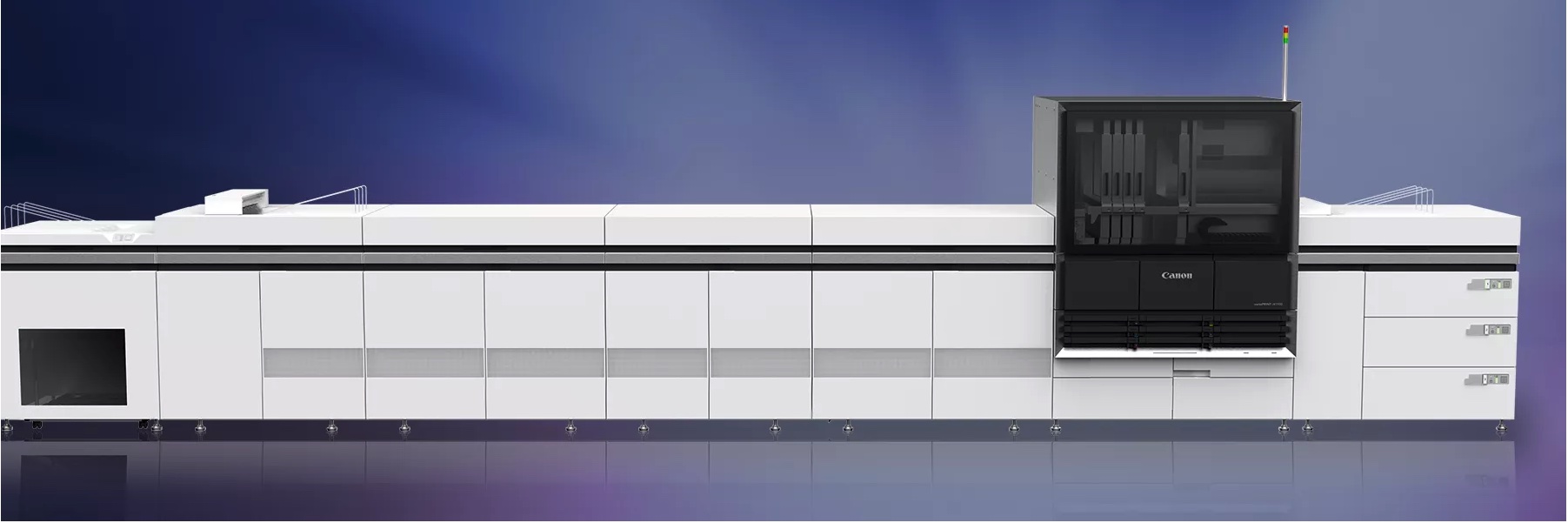
The company has now shifted almost completely to on demand production and dramatically increased their volume of letter mail. Mike credits inkjet for much of this shift. “With continuous inkjet, we have been able to adjust and gain more letter work.” In 2014 the company produced under 10 million pieces of letter mail and now they produce over 80 million per year. In addition to the Ricoh IP 5000s, the company also invested in several Canon ColorStream 3900 continuous and VarioPrint i300 sheet-fed inkjet presses. They also continue to invest in full color toner equipment, most recently, 2 Xerox Iridesse presses, to provide the greatest flexibility in the work they can produce for customers.
At a time when many printing organizations are struggling, Toppan Merrill finds themselves in an enviable position. They had already shed most of their offset equipment before offset volumes dropped. They are backed by a parent company rooted in the printing industry with the ability to weather financial hurdles, but have the flexibility to focus on local markets, and very importantly they had already climbed the learning curve on data management and letter mail. Mike advises, “It is becoming more difficult for printers to comply with all of the privacy requirements needed for data processing, including background checks and training. You need to be big enough to support all of that regulation while staying nimble and flexible enough to do things that traditional large companies can’t do.”
Ten years ago, I had the opportunity to work with some great people at Merrill, but I would not have described them as exceptionally nimble. This was not a start-up. No big consulting firm came in and did a management make-over. This was some smart people who recognized that they needed to make some changes. They chipped away at it and the more they changed, the easier change became. Access to capital certainly did not hurt – but I think the biggest driver was seeing first-hand what they could accomplish when they changed.
For more interviews from our Inkjet Lane Changers and Game Changers series, see Thomas Printworks: from Business Cards to Buildings.
[/is_paid]