During the recent Smithers Digital Textile Printing virtual conference, Margaret Getty, Senior Associate for Woven Fabric and Trim, shared the Lilly Pulitzer story—how she got started, and how the company has continued to leverage technology to continue to innovate.
 Margaret, who has worked for the company for more than seven years, stated that when Lilly eloped with Peter Pulitzer, grandson of the Pulitzer Prize’s Joseph Pulitzer, the couple settled in Palm Beach where Peter had several citrus groves. Although she was a socialite, Lilly wanted to have her own ventures, so she started her own juice stand. But the juices were getting all over her clothes when she was squeezing the fruit, and she needed something to mask the stains. Lilly went to her dressmaker to find a simple shift, clean cut and comfortable but colorful enough to hide all the stains. And from that the classic Lilly shift was born.
“As it turned out,” Margaret continued, “juice wasn’t getting as much love as the dresses, and it really took off when Jackie Kennedy was featured in Lifemagazine wearing a Lilly.”
Up to the present, the company has continued to create unique designs that still carry the spirit of what Lilly created at the outset. But Lilly Pulitzer has also stayed current with technology to both streamline the workflow and increase creative options available to the design team.
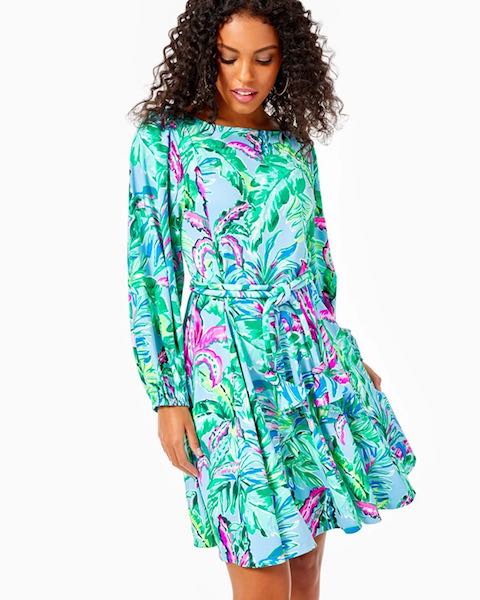
Classic Lilly Pulitzer design. Image sourced from Lilly Pulitzer.
A case in point is the company’s use of digital printing during the sampling process. Margaret explains, “Colors and prints are designed by our talented in-house print and color teams. They paint them and are constantly researching new methods and artistic techniques. The designs are then worked on in computer programs. Once the print team is happy with the prints, they are sent over to our sublimation lab where our lab technicians do extensive color matching, and then they are printed on paper and transferred to fabric. Using this method, designs are ready much faster than we were used to before with the wet printing process. It’s helpful to be able to see a print come to life; how they read on screen is very different than how they look on the actual fabric. Maybe that green isn’t suited to that print; maybe we need a yellow in there to make it pop. So it just really helps us get a full holistic look at the print, the style, the silhouette. The yardage is printed in house and connected to our sampling room so we are able to have a sample garment made up same day.”
Margaret points out that before implementing digital printing for sampling, it could take 30 days to six weeks to have fabric woven and then printed with screen or rotary printing, adding, “There were a bunch of limitations with that process. With digital printing, our artists are able to use as many colors in the palette as they wish. Otherwise, when we are wet printing, they are limited to maybe 12 colors, or whatever the number of screens is able to be used in the wet printing process for that particular fabrication.”
The company uses digital printing for two sampling stages, and samples are sent overseas so the factory can see exactly how it should look, get accurate costing, and have the factory know what samples are allocated to them. She states that it makes sense to do print overseas since that is where the cut-and-sew operations are located. “In full production, the majority is wet printing,” Margaret says, “but we do use some digital printing, especially for our engineered prints.”
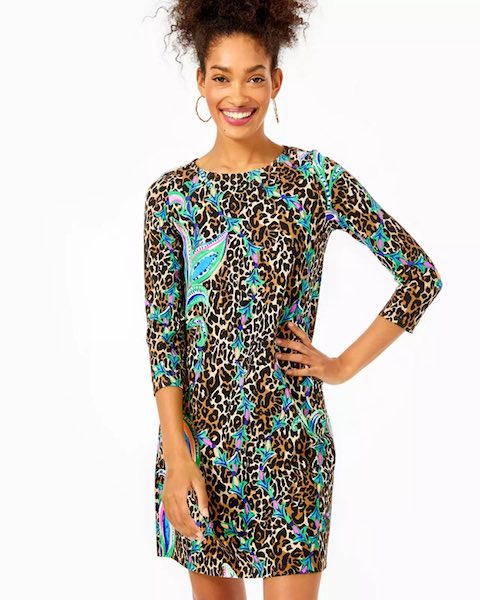
Sample engineered print. Image sourced from Lilly Pulitzer.
According to Margaret, engineered prints are prints with a specific placement/layout for the motif built for a particular style/ silhouette unlike the all-over prints where the layout can be used across multiple styles/silhouettes. “We really love our engineered prints at Lilly Pulitzer,” she says. “they are really fun, and all of our teams work together—our print team, the fabric team that I am part of, our color team, and our design team working with silhouettes. It is a full team labor of love for all of us, and we know our customers love them as much as we do.”
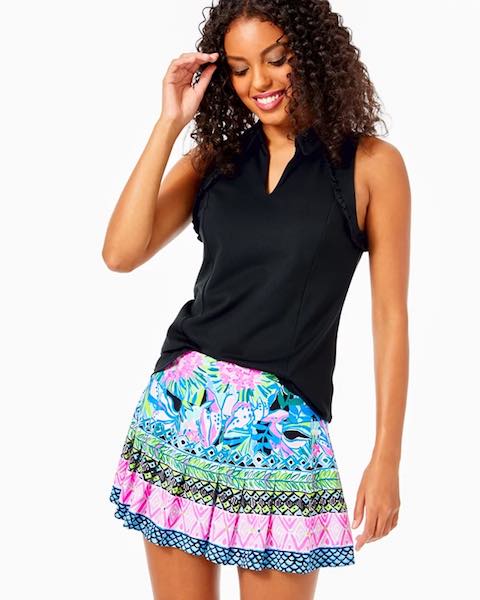
Annora Skort, an example of an engineered print. Image sourced from Lilly Pulitzer.
At Lilly Pulitzer, an engineered print may have a special border print going down the front or center back, an engineered collar, or maybe a waistband or belt or a band at the bottom, as depicted above. Margaret explains that all engineered prints are made for a certain style so it falls correctly in that style, noting, “We can’t just use this one print on another style. It’s engineered for this particular style so it lays in the exact placement it should be, and it’s made specifically for the measurements of that garment. Being able to print the design digitally gives us a holistic look at the print, the style, the color and how they are working together. It might look good on paper, but once you print them onto fabric, you can really see how they come alive.”
Asked about the future, Margaret had this to say: “Given the capabilities digital print will have, it will only grow from here. There are certain styles that we do digitally print in bulk, but it ultimately comes down to cost. Printing digitally is often more costly than wet printing, but as the technology advances, I’m sure that is going to even out. I can only imagine it will grow in the future.”
(View Cary Sherburne’s full interview with Margaret Getty here.)