

The first time you listen to a Notebook LM “audio overview,” it’s shocking to the senses. You input a webpage, a capabilities guide, or a blog post, and what comes back sounds like a professional podcast, with a man and a woman engaged in a “deep dive” discussion. There are two voices discussing the subject in a very natural way, complete with “ums” and “ahs” like a real conversation. It’s as if it was scripted, except it was generated by AI in two minutes or less.
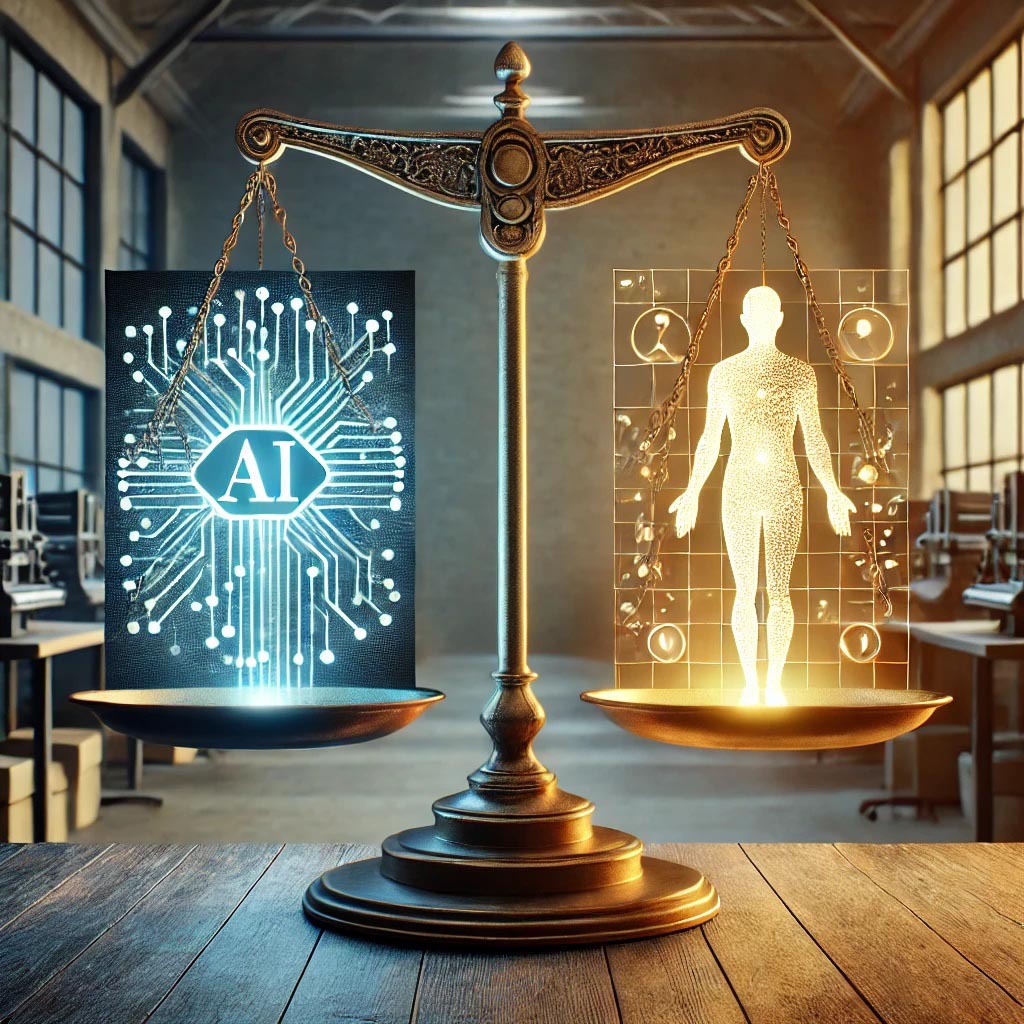
At first blush, AI has gotten so good that we no longer need people. It replaces copywriters, data analysts, and marketing campaign developers. Then you look deeper, and AI has downsides that may not be noticeable right away. Those downsides fundamentally change how we think about and use AI.
Who’s Using AI?
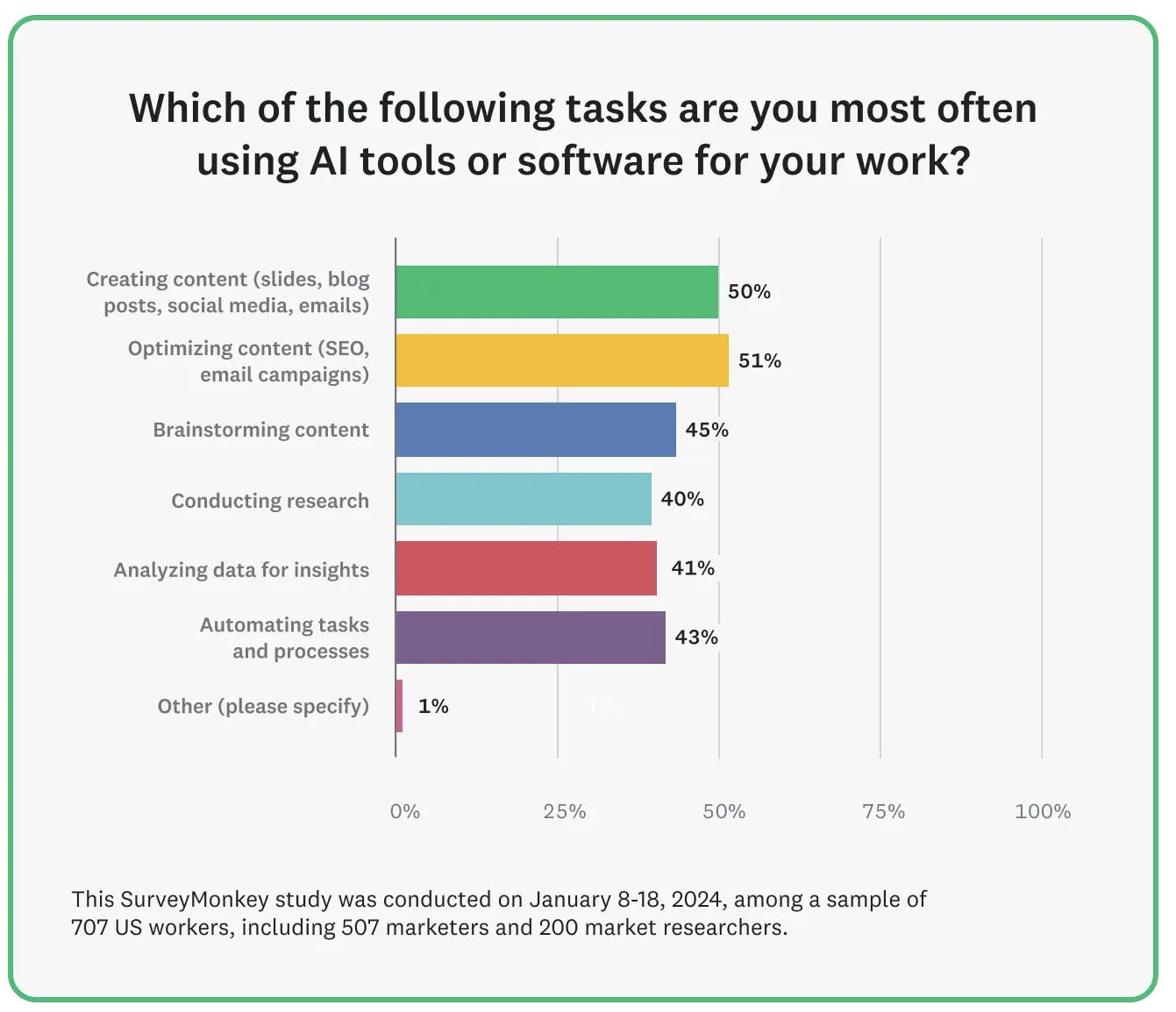
Everybody, it seems, is using AI in some form or fashion. Small companies are using ChatGPT to write email content. Mid-sized companies are adding chatbots to their websites. Large companies are using it for predictive modeling and data analysis.
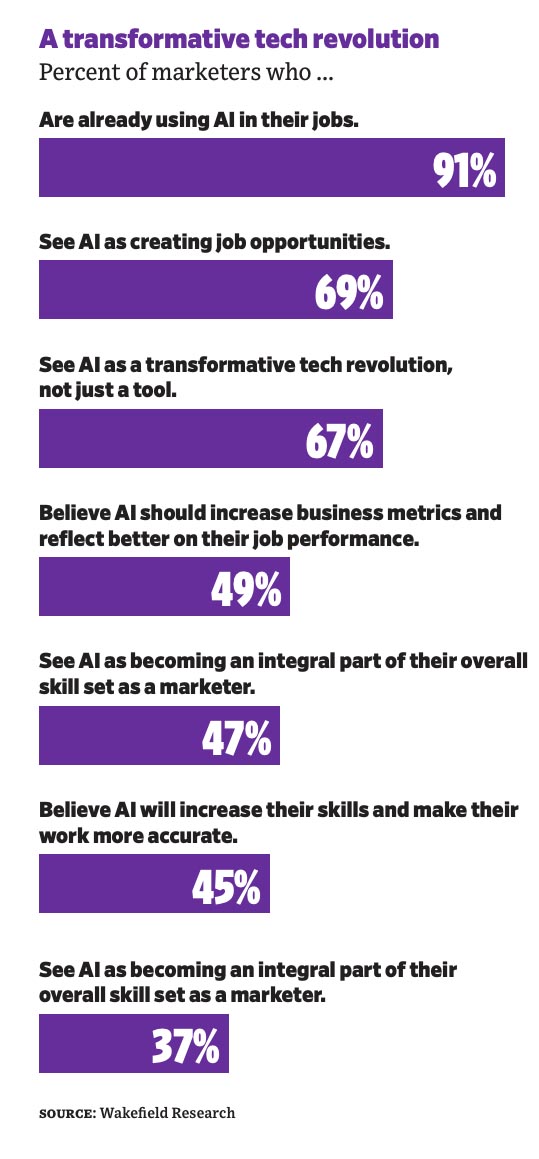
Indeed, a survey from SurveyMonkey of businesses that found that 56% of marketers say they are incorporating AI into their marketing operations (while 44% are taking a “wait and see” approach).[1] (Iterable, which offers AI integration as part of its platform, found that this to be 91%.[2]) According to research from Business.com, 42% of small and medium-sized businesses, specifically, use AI regularly, if not daily.[3]
But how is AI defined, exactly? AI can be as simple as using chatbots to answer questions. Or it can be as sophisticated as analysis of customer data to identify and create personas and offer real-time website personalization. Most of these studies leave AI undefined, which can support the perception that AI integration is farther along than perhaps it really is.
AI: Still Largely Siloed and Simple
While AI in marketing is certainly on the rise, it’s largely siloed and, with the exception of the largest and most progressive companies, confined to simple operations. Even if a company uses it for AI-driven website personalization, for example, it likely does not have that functionality integrated with email, social, and customer service. Those workflows may be using AI, too, but they are disconnected. So much for creating a consistent customer experience!
According to a study from SiteCore, the challenge with AI isn’t adoption. It’s integration. [4]Nearly one in nine (86%) companies surveyed are not using standardized AI toolsets across their organizations, and 80% are simply using “out of the box” functionality from existing tools and platforms. According to a CFO survey conducted by the Duke and the Atlanta and Richmond Banks[5], more than three-quarters (77%) of SMBs are adopting tools that already have AI embedded.
In other words, if you use ChatGPT to write your work emails or “help me write” function for social posts in HubSpot, you qualify as “using AI” for marketing. None of it is plug and play, and all of it still takes a real human being to make it work.
Not as Easy as It Looks
Let’s take Notebook LM for starters. Notebook LM is Google’s free “research assistant” that takes the sources you input and analyzes them and provides a variety of outputs, including the audio overview that sounds very much like a scripted podcast. But when you create more than one of these overviews, you see very quickly that they use the same voices and have many of the same patterns. While people may refer to Notebook LM as creating “podcasts,” no one who has used Notebook LM would confuse it with one.
Notebook LM (and similar tools) can also incorporate information that is inaccurate, and they can repeat themselves and make errors. Because Notebook LM does not allow you to edit the transcript, if parts are inaccurate, inappropriate, or undesired, that’s too bad.
This is where human input is required. If you like the content but want to tweak it, you can use a program like Temi to transcribe the audio, then import the transcript into another generative AI tool like Speechify Studio. From there, you can tweak and edit the content, but it requires a real human being with the right skills.
Then there are the AI voices. One standout feature of Notebook LM, despite its limitations, is very natural-sounding voices. But finding that level of natural sound in other AI platforms is more of a challenge. You can create clones of people in your organization, but that—again—requires real people. It also comes with its own set of challenges. How many takes does it require to get your top executives to get a good recording?
Similar challenges exist with AI-generated video. The concept sounds great. Just input your transcript and out pops a professional video. Many, like inVideo, allow you to edit the transcript easily (there is the need for that human again), but unless you have your own video to insert, the platform will draw from its stock library. Want to make videos about traveling to Alaska? No problem. Want to talk about something more technical or niche? The platform will pick the closest thing, which can produce some funky results.
Not everyone has the capabilities of creating commercial video. Even if your subject matter lends itself to stock content the challenge of video duplication, inappropriate selection of video, and those AI-generated voices (unless you choose to provide your own) remain.
The list of challenges goes on. Unless your images are simple, AI image generation has a pretty steep learning curve. Complex images require Photoshop to combine multiple elements. ChatGPT can churn out basic copy, but it requires a human author to add complexity and nuance. If you are using AI for anything more than creating outlines and drafts, the output is fairly easy for someone “in the know” to spot. (Have you ever wondered why so many of the product descriptions on Amazon and eBay now sound the same?), and online AI checkers will tell readers exactly what percent of the content is likely written by AI if asked. Content that has not been modified by a human author does not fare well in search engines.
This doesn’t mean that AI assistants aren’t great tools. They simply require human beings to manage and build on them.
AI: Humans Required
This goes against what some of the studies seem to say. There are a number of surveys out there indicating that companies agree that AI will be used to replace human tasks. For example, the CFO survey found that 60% of the companies surveyed (and 84% of large companies) indicated that, within the past year, they had used software, equipment, or technology (including AI) to automate tasks previously handled by employees.
But using ChatGPT to write product descriptions or analyze data isn’t replacing human beings. It replaces human tasks, allowing the humans to do other things. When AI writes the press release, human beings can spend that time researching additional places to send it.
Indeed, the Iterable study, which also included insights from Priceline, Redfin, Vimeo, GitLab, Strava, and Care.com, found that marketers are no longer threatened by AI, but see it as a tool. Nearly one in seven (69%) see AI as creating job opportunities rather than as some kind of threat.
That’s because AI needs our help. The more we use it the more we discover just how much human are needed. Sure, you can use Wonder.ai to create “the perfect image” faster than searching the stock library, but what happens when you discover too late that the lady sitting at the table has three legs? Or that your product descriptions in your new brochure read just like those of another company because you both used the same prompts in ChatGPT?
Maintain a Skeptical Eye
That’s why it’s important to look like at these studies with a critical eye. When 65% of SMBs say they use AI in customer service, that might be true, but do those “out of the box” chatbots offer information of real value? Likewise, marketers might utilize AI in campaign performance tracking and analytics, but if it’s part of a subscription to a marketing platform, does the marketing team understand and use them in an effective way? Often, you get what you get—and to get what you want, you need a human’s help.
Likewise, you can purchase solutions that will analyze data and create customer profiles and personas, but it still takes a human being to make sure that data is clean and accurate in the first place.
Is AI a tool that will continue to grow and be integrated into our daily and work lives? Absolutely. For some tasks, AI saves time, and for many companies, it saves money. But it creates new tasks and opens doors to new expenses, too. So embrace AI, but remember the old adage: “Sometimes you know just enough to be dangerous.” AI is easy (and often free) to use if you want to do it amateurly. It takes human time, effort, and expense if you want it to use it like a pro.
[1] “Marketing Trends for a New Era” (Survey Monkey, 2024)
[2] “Less Do, More Think: How to Succeed in the AI-Powered Marketing Era,” Iterable (2024).
[3] “AI Boosts Small Business Productivity” (Business.com, 2024)
[4] “From Content to Experience: How AI Is Shaping the Future of Marketing,” SiteCore (2023).
[5] “U.S. Companies Ramp Up Automation and AI as Inflation Persists” (Federal Reserve Bank of Richmond, 2024)