

(Watch the related webinar, presented by Kelly Lawrence and Tom Zoes here.)
Introduction: Framing the AI Reality for Print Houses
Artificial intelligence (AI) is revolutionizing industries worldwide, including the print industry, by transforming how jobs are performed, and decisions are made. It can enhance efficiency, decision-making, and creativity across nearly every function—customer service, operations, human resources, marketing, technology, and sales. While the potential of AI is vast, its integration must be approached strategically, considering its benefits and the challenges it presents. In this article, we explore the practical applications of AI in printing and dig into what's possible and what’s not.
What Is AI?
OpenAI defines artificial intelligence (AI) broadly as the simulation of human intelligence processes by machines, particularly computer systems. These processes include:
- Learning: Acquiring information and rules for using it.
- Reasoning: Applying rules to reach conclusions.
- Self-correction: Adjusting based on feedback and results.
AI encompasses a wide range of technologies, from rule-based systems to complex machine learning models like neural networks. Below are key types of AI with examples of commercially available solutions:
- LLMs (Large Language Models): Focus on understanding and generating human-like text. Examples include OpenAI’s GPT models, Google’s Bard, and others.
- Computer Vision Models: Designed for visual tasks like image recognition, facial recognition, or object detection. Examples include Amazon Rekognition, YOLO (You Only Look Once), and Google Cloud Vision AI.
- Reinforcement Learning Models: These are used for decision-making tasks, such as training AI agents to play games or manage complex systems. Examples are DeepMind’s AlphaZero and Microsoft Bonsai.
- Expert Systems: Rule-based systems for specific industries like medical diagnosis or engineering design. Examples include IBM Watson Health and Pegasystems’ Pega Platform.
- Generative AI Beyond Text: Models that generate images, code, or other creative outputs. Examples are OpenAI’s DALL-E (image generation) and Codex (code generation).
CB Insights tracks venture funding in AI. Since 2020, it notes that over $52 billion in venture funding has been secured for AI. Private open-source AI model developers have attracted $14.9 billion in venture funding, while closed-source developers have secured $37.5 billion, reflecting different bets on how AI innovation will unfold.
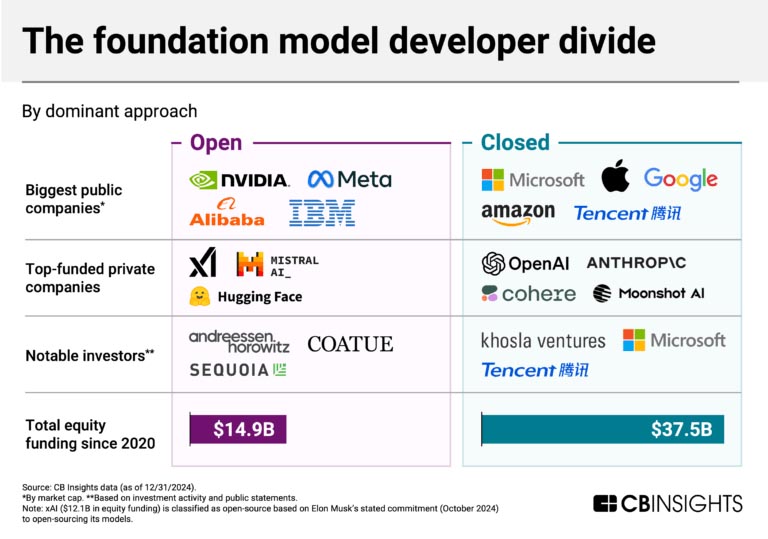
CB Insights notes over $52 billion in venture funding has been secured for AI since 2020. This is split amongst open-source and closed-source developers, reflecting how bets on AI innovation will unfold.
Where AI Excels
If you are not familiar with AI, today it widely regarded as being good at:
- Reducing repetitive tasks for employees, enabling them to focus on more impactful work.
- Analyzing large data sets quickly and summarizing key takeaways to inform human decision-making.
- Documenting standardized procedures that can then be further edited by humans to account for unique situations.
Today, AI lacks the ability to fully comprehend the nuances of situation-specific challenges. If there's variability in the process, best to have humans handle these tasks and decision-making. A well-stated summary from Kyle Coleman, Chief Marketing Officer of Copy.ai: “AI is here to eliminate inefficiencies, not jobs.”
In summary, AI is real and is continuing to evolve. Continued commitment to innovation is backed by substantial investment. Currently, different types of AI can be used to develop solutions to different problems. Multiple providers are emerging in each area. Because of this, each company needs to think through its governance for AI before utilizing the technology. What are the ethical and legal considerations for leveraging AI to help you analyze your specific data and the data you have from your customers? What use cases does your company have for AI?
Potential Use Cases for AI In the Printing Industry
The printing industry is well positioned to leverage AI as a tool to unlock new possibilities across various operational and customer-facing areas. From optimizing production workflows to enhancing customer service, AI is being deployed to tackle common industry challenges while driving efficiency and innovation. In the following sections, we’ll explore how AI is already making an impact in service and training, predictive maintenance, production analytics, job intake, scheduling, estimating, sales applications, and creative services. By examining these use cases, we’ll see how AI is not just a futuristic concept but a practical tool ready to elevate the printing industry today.
Service: Smarter Customer Support Systems
AI is already transforming customer service in different industries. Chatbots, for example, handle routine inquiries such as order tracking or troubleshooting file submissions. These systems are available 24/7, ensuring customers receive immediate assistance.
Printing Possibilities in Service: What would it do for your print operation if your CPG customer could access a chatbot on your website to check their order status? What if proofs were made instantly available for either edit or approval? What if, upon approval, the workflow could be automatically scheduled to optimize your production and the customer could get immediate feedback as to an estimated time their order would ship? This is an example of how AI can help a print house take repetitive tasks that are backed by data and clear decision trees to enhance operational efficiency.
AI in Human Resources: Employee Recruitment and Training
Employee Recruitment: AI can also assist HR teams by drafting job descriptions that are tailored to specific competencies. Elizabeth Falvo, Director of Customer Success at Textio, highlighted how purpose-built AI tools improve workplace efficiency and help HR professionals create inclusive and effective job postings. This creates a faster path to getting the right person in the right seat. Falvo also noted that AI tools can suggest training courses for employee development based on competency scores.
Employee Training: On the employee side, adaptive learning systems train staff on new technologies, tailoring content to individual skill levels. Over the years, I’ve heard from leaders across manufacturing sectors who lament the challenges of finding the right employees and the time spent onboarding employees to learn industry-specific skills. AI’s ability to personalize training offers a potential solution.
Printing Possibilities in Human Resources: How much time would your human resources department save by quickly authoring job descriptions for open positions that attract the right talent that is aligned with your corporate values? How might this impact productivity and overall employee motivation?
Imagine a new operations team member guided step-by-step through prepress workflows using an interactive AI assistant—the possibilities for reducing learning curves are immense.
Imagine hiring a new salesperson. In another example, The AIM Institute has an AI Chatbot as part of its https://www.salesprep.com/ service that teaches salespeople how to improve their probing skills in customer meetings. An AI training program can help onboard salespeople and ensure consistency among core competencies across employees. Further, the AI training program can help an individual improve key performance skills required for job success.
AI In Operations
Predictive Maintenance: Downtime on the operations floor of any manufacturing business is bad news, and that’s no different for print houses. The number one rule around downtime? Avoid it. Equipment failures can be costly, delay customer jobs, and cause print houses to lose out on future repeat business opportunities. AI-powered predictive maintenance systems leverage IoT sensors to monitor machinery and forecast potential failures.
Heidelberg’s predictive maintenance tools are a prime example, offering real-time insights to prevent breakdowns. According to the company website, Heidelberg’s Predictive Monitoring utilizes intelligent sensors in the machine to record data then upload it to a cloud service where the data is evaluated using big data analytics. If abnormalities are found, the Heidelberg Predictive Monitoring experts plan a package of countermeasures that are implemented before problems actually occur.
Predictive maintenance like this can prevent expensive downtime by flagging worn parts before they fail, enabling employees to schedule downtime or to make repairs off-shift. Further, AI can be used to optimize inventory for spare parts by predicting which components are likely to fail and ensuring they are available when needed. This proactive approach minimizes delays caused by sourcing parts after a breakdown.
Production Analytics—Harnessing Data for Better Decisions: AI-driven analytics systems analyze production data to optimize workflows, reduce waste, and improve sustainability. Production analytics powered by AI also enable print houses to track key performance indicators (KPIs) like material usage, energy consumption, and press downtime. By providing real-time dashboards, these tools empower managers to make informed decisions that enhance operational efficiency. HP’s PrintOS is an example of a tool that provides actionable insights into press performance and resource utilization.
Job Intake and Onboarding—Simplifying the Start: AI simplifies the intake process by automating tasks such as file preflighting, customer data entry, and proof approvals. EFI offers a suite of options (EFI Fiery, EFI IQ, EFI Insight, EFI Go) that work together to streamline job onboarding, ensuring consistency and accuracy. Cutting job intake time can free up staff to focus on higher-value tasks like customer consultations. Catching preflight errors can reduce rework, saving both time and materials.
Workflow Automation: Heidelberg touts its Prinect Workflow as paving the way for autonomous production. Today, it is a comprehensive solution designed to digitize and automate printing processes, enhancing efficiency and integration across the print production chain. Heidelberg estimates that around 60% of its customers worldwide use the software—well into mainstream adoption rates. Like the HP and EFI solutions previously mentioned, Heidelberg offers Prinect Business Analytics Apps and Service Apps through cloud-based platforms, providing tools for efficiency comparisons, data-driven decisions, and increased machine availability. The system integrates both offset and digital printing into a continuous workflow via the Prinect Digital Frontend. It automates the calculation of print jobs in prepress to determine the most cost-effective output device, directing the job accordingly.
Graphic Design and Creative Services: AI tools like Adobe Sensei, Stable Diffusion, Midjourney, and Dall-E 2, to name just a few, streamline design processes. AI design tools can suggest layouts and optimize variable data for personalized campaigns. They can help designers generate ideas for concepts and then quickly draft concepts. Still others are able to take low resolution images and turn them into high resolution images that are ready to be printed. After scouring some designer blogs reading AI graphic tool reviews, it’s clear that AI is not replacing creativity. In reality, these tools enhance the designers work, letting them focus on high-impact tasks and arguably enabling more creativity.
Project Planning—MIS/ERP Implementation and Beyond: Using AI in ERP systems offers transformative potential, particularly in streamlining complex implementations. According to IT executive Marc Uhrich, Founder of Headwinds Technology, one of the major use cases for AI involves breaking down project plans with precision. Marc shared how he customized a JIRA template to create initiatives, features, epics, and stories, allowing AI to suggest deliverables, task breakdowns, and estimated timelines. While the AI-generated output required refinement to align with the business's unique requirements, it provided a robust starting point that significantly expedited planning.
Marc pointed out that AI also shines in standardized tasks like accounting and warehousing, where well-documented procedures can guide automation effectively. By entering specific parameters, such as the number of GL codes, businesses can fine-tune AI outputs to match their scenarios. Marc highlighted how AI has proven invaluable for scaffolding ETL jobs, particularly when datasets in source and destination systems are well-documented.
Additionally, AI tools can assist in evaluating marketplace options, offering insights into the strengths and weaknesses of various solutions to support informed decision-making.
By leveraging AI in these ways, businesses can not only accelerate ERP implementation but also enhance accuracy and optimize operational workflows.
Printing Possibilities in Operations: Imagine a printing world where breakdowns are a thing of the past. AI-powered predictive maintenance systems leverage intelligent sensors and cloud-based analytics to identify potential equipment issues before they cause downtime. By flagging worn parts and optimizing spare part inventory, print houses can schedule repairs during off-shift hours, ensuring uninterrupted production.
But predictive maintenance is just the beginning. AI-driven production analytics provide real-time dashboards that track KPIs such as material usage and energy consumption, empowering managers to make data-driven decisions that enhance efficiency and sustainability. AI also simplifies job intake and onboarding catching errors, and freeing up staff for high-value client consultations.
Finally, workflow automation soars to new heights, integrating offset and digital printing into a seamless process that digitizes and automates workflows from start to finish.
What would it do for your printing business if you could anticipate failures, optimize workflows, and eliminate bottlenecks before they happen? What would it do for your business to free-up employees to focus on higher value activities?
Estimating—AI-Driven Cost Transparency: AI improves estimating by analyzing historical data and providing precise pricing recommendations. Procurement professionals now have access to tools like the “Should Cost” model, which calculate the theoretical lowest cost of a product or service based on raw material, labor, and operational expenses. AI enhances these models by integrating real-time data and predictive analytics to provide highly detailed supplier cost breakdowns. My friend Tom Zoes, founder of Value Selling Excellence and former Fortune 500 award-winning sales professional, helped me understand that “Should Cost” models aren’t coming—they’re here. Tom went to ChatGPT and asked it to create a “Should Cost” Model for a popular premium high gloss paper that is 60 inches wide and 5,000 feet long. ChatGPT proceeded to estimate the raw materials, labor, overhead and profit margin in the product. It scarily gave an estimate of $1,000 per roll which appears to be in the ballpark.
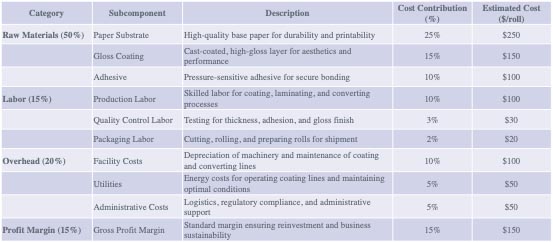
Contributed by Tom Zoes, Founder of Value Selling Excellence. Example of a “Should Cost” model generated by ChatGPT for a popular premium high-gloss paper that is 60 in. wide and 5,000 ft. long.
Buyers equipped with AI-powered insights can challenge supplier pricing by referencing cost benchmarks and demanding justification for additional charges. It changes the negotiation field.
Buyers are also gaining efficiencies by leveraging Intelligent Virtual Assistants (IVAs) to streamline supplier evaluations, contract compliance checks, and bid comparisons. This frees procurement teams to focus on strategic activities. In one example, IVAs automate the analysis of hundreds of NDAs to identify risk profiles and prioritize supplier partnerships, saving significant time and resources.
Of course, procurement professionals must be prepared for AI-equipped suppliers, who may counterbalance these cost analyses with data-driven justifications of their own.
Sales Applications—Driving Growth and Efficiency: AI’s impact on sales has been profound.
As buyers increasingly use “Should Cost” models, so should the sales professional. It helps a sales person understand and prepare for negotiations. In his whitepaper, The Silent Power Shift In B2B Sales: 4 Overlooked Selling Skills to Regain the Upper Hand, Tom Zoes provides tips for how sellers can leverage AI to become stronger conveyors of value to their customers creating win-win situations for supplier and customer. These include:
- Reframing Conversations: Sales teams can preempt buyer objections by proactively delivering customer-specific outcomes, such as reducing their time-to-market or improving their bottom-line profitability. For instance, providing technical expertise or personalized solutions helps offset pricing pressure. For example: A seller introducing bulk containers instead of drums not only reduces customer costs but also improves safety and efficiency.
- Anticipating AI’s Impact: As buyers’ AI tools become more sophisticated, sellers will need to refine their strategies further to defend margins. Training in value selling becomes essential to combat buyers’ increasing access to cost transparency and competitive pricing models. Remember our employee training example from the HR section of this article? com helps sales people quickly generate customer insight reports that summarizes the latest news, current trends and likely problems the buyer is facing. Further, the site’s AI Chatbot, Claire helps sales professionals ask better probing questions to enable solution-based value selling.
- Practical Tools for Sales Teams: The white paper suggests leveraging tools like fishbone diagrams to organize complex value propositions and address customer concerns systematically.
AI is impacting the entire sales process beyond research, probing, and value selling. It’s impacting key sales processing including lead generation, customer engagement, and forecasting. AI-enhanced CRMs automate data entry and track interactions, freeing sales reps to focus on closing deals. These systems analyze vast amounts of customer data to identify patterns and trends that would otherwise go unnoticed, enabling teams to craft tailored sales strategies.
John Stephens, a fractional VP of sales with Sales Xceleration, emphasizes the value of AI in refining sales processes. He highlights that AI tools can analyze historical sales data to provide detailed forecasts, helping sales leaders allocate resources more effectively.
Additionally, AI chatbots excel at automating initial customer outreach—scheduling appointments, qualifying leads, and even managing follow-ups. Businesses can build stronger relationships and improve conversion rates by leveraging AI to predict customer needs and personalize interactions.
AI as a Strategic Imperative for the Printing Industry
AI offers transformative potential for the printing industry, enhancing efficiency and enabling strategic decision-making across multiple functions. However, successful integration requires thoughtful governance, clarity on its role as an assistant, and an emphasis on automating repetitive tasks.
Actionable Steps:
- Be clear on governance: Define how AI will be used and the boundaries for acceptable practices.
- Use AI as an assistant: Leverage its capabilities to enhance productivity and creativity.
- Apply AI agents: Automate repetitive tasks with well-defined decision trees.
As the printing industry continues to evolve, the strategic use of AI can position businesses as leaders in innovation and efficiency. By embracing AI thoughtfully, print houses can not only stay competitive but also drive greater value for their customers. The question is no longer whether to adopt AI but how to do so responsibly and effectively.
Leveraging AI in your business? Share your story with us. Email Kelly at [email protected].