Key Takeaways
- PSPs that deal with marketing applications must continually focus on critical direct marketing trends so they can understand and address customers’ changing priorities.
- According to the Winterberry Group, “Direct and Digital” marketing spend was $153.2 billion in 2015.
- Regardless of marketing channel, the top priority in terms of data-driven marketing is delivering a personalized customer experience.
- According to the 2015 Cross-Channel Marketing Report from Econsultancy and Oracle, marketers have moved away from the challenges associated with managing data (collecting, cleansing, and applying).
- There are a number of tools available that can help service providers deliver consistent messaging across multiple channels while blending direct mail and digital communications.
Although keeping up with industry news might seem to be just one more thing to add to your already long to-do list, the benefits of doing so can be significant for print service providers (PSPs). Keeping tabs on the industry enables you to:
- Make better business decisions
- Spot threats and opportunities early for a competitive edge
- Understand critical market dynamics that shape your organization's strategy
- Take advantage of sales and marketing opportunities that come your way
- Be viewed as an expert business partner
- Earn trust and respect from clients and prospects
Data Points from the 2016 DMA Statistical Fact Book
Each year, the Direct Marketing Association (DMA) compiles hundreds of relevant industry stats and facts for publication in its Statistical Fact Book. The publication culls stats from over 60 leading research sources and marketing experts. It covers a number of key topics, including marketing communications, spending allocations, response rates, and numerous other trends. PSPs that deal with marketing applications must continually focus on critical direct marketing trends so they can understand and address customer’s changing priorities. The DMA Statistical Fact Book is a great source of market insight, and PSPs should take notice. Some key data points that were highlighted in the 2016 DMA Statistical Fact Book are outlined below.
Direct Marketing is a Big Business… and Print is an Integral Component!
According to the Winterberry Group, “Direct and Digital” marketing spend was $153.2 billion in 2015. The printed direct mail component represented $46.8 billion of spend, up from $46 billion in 2014.
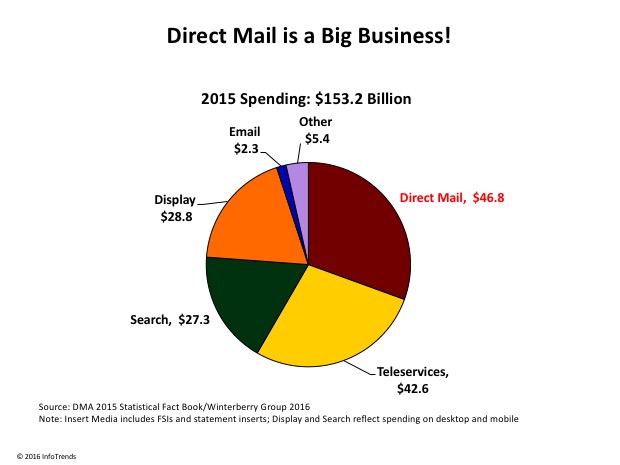
U.S. “Direct & Digital” Spending, 2015
Printed Direct Mail is Making a Comeback
Print is not dead, and direct mail is actually experiencing a resurgence. According to the 2016 Fact Book, spending on direct mail increased even though volumes declined. Plausible explanations for this include postal rate increases and the increased use of more targeted direct mail where marketers invest in higher-quality pieces that are more personalized and relevant. Although these pieces are produced in lower quantities and often cost more, they usually deliver higher response rates. When used correctly, direct mail is an efficient and measurable complement to online counterparts. In today’s world, the new marketing mantra is that print and digital media work better together.
Data is Driving Marketing Success
The business world has moved into the era of data-driven marketing. Marketers know that data is central to bringing value to campaigns, so they are sorting through their customer data to create the most relevant campaigns possible. Regardless of marketing channel, the top priority in terms of data-driven marketing is delivering a personalized customer experience.
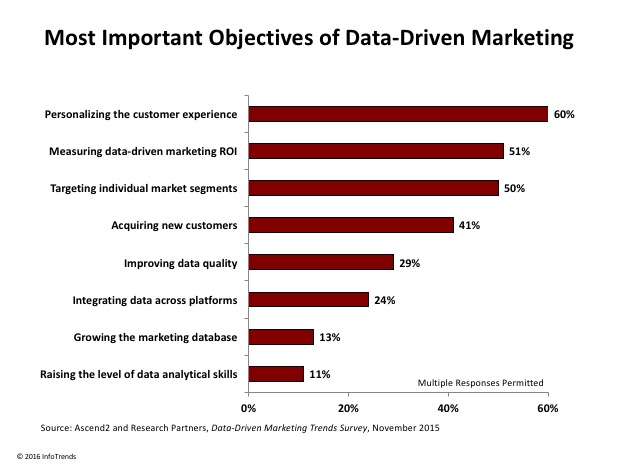
Most Important Objectives of a Data-Driven Marketing Strategy
The U.S. data-driven marketing economy employs nearly 1 million people, and the employment level rose 49% between 2012 and 2014[1]. In addition, the value of the data-driven marketing industry has experienced a 35% growth in just two years, reaching $202 billion[2]. According to the 2015 Cross-Channel Marketing Report from Econsultancy and Oracle, marketers have moved away from the challenges associated with managing data (collecting, cleansing, and applying). 44% of respondents report that their focus is on investing in data management platforms, while another 33% are planning to invest[3]. The challenge now, according to 23% of marketers, is analyzing the data[4]. Service providers of all types must assess their strategy for participation in today’s highly data-driven world.
Use e-Mail Strategically
Consumers want control over when and where they see e-mail messages. They are savvy with their inbox and spam filter settings, and aren’t shy when it comes to telling marketers about when and how often they want to be reached. 43.8% of consumers say that they want to hear from companies weekly[5]. Meanwhile, 59% say that marketing e-mails influence their purchasing decisions and most of them seek offers such as free shipping or dollars/percentages off their purchases[6]. Furthermore, personalized e-mails have proven to be an effective way to engage consumers and link with print for a fully integrated marketing campaign. There are a number of tools available that can help service providers deliver consistent messaging across multiple channels while blending direct mail and digital communications.
The Bottom Line: Make the Time!
The DMA 2016 Statistical Fact Book is full of useful information and trends pertaining to the retail market (think coupons and digital displays), catalogs, Internet, SEO, mobile, and social media. Although it is only a single source of data, it pulls its trends and insights from the very latest research reports. Regardless of the data sources they utilize, PSPs must take the time to stay current with the trends in the markets they are serving or hoping to serve. The market is moving very quickly—if you can’t stay well-informed about critical trends, you will be left behind.
[1] “The Value of Data 2015: Consequences for Insight, Innovation & Efficiency in the US Economy,” John Deighton, Harold M. Brierley, Professor of Business Administration, Harvard Business School and Peter A. Johnson, recent Adjunct Professor, Columbia University.
[2] “The Value of Data 2015: Consequences for Insight, Innovation & Efficiency in the US Economy,” John Deighton, Harold M. Brierley, Professor of Business Administration, Harvard Business School and Peter A. Johnson, recent Adjunct Professor, Columbia University.
[3] Econsultancy and Oracle, “Cross-Channel Marketing Report,” 2015.
[4] Infogroup, “7 Key Insights into the Evolution of Data-Driven Marketing,” 2015.
[5] BlueHornet, “Consumer Views of Email Marketing,” 2015.
[6] BlueHornet, “Consumer Views of Email Marketing,” 2015.