WhatTheyThink

Premium Commentary & Analysis

The schizophrenic printing industry

As the number of printing services declines; the number of printing services increases. You read that correctly.

Monday, February 27, 2012

As the number of printing services declines; the number of printing services increases. You read that correctly.

In the 1890s, the Golding press company of Boston introduced the iconic Pearl letterpress. Commercial printers refused to buy it. They called it a “bedroom press” because folks were operating home printing businesses. Mr. Golding hired a famous print person named Henry Lewis Bullen to mount an ad and PR campaign to influence mainstream printers. The campaign only helped to influence those home printers, some of whom grew to become mainstream printers.

At the end of the 1960s a single machine created the quick printing industry. It was the Itek 214 camera platemaker. It was a camera that exposed print-ready pages directly to a non-metal printing plate. The offset duplicator had been around for a while from Multigraphics, A.B. Dick, even Mergenthaler which had sold the Davidson duplicator press.  The 214 made platemaking easy and it spawned an entire industry.

You can trace the lineage of many of today’s printing firms back to those days. Many of them began in basements and garages and grew into larger and larger presses.  The footprint was much smaller than letterpress shops. Type no longer required metal; you could even use typewriters, some of which had proportionally-designed fonts.

This gave rise to the growth of printing up to the mid-1990s, when the forces of electronic communication led by the Internet offered lower cost alternatives to paper and postage. Many print buying organizations replaced print bit by bit.

Thus the printing industry is roughly half of what it was in the mid 1990s.

But wait, there is growth that few have noticed.  Once again, it is based on technology that makes print easier. It’s digital printing and print is back in the basement and the garage (right next to the kid’s bikes).

It all began when light lens copiers were re-invented and their analog lens systems replaced with scanning systems.  The Xerox Docutech in 1990 was among the first printers to scan the page to disk and then print from the stored file.  “Scan and print” became the new “copy.”

By the late 1990s almost all printers operated in this manner. The machines looked like the old photocopiers but could do something those single-purpose copiers could not do: they could accept digital files for printing.  Slowly but surely the cost of color printing came down and color printers began to replace their monochrome counterparts.

Because these new machines could now perform multiple functions, they acquired new names that tried to describe their new functions— “multi-function device (MFD)” or “All-In-One (AIO).” They are printers that can print or copy (and often scan and fax).. Although they were first directed at the office market, they found great acceptance in the printing industry, especially in small shops.

Because they are acquired from local dealers and distributors, who do not keep statistics as well as direct-sell suppliers, their growth has been largely under the radar.

Because they do not list themselves on tax forms as “printers” government statistics also loses track of them. In fact, NAICS data extrapolates small printer data using social security information. Everyone has difficulty keeping track of small services.

We have always understated the number of non-franchise small printers, the so-called mom-and-pop shop. Many of them are run by entrepreneurs who may have full-time jobs and operate a basement business. Almost all are listed in the Yellow Pages and do work locally.

Their business is based on the new breed of compact MFPs. They buy their paper at office superstores. They do small jobs, most of which come to them as files. Some have upgraded to light production color printers. Some are being forced to find commercial space because they are ready for 70 to 100ppm machines which do not fit in basements.

As analog printers of all sizes continue to merge or go away, small digital printers are growing at double digits per year. They are learning how to price and balance workflow and manage part-time workers and even their own families.

In the 1980s, a printer from the Carolinas helped to form a small all-volunteer trade association for “instant” printers. It grew to the point that it needed professional management and over time the organization priced itself out of the range of the very constituency it was created to serve.

Someone is going to organize these new digital entrepreneurs.  Some will be, after all, the future giant businesses of the future.


Continue reading your article
with a WhatTheyThink membership.

WhatTheyThink Annual Membership

Less than $4/week.

Get unlimited access to in-depth commentary and analysis covering the latest trends, emerging technologies, operational strategies, and key events across every segment of today's printing industry.

Stay informed. Stay competitive. Stay ahead.
WhatTheyThink Day Pass

$5 for 24 hours

Unlimited access to all of WhatTheyThink. Get your Day Pass

Already a member?
Sign In

About Frank Romano

Frank Romano has spent over 60 years in the printing and publishing industries. Many know him best as the editor of the International Paper Pocket Pal or from the hundreds of articles he has written for publications from North America and Europe to the Middle East to Asia and Australia. Romano lectures extensively, having addressed virtually every club, association, group, and professional organization at one time or another. He is one of the industry's foremost keynote speakers. He continues to teach courses at RIT and other universities and works with students on unique research projects.

Recent Articles from Frank Romano

Confessions of a Former Typographer

Confessions of a Former Typographer

Frank interviews Bob Wislocky, whose typesetting business weathered hot metal, phototypesetting, electronic imaging, digital printing, and other production technologies over 90 years. Read More

Romano a Mano

Romano a Mano

Frank and Richard share a sofa and some banter about the printing industry. Read More
Frank Takes the Pledge

Frank Takes the Pledge

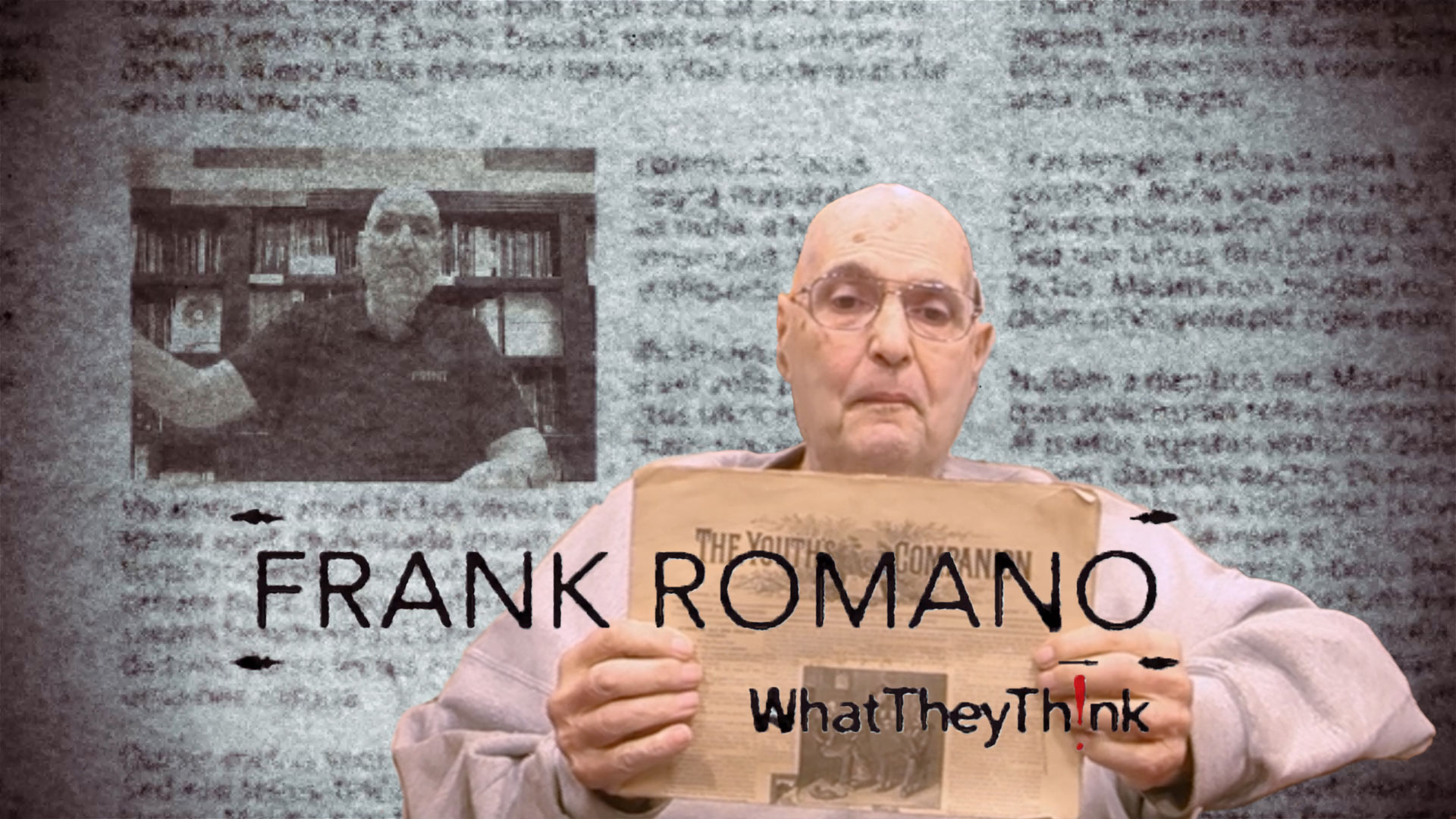
Frank talks about The Youth’s Companion, a newspaper published in Boston for over 100 years. In 1892, its editor proposed a Pledge of Allegiance. Read More

The Font I Want

The Font I Want

Frank describes his informal survey to discover the most-used typefaces. Over a decade, he has asked users what font they use most often. See the results. Read More

Jeopardy in Jeopardy

Jeopardy in Jeopardy

Frank reacts to a Jeopardy game show segment that involves Johann Gutenberg. There is much misinformation about the invention of printing and Frank is on a mission to present the facts, even if it means yelling at a TV screen. Read More