WhatTheyThink

Premium Commentary & Analysis

VDP for you and me . . . finally

VDP volume is less than 10 percent of all digital printing and digital printing is less than 15 percent of all printing. The use of variable data (or document) printing has been retarded over the last decade by short-sighted suppliers, specifications, and associations. Now perhaps we are on the cusp of opening VDP to all users, big and small. ISO is about to release a worldwide standard for variable data exchange.

Friday, April 02, 2010

VDP volume is less than 10 percent of all digital printing and digital printing is less than 15 percent of all printing. The use of variable data (or document) printing has been retarded over the last decade by short-sighted suppliers, specifications, and associations. Now perhaps we are on the cusp of opening VDP to all users, big and small. ISO is about to release a worldwide standard for variable data exchange.

ISO (the International Organization for Standardization) is a worldwide federation of national standards bodies. The work of preparing International Standards is carried out through ISO technical committees and international organizations, governmental and non-governmental. The main task of technical committees is to prepare International Standards. Draft International Standards adopted by the technical committees are circulated to the member bodies for voting. Publication as an International Standard requires approval by at least 75 percent of the member bodies casting a vote.

Since 1994, we have been able to take almost any designed job and save it as a PDF and give to almost any printer to be printed on almost any printer or press. But that has never been possible with VDP. Suppliers have proprietary workflows and enterprising entrepreneurs forced fake standards upon us. There has never been an efficient method for saving a VDP job and sending it to any digital printer. Now there is.

The PDF/VT document format specifies the methods for the use of the Portable Document Format (PDF) for the definition and exchange of all content elements and supporting metadata necessary for printing variable or transactional document content.

It allows the specification of document structure, document layout, content data, and interaction of graphical elements in a graphics model that supports transparency. PDF/VT is designed to enable variable document printing (VDP) in a variety of environments from desktop printers to digital production presses. This includes hybrid workflows involving both conventional and digital printing.

There are three conformance levels:  
1. PDF/VT-1 for a complete single file exchange. PDF/VT-1 requires all resources necessary for proper interpretation of the PDF data to be included within the conforming PDF file.  

2. PDF/VT-2 for multi-file exchange. PDF/VT-2 permits a conforming file to refer to an external ICC profile file and additional content defined in external PDF/X conforming files for use as page content.  

3. PDF/VT-2s for streamed delivery. PDF/VT-2s allows for processing (streaming) of multiple compound entities representing graphical content before the entire PDF/VT instance has been generated. A PDF/VT-2s stream is a MIME package that contains a sequence of one or more PDF/VT files and supporting resources.

The trend towards the separation of variable document content creation from the details of print production workflow and printing device dependency is evolving rapidly. CIP4's JDF job ticket specification provides one means of specifying a print product and corresponding production process in a way that is independent of any particular graphical content format.

PDF/VT is workflow architecture neutral. It has no provision for encoding workflow or device specific control information, unless some suppliers bastardize it. The aspects of device control, resource, and production management are outside the scope of this part of ISO 16612. In a production environment, PDF/VT relies on the use of JDF, or similar job ticket format, to define a print product and the corresponding production requirements. The primary focus of PDF/VT is on the exchange of content between businesses or within an integrated environment that produces variable document printing.

Graphics design applications continue to evolve with greater capability and increased sophistication of the graphical content and design effects based on graphics models that support transparency. This graphics model is required to support features such as drop shadows and colour blending effects that are associated with the interaction of transparent content objects. These capabilities are used in the creation of one-to-one customer communication print applications including direct marketing documents, transactional documents, and trans-promotional documents.  

This part of ISO 16612, referred to as PDF/VT, includes support for the PDF 1.6 imaging model which includes support for transparency. It builds on the PDF/X-4 and PDF/X-5 standards (defined in ISO 15930-7 and ISO 15930-8), which, in turn, reference PDF 1.6. Yeah, that's the way standards committees talk.

The new standard guarantees portability of conforming VDP content and metadata across conforming digital printing systems. It is focused on defining the content data and metadata necessary to support efficient workflow manipulation and processing based on the use of JDF or similar job ticket format. More specifically, the job ticket is expected to define the production requirements and draw upon PDF/VT for its content and met

PDF/VT supports the use of graphical object definitions as a method of specifying graphical content data only once in a PDF/VT file independent of the number of times it is referenced in the file. This approach serves to reduce the file size of a PDF/VT file and allows implementers of conforming readers to employ various processing optimization strategies. Within the context of PDF/X-4, these graphical objects are specified as image, form and transparency group XObjects.

XObjects referenced multiple times from various content streams can be tagged with hint information that aids the conforming reader in its determination of XObject reuse. These hints can be referenced multiple times, such as within the current file, across multiple files of a PDF/VT instance or across PDF/VT instances. An XObject can also be tagged with an identifier to assist a conforming reader in the identification and management of such recurring definitions.

PDF/VT is off for ISO publication. It will be widely adopted, accepted, and used. It will bring VDP into the mainstream.


Continue reading your article
with a WhatTheyThink membership.

WhatTheyThink Annual Membership

Less than $4/week.

Get unlimited access to in-depth commentary and analysis covering the latest trends, emerging technologies, operational strategies, and key events across every segment of today's printing industry.

Stay informed. Stay competitive. Stay ahead.
WhatTheyThink Day Pass

$5 for 24 hours

Unlimited access to all of WhatTheyThink. Get your Day Pass

Already a member?
Sign In

About Frank Romano

Frank Romano has spent over 60 years in the printing and publishing industries. Many know him best as the editor of the International Paper Pocket Pal or from the hundreds of articles he has written for publications from North America and Europe to the Middle East to Asia and Australia. Romano lectures extensively, having addressed virtually every club, association, group, and professional organization at one time or another. He is one of the industry's foremost keynote speakers. He continues to teach courses at RIT and other universities and works with students on unique research projects.

Recent Articles from Frank Romano

Romano a Mano

Romano a Mano

Frank and Richard share a sofa and some banter about the printing industry. Read More

Frank Takes the Pledge

Frank Takes the Pledge

Frank talks about The Youth’s Companion, a newspaper published in Boston for over 100 years. In 1892, its editor proposed a Pledge of Allegiance. Read More

The Font I Want

The Font I Want

Frank describes his informal survey to discover the most-used typefaces. Over a decade, he has asked users what font they use most often. See the results. Read More

Jeopardy in Jeopardy

Jeopardy in Jeopardy

Frank reacts to a Jeopardy game show segment that involves Johann Gutenberg. There is much misinformation about the invention of printing and Frank is on a mission to present the facts, even if it means yelling at a TV screen. Read More
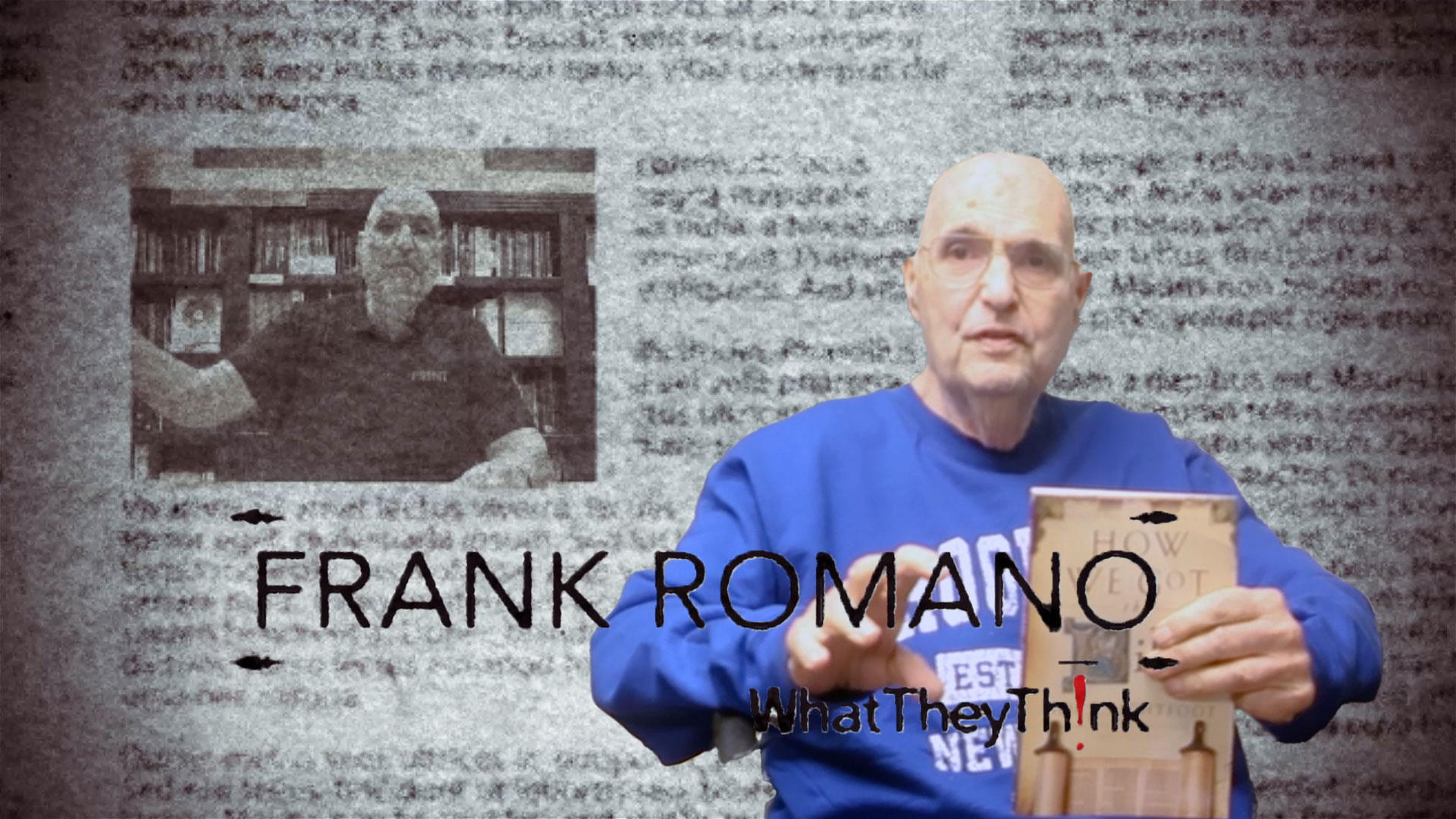
Evolution of the English Bible

Evolution of the English Bible

Frank traces the evolution of the printed Bible as reported in Neal Lightfoot’s book “How We Got the Bible.” The English Bible evolved from Hebrew, Greek, and Latin versions. Martin Luther’s German translation influenced other translations. Read More