WhatTheyThink

Premium Commentary & Analysis

The tormented history of Garamond

Claude Garamond begot a typeface that has survived eponymous imposters,

Friday, May 08, 2009

Claude Garamond begot a typeface that has survived eponymous imposters, a fanatical Cardinal, a forensic female typographer, hot and cold typesetting, and competitive digital fonts. There are more versions of the Garamond typeface than any other font ever created.

Our story begins in France when he is born around 1480 in Paris, but does not end when he died in 1561 in the same city. In 1510 he began his training as a punch-cutter with Simon de Colines. In 1520 he was a student with Geoffroy Tory and in 1530 Garamond’s first type is used in an edition of a book by Erasmus. It is based on Aldus Manutius’ 1455 type De Aetna. In 1520 Robert Estienne, celebrated Parisian editor-printer, approached Garamond to order a roman font. King Francis I commissioned Garamond to cut a Greek type and the ensuing Grec du Roi was also used by Estienne. Garamond went on to sell the typeface to other printers, making him the first typefounder.

From 1545 onwards he also worked as a publisher. After Garamond’s death, Christoph Plantin from Antwerp, the Le Bé type foundry, and the Frankfurt foundry Egenolff-Bermer acquire a large proportion of Garamond’s original punches and matrices. The latter were used to print the famous specimen sheet of the Egenolff-Berner foundry of Frankfurt in 1592, a specimen which associated for the first time the roman of Garamond with the italic of Granjon. The typefaces Garamond produced are considered typographical landmarks in the history of the serif typeface.


Continue reading your article
with a WhatTheyThink membership.

WhatTheyThink Annual Membership

Less than $4/week.

Get unlimited access to in-depth commentary and analysis covering the latest trends, emerging technologies, operational strategies, and key events across every segment of today's printing industry.

Stay informed. Stay competitive. Stay ahead.
WhatTheyThink Day Pass

$5 for 24 hours

Unlimited access to all of WhatTheyThink. Get your Day Pass

Already a member?
Sign In

About Frank Romano

Frank Romano has spent over 60 years in the printing and publishing industries. Many know him best as the editor of the International Paper Pocket Pal or from the hundreds of articles he has written for publications from North America and Europe to the Middle East to Asia and Australia. Romano lectures extensively, having addressed virtually every club, association, group, and professional organization at one time or another. He is one of the industry's foremost keynote speakers. He continues to teach courses at RIT and other universities and works with students on unique research projects.

Recent Articles from Frank Romano

Frank Takes the Pledge

Frank Takes the Pledge

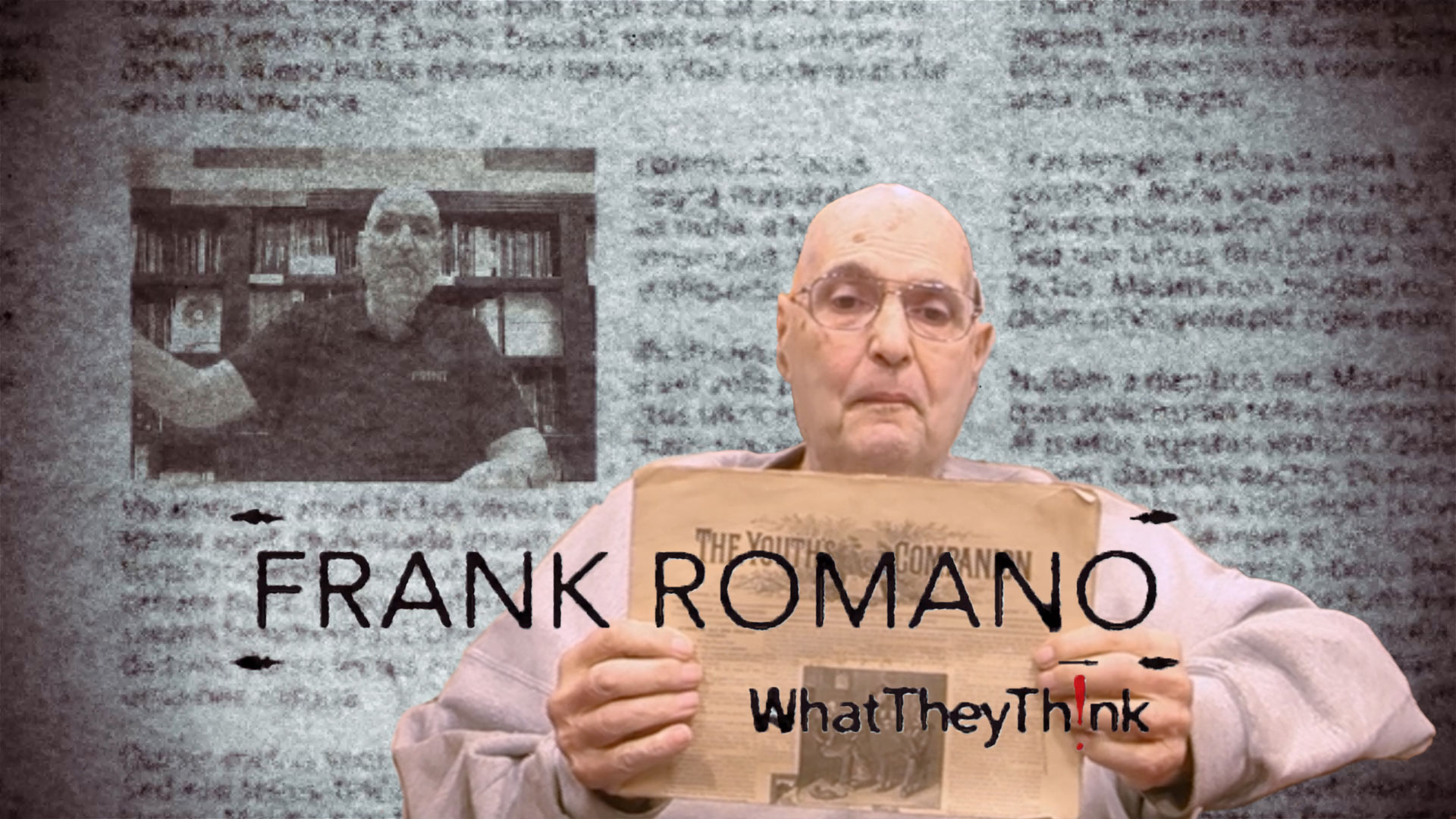
Frank talks about The Youth’s Companion, a newspaper published in Boston for over 100 years. In 1892, its editor proposed a Pledge of Allegiance. Read More
The Font I Want

The Font I Want

Frank describes his informal survey to discover the most-used typefaces. Over a decade, he has asked users what font they use most often. See the results. Read More

Jeopardy in Jeopardy

Jeopardy in Jeopardy

Frank reacts to a Jeopardy game show segment that involves Johann Gutenberg. There is much misinformation about the invention of printing and Frank is on a mission to present the facts, even if it means yelling at a TV screen. Read More

Evolution of the English Bible

Evolution of the English Bible

Frank traces the evolution of the printed Bible as reported in Neal Lightfoot’s book “How We Got the Bible.” The English Bible evolved from Hebrew, Greek, and Latin versions. Martin Luther’s German translation influenced other translations. Read More

Frank Sees the Forest for the Trees

Frank Sees the Forest for the Trees

Frank notes that there are now shortages of newsprint for those newspapers that produce a paper edition. Paper production is down because we now lose more trees to fires. And paper mills are replacing newsprint with packaging papers. “Save the trees” now has a different meaning from when it meant printed page reduction. Read More