WhatTheyThink

Premium Commentary & Analysis

Wireless roots

The tragedy of the RMS Titanic that fateful night of April 14,

Friday, August 08, 2008

The tragedy of the RMS Titanic that fateful night of April 14, 1912 could have claimed all 2,205 passengers. The Californian, a passenger ship within sight, but ten miles away when the Titanic struck the iceberg, missed the distress flares of the Titanic, nor was its new wireless radio turned on. The passenger ship Carpathia, 58 miles from the doomed Titanic, did hear the wireless distress call got there in time to rescue 705 survivors adrift in lifeboats.

Communication by wireless had just emerged because Guglielmo Marconi discovered an application for Hertzian waves. The commercial intent was profit from transmission and receipt of messages. The Titanic was equipped with a wireless system to derive revenue from passenger “MarconiGrams.” The tragedy of the Titanic brought wireless to everyone’s attention and spurred the growth of the radio, communications, and electronics industries that today are said to provide the greatest number of jobs in the history of civilization.

Guglielmo Marconi did not “invent” radio — Faraday, Maxwell, Hertz, Lodge, Righi, and Tesla had something to do with it. Marconi was born in Bologna, Italy, in 1874. His father was a wealthy Italian businessman and his Irish mother came from a wealthy distilling family. As a child, he pursued his interest in science, particularly electricity. Marconi learned about electromagnetism and the mathematical work of Maxwell; about experiments with electromagnetism by Hertz, the work of Lodge in England, of Slaby in Germany, of Branly in France, plus the induction coils of Faraday, the spark gap of Righi, and the telegraph cable system of Morse. He set up a laboratory in his home and began to send wireless signals over short distances with his first success in 1894. He went on to develop wireless telegraphy in 1896 and the amplifying valve in 1906, both based on the modulation of a signal over a carrier wave.


Continue reading your article
with a WhatTheyThink membership.

WhatTheyThink Annual Membership

Less than $4/week.

Get unlimited access to in-depth commentary and analysis covering the latest trends, emerging technologies, operational strategies, and key events across every segment of today's printing industry.

Stay informed. Stay competitive. Stay ahead.
WhatTheyThink Day Pass

$5 for 24 hours

Unlimited access to all of WhatTheyThink. Get your Day Pass

Already a member?
Sign In

About Frank Romano

Frank Romano has spent over 60 years in the printing and publishing industries. Many know him best as the editor of the International Paper Pocket Pal or from the hundreds of articles he has written for publications from North America and Europe to the Middle East to Asia and Australia. Romano lectures extensively, having addressed virtually every club, association, group, and professional organization at one time or another. He is one of the industry's foremost keynote speakers. He continues to teach courses at RIT and other universities and works with students on unique research projects.

Recent Articles from Frank Romano

Confessions of a Former Typographer

Confessions of a Former Typographer

Frank interviews Bob Wislocky, whose typesetting business weathered hot metal, phototypesetting, electronic imaging, digital printing, and other production technologies over 90 years. Read More
Romano a Mano

Romano a Mano

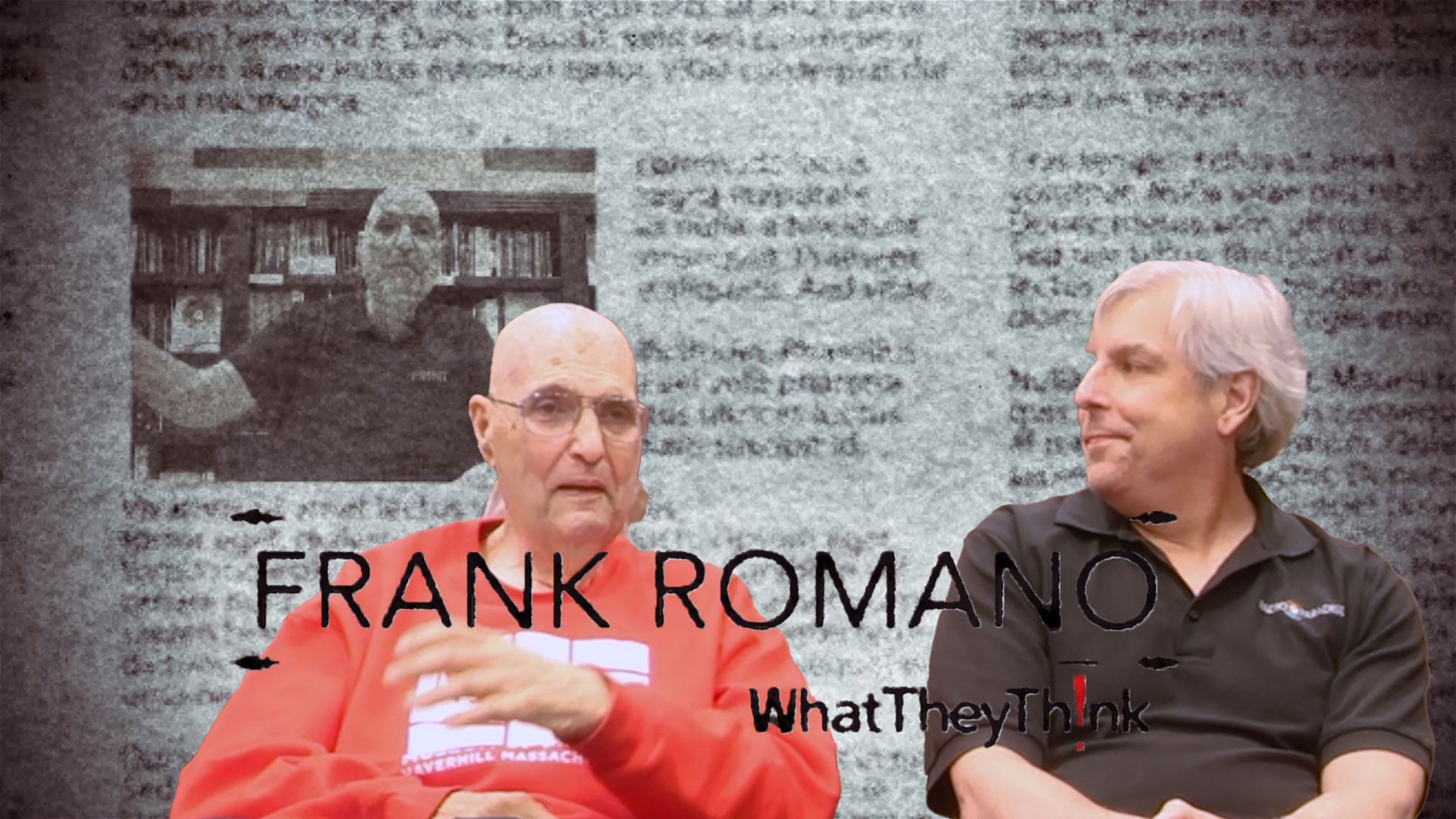
Frank and Richard share a sofa and some banter about the printing industry. Read More
Frank Takes the Pledge

Frank Takes the Pledge

Frank talks about The Youth’s Companion, a newspaper published in Boston for over 100 years. In 1892, its editor proposed a Pledge of Allegiance. Read More


The Font I Want

The Font I Want

Frank describes his informal survey to discover the most-used typefaces. Over a decade, he has asked users what font they use most often. See the results. Read More

Jeopardy in Jeopardy

Jeopardy in Jeopardy

Frank reacts to a Jeopardy game show segment that involves Johann Gutenberg. There is much misinformation about the invention of printing and Frank is on a mission to present the facts, even if it means yelling at a TV screen. Read More