The press is not just CNN or Fox, or the Times or the Tribune, or Printing Impressions or American Printer, or even WhatTheyThink.com. The press is you and me and freedom of speech.
Most of the other provisions of the Bill of Rights protect specific liberties or specific rights of individuals . . . In contrast, the free press clause extends protection to an institution. The publishing business is, in short, the only organized private business that is given explicit constitutional protection. —so said Potter Stewart, Justice of the Supreme Court, 1974
Even Supreme Court Justices can be wrong. It used to be said that freedom of the press belongs to those who own the big printing press. This is not the case any more. The “press” has now shifted from being institutional to being personal. Every e-mail I receive in response to an article affirms it.
Lenin said that no one should be allowed to criticize the government and therefore the press should be restricted. In Russia not too long ago, you could not even own a copying machine because it was a de facto printing press. But media change and you are not reading this on paper.
Potter Stewart said publishing is a business and generally that is true. But there is also personal publishing. And personal opinion. As the only person in this industry ever sued by a company unhappy with my opinions, I treasure the Bill of Rights. Opinion is protected and I believe it is what makes America America.
My kids grew up in a small NH town and we attended every Town Meeting where you could truly see how democracy works. That line about “I may not agree with what you say but will defend to the death your right to say it” has relevance in a society that is becoming so politically correct that we take umbrage at anything we do not agree with. Umbrage is OK so long as I the right to say what makes you umbrageable.
Every news channel will be judged on its ability to balance opinions. If they only carry press releases and ignore the different voices that make up our industry, we will all go somewhere else for our news and information. That goes for websites and printed magazines and newsletters.
Recently, one of my opinions rubbed people the wrong way (actually, a common occurrence). Instead of asking me to justify them, they resorted to personal attacks. That is the last refuge of those who cannot stand debate or have something to hide. Challenge the message to your heart’s content; celebrate the messenger for making you think.
When the Bill of Rights was enacted, the press was not a giant mega-business. It was a group of entrepreneurial individuals, like John Peter Zenger, Ben Franklin, and Isaiah Thomas. It was Zenger, not Zenger, Inc. or Time Zenger, whose trial established the bedrock principle of freedom of the press.
One of my most special evenings was at the home of J. Ben Lieberman in Tarrytown, NY. Lieberman (1914-1984) was founder of the American Printing History Association. You could not leave his house without setting type and printing a page on the hand press (in his living room) he acquired from Fred Goudy who had acquired it from the estate of William Morris. Ben rang a bell and said “Let freedom ring” because he believed passionately in freedom of the press — and that everyone should have a press. He supported the hobby press movement. I signed the guest book that night right after Alfred Knopf.
The Internet has changed the definition of “press” forever. We now have our own websites. Ergo, we are publishers. We have blogs. The PrintCEO blog is among the best. And there are millions of us. It is not always a business; it is a hobby, a cause, or even a whim that motivates us. Look at the rise of the political blogs and the alternative news channels. Our associations and publications filter information to the point of uselessness. I sometimes think they do not respect the intelligence of printers.
You may not agree with me, and that is your right. But we can debate in the public arena with openness and without malice. Our industry does not always like openness or contrary opinions; yet, public associations, foundations, and others are not immune from examination, and certainly not immune from opinion.
True journalism is uncovering what someone does not want you to know. Too many journalists begin with a point-of-view and then seek to support it. I think it is the other way around — ask the questions that reveal the truth.
Freedom of the press is not just for organized media. It is for anyone with an idea, a principle, or just a big mouth.
Freedom of the press is for all of us, because all of us now own the press.
I am the PRESS.
You are the PRESS.
We are the PRESS.
Continue reading your article
with a WhatTheyThink membership.
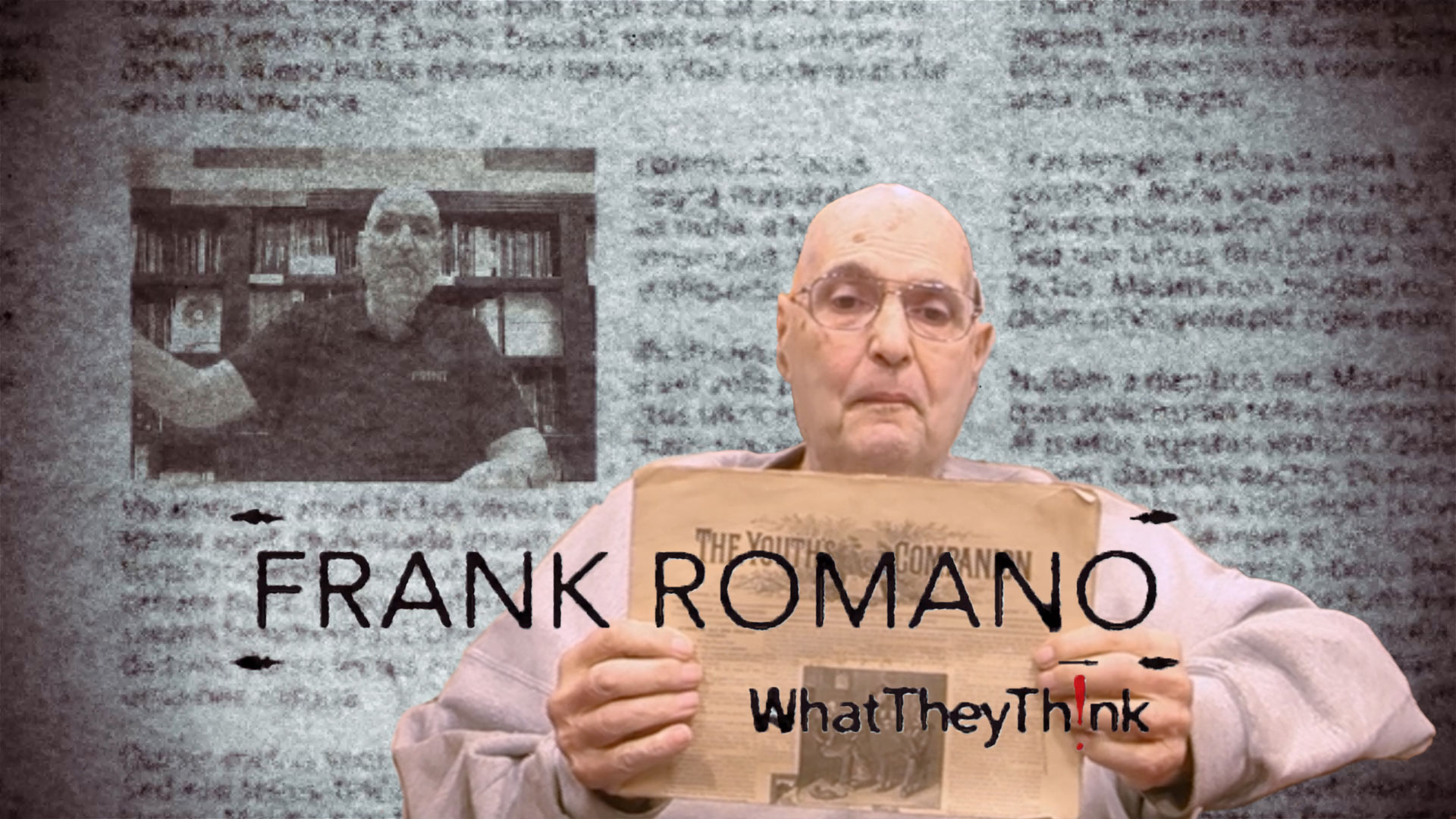
About Frank Romano
Frank Romano has spent over 60 years in the printing and publishing industries. Many know him best as the editor of the International Paper Pocket Pal or from the hundreds of articles he has written for publications from North America and Europe to the Middle East to Asia and Australia. Romano lectures extensively, having addressed virtually every club, association, group, and professional organization at one time or another. He is one of the industry's foremost keynote speakers. He continues to teach courses at RIT and other universities and works with students on unique research projects.