The Printcafe Saga Continues – Now What?
After reviewing the details of the Printcafe/EFI deal just announced, I would like to say that the deal is a win for recent stockholders of Printcafe, but anyone who bought at the initial offering price of $10 and held on took quite a bath.
What makes this interesting is that EFI, assuming the deal goes through, now has the information hearts and minds of some of the biggest print businesses. So one must ask, "Now what?"
Will there be other acquisition attempts to get EFI more deeply involved in the commercial print business, especially at the high end where EFI has had no presence of note? And for Creo, one can only wonder how wise it was to announce they had 55% of the company when they really didn't have it yet. Credibility with stock analysts, however deservedly maligned they have been over the past two years, is still something to be cultivated. Now whatever goodwill they had with "the Street" needs to be re-established.
There is a good chance that the story is not over yet. Will it end up in court? Will Printcafe and EFI strike a deal? It's not over until all the checks clear and everyone gets new business cards.
Dr. Joe’s Little-Known Economic Indicators
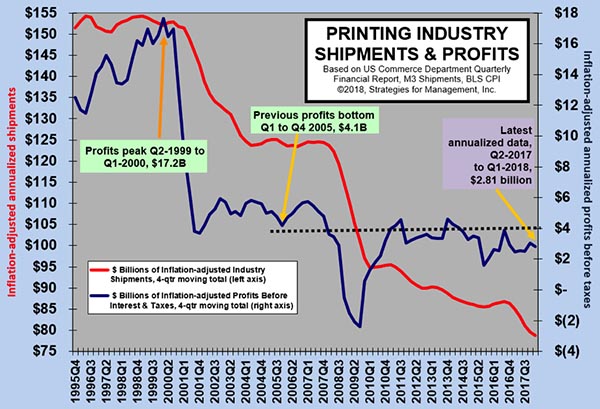
The government has an often overlooked data series that tracks the monthly shipments of printing, trade services, and related businesses called the M3 Series. After I adjusted these data for inflation, they revealed some remarkable things about how the industry is changing. (Adjusting for inflation is my personal crusade; how you can make comparisons without using a consistent measuring stick defies logic; more about that some other time).
Since 1992, the industry has shown a decline in annual revenues of 7.4%. The peak year for output was 1998, and compared to that peak, 2002's shipments were down by 13.4%. That's the equivalent of shutting down for seven weeks of the year compared to 1998. That’s more vacation time than they take in France! I'm not one for depressing data, despite my reputation as "Dr. Doom," but facts are facts, and as managers our job is to navigate through the realities.
Seasonality is Changing in the Printing Industry
What's more fascinating is how things have shifted on a monthly basis. Traditionally, the strongest months for the industry are September to November, reflecting the holiday season retail promotions of stores and catalogers, primarily web offset work. Prior to 1999, this period represented 27.4% of annual volume, while today it represents 26.4% of annual volume. November all by itself is down -9.5% from historical sales levels.
What does this mean? The data show a decline in retail printing and a change in the seasonality of the print business. For retailers, after 1998 there was a shift to e-commerce as a means to secure business. E-commerce did not replace print, but it does affect page counts and frequency of print promotions. Postage rate changes didn't help, either. But it's always important to remember that the Internet didn’t have to go through everything that print did, it just had to steal part of the budget. The growth of Wal-Mart (who does not use print extensively) and the decline of K-Mart (who did) did not help either.
The seasonality of the print business affects pricing, too. Buyers know, intuitively if not explicitly, that getting things printed prior to the peak September-to-November period is cheaper. While I don't know if there is a reliable way to measure this, I have encountered a great deal of anecdotal evidence that indicates that this is true for some buyers, who take advantage of slow periods in the summer. If the peak period is getting less important, then buyers have more price negotiation power at that time than they’ve ever had before.
The trend lines on the graph below show how the year's monthly sales variations are flattening out. This means that companies will be less inclined to arrange their capital investments for peak period capabilities.
This is yet another sign that capacity utilization is a very bad tool for measuring this business. You can have great capacity utilization all the time and never be selling at the prices you want or need because the market dictates prices, not your equipment. (We can discuss that one at a later time, too.)
The Position of Print in Today’s Media Mix
A piece of the puzzle is the perceived effectiveness of print alternatives. But the larger factor is that print occupies a smaller piece of today’s media mix pie, and the strong areas for print had seasonal patterns favoring the end of the year holiday promotions.
I strongly encourage you to visit some of the places that are reporting what big agencies and corporate buyers are thinking and saying. The extremely self-serving and biased (some would claim) report of the Internet Advertising Bureau should give many great pause, as it discusses campaigns that involve cross media (See this), suggesting that 10 to 15 percent of advertising campaign dollars should be spent there. Sure, some of the dollars come out of broadcast, but my gut tells me that print advertising is suffering a bit more than some would like to think.
B-to-B, a magazine catering to business marketers, reports interviews with six high-tech marketing managers considered to be best of their class, discussing how they use Internet advertising to complement their offline efforts. Among them are Dell, IBM, Oracle, EMC, Macromedia, and an emerging company, Groove Networks Inc. See this
More of the Fortune 500 companies are spending money on Internet advertising, as reported at Internet.com. See this
The point is that print competes for the same budget that other media do. It doesn't matter what size the company is or what they sell. The choices that managers have to make regarding budget allocation are quite different than they were even three years ago.
A Stagnant Economy Favors New Media
And here’s a point about how the condition of economy plays into this. The more sluggish the economy is, the more managers are pressed to find new ways to cut marketing and other costs. That is, there is a greater receptivity to trying new things and implementing new technologies on the promotion side. If the economy were growing, it would mean that tried and true promotion methods would be perceived as working, and there would be less inclination to change. The longer the economy lays stagnant, the more inroads new media will make.
Today, e-mail campaigns work. Well-crafted banner campaigns work, too. Web campaigns that aren't working can be detected quickly and changed in hours, if not minutes, and put back on track. And good websites provide great value in developing customer relationships. As these alternatives to print improve their measurability and their accountability, which they are doing, the print business will be left with its arms extended and its palms up, unable to answer the question, "How do we know that what we print using your services is effective?"
The Time for Action is Now
It's time to act, before the situation gets worse. Remember, we read about the dot-com collapse online. And that's where you're reading this column, as well. The electrons are winning. Wood pulp and pigments are not. What are we doing as an industry to change this situation? And how can we as an industry use the Internet in our favor to deliver the message that print is still viable and vibrant?
Don't Be Misled By the Dour Retail Sales Number Yesterday
Retail sales were down by 0.9%. That included a big drop in auto sales, but that January drop was about equal to the increase that autos had in December. Gee, do you think some executives were trying to make their 2002 fiscal year look good? Compensation plans are notorious for distorting true sales patterns. When you take out autos, sales at other retailers rose by 1.3% in January, the biggest gain since September 2000, and might I say, continuing the pattern of a strong consumer sector propping up the rest of the economy.
The Proof is in the Electrons: Gannett Generates Huge Internet-Based Revenue
At the end of the year, Gannett had more than 100 domestic publishing Web sites, including USATODAY.com, one of the most popular newspaper sites on the Web. The company also had Web sites in all of its 19 television markets. In December, Gannett’s consolidated domestic Internet audience share was 11.8 million unique visitors reaching about 9 percent of the Internet audience according to Nielsen//Net Ratings.
Gannett’s Newsquest is also an Internet leader in the United Kingdom, where its network of Web sites attracts more than 14.3 million monthly page impressions from more than 1.1 million unique users.
For the year, the company generated approximately $91 million in revenues from Internet activities, about a 27 percent increase over last year.
Dr. Joe’s Q&A – Response to Reader Question
Q: Will the Internet be as important as TV? Is it more important in a B-to-B environment than B-to-C, considering that most desktops have Internet access.
A: After a while, TV and the Internet will be almost indistinguishable. It will take some time, but if you look at the work that Real Networks is doing, as well as brand franchises like Major League Baseball investigating their own networks, it is clear that the Internet will be filling the role originally identified for cable companies efforts in pay-per-view. The direction that the NFL and baseball take when their various TV contracts are up will likely include some kind of webcast subscriptions.
Continue reading your article
with a WhatTheyThink membership.