WhatTheyThink

Premium Commentary & Analysis

Fed Interest Rates, Q4 GDP, PIA Projections, Beware the E-Magazine

No Surprises from The Fed!

Friday, January 31, 2003

No Surprises from The Fed!

To no one's surprise, The Fed left interest rates alone this week. Seemed that they realized with uncertainty like Iraq hanging over the market, any Fed easing wouldn't work anyway. Had they eased, some would have construed it as panicking about the shape of the economy.

U. S. Department of Commerce GDP 4th Quarter 2002 Stats

GDP grew at a rate of 0.7% in the fourth quarter, and only 2.4% for the year. We seem to be in an alternating good quarter/slow quarter pattern. At least it's not declining, but it's clear we're not growing at the rate necessary to build greater investment confidence. The Commerce Department did not release corporate profits data in this advance GDP release, and that will be critical in assessing when the print business might pick up. In the meantime, the NASDAQ is a good surrogate, and that has been nothing to write home about. Once optimism about sustainable growing corporate profitability takes hold, we'll see the increased spending on promotions and advertising that is so important in driving the print business, but that will take some time.

The employment cost index was up, with private industry wages and salaries up 2.7%, and benefits costs up 4.7% for 2002, the latter due principally caused to health care costs. Look for companies to start telling employees how much their "free" health care actually costs, raising employee contributions to those costs. Increasing total benefits, however, is a sign that tax avoidance is again becoming a goal of many compensation packages. How soon we forget that vacations and health benefits were added half-a-century or more ago partly as a means of avoiding wage and price controls. (More barely useful trivia from Dr. Joe).

Jobless claims were up, but the four-week moving average of the index was down. Look for continued unspectacular movement in unemployment. I still remind everyone that back in the late 70s and early 80s economists considered 6% to be full employment. How soon we forget (do I have to remember everything around here?) -- the real target for full employment number is 3-4% unemployment rate. Whatever the case, a jobless recovery is no recovery at all.

In Other Economic News . . .

The U.S. Department of Commerce reported this week that durable goods orders were up, but not as much as was expected. Buried in the report is good news, though -- a 2.8% increase in orders for computer products and a similar increase in non-defense capital spending.

Consumer confidence as reported by the Conference Board on January 28th dropped to its lowest level since November 1993, but home sales were up. Consumer spending is still strong, despite the confidence index dropping in 7 of the last 8 months.

Perhaps business investment is starting to pick up? While it’s not enough yet, at least we're moving sideways and not down.

More on the PIA Projections for Tax Cut Impact
(See the original DJW Quick Take)

On January 24th, the PIA released its assessment of the effect of the President’s proposed tax plan on the printing business, indicating 2004 would be the best of the next three years, with sales growth for 2004 of 3.8%, up 0.6% from previous estimates.

As I said in my Quick Take earlier this week, I believe this assessment is too rosy. To bolster its forecast, PIA cited the fact that 2004 is both a political and an Olympic year. While this may have been the case a while ago, the most recent year these events aligned was 2000, not a particularly good year for the print business. In 1992, it was the "it's the economy stupid" campaign, and the incredibly high growth of the fourth quarter of 1992 was way too late to help Bush41. 1996 was a pretty good year mainly because Congress controlled spending growth (mostly because of gridlock, rather than specific intent it seemed) and there was an increase in productivity as computer networking and Internet technologies started to storm through the economy. IT spending also started to rise as managers worked to avoid Y2K problems – and IT spending is critical to B2B printing. Its absence today is significant.

So the fact that it is a political and Olympic year are positives, but they exist within the context of a total environment of technology, regulation, and social factors which I believe will have far stronger impact. Having read accounts of the role of e-mail in these last elections, one can only think that e-marketing will play yet a bigger role in both political and Olympic promotions in the future.

Cross Media is Dead (AOL/T-W Strikes Again)

After posting an incredible quarterly loss from more write-downs at AOL, Ted Turner says he wants CNN and the Atlanta Braves back. AOL could use the cash. Don't be surprised if they take the offer (sources say “Braves yes, CNN no” so far). Turner honestly loves both properties and probably doesn't want AOL/T-W to do to the Braves what they have been doing to CNN. The Braves are one of the best-managed businesses -- not just sports teams -- in the U.S. We're rooting for Ted. But we still love the Mets (don't ask; it's a misplaced loyalty thing).

Beware the E-Magazine

Some of you know about my misadventures with Zinio, the electronic magazine service used by Ziff-Davis that has been such an administrative headache for me. My problems seem to have passed, for now at least, and I strongly recommend that anyone involved in the print business take a good hard look at this technology. Visit http://www.zinio.com to download the free Zinio reader and some free magazines, including prototypes of Harvard Business Review and PC Magazine.

Any attack on print magazines -- a critical part of the heatset web and gravure businesses and the segment that makes big printers big -- must be taken seriously.

Watch for my WhatTheyThink Special Report on E-Magazines this coming Tuesday! I’ll report on the future of e-magazines and where the concept might fit best. And I’ll have some comments on what it’s like to use Zinio.


Continue reading your article
with a WhatTheyThink membership.

WhatTheyThink Annual Membership

Less than $4/week.

Get unlimited access to in-depth commentary and analysis covering the latest trends, emerging technologies, operational strategies, and key events across every segment of today's printing industry.

Stay informed. Stay competitive. Stay ahead.
WhatTheyThink Day Pass

$5 for 24 hours

Unlimited access to all of WhatTheyThink. Get your Day Pass

Already a member?
Sign In

About Dr. Joe Webb

Dr. Joe Webb is one of the graphic arts industry's best-known consultants, forecasters, and commentators. He is the director of WhatTheyThink's Economics and Research Center.

Recent Articles from Dr. Joe Webb

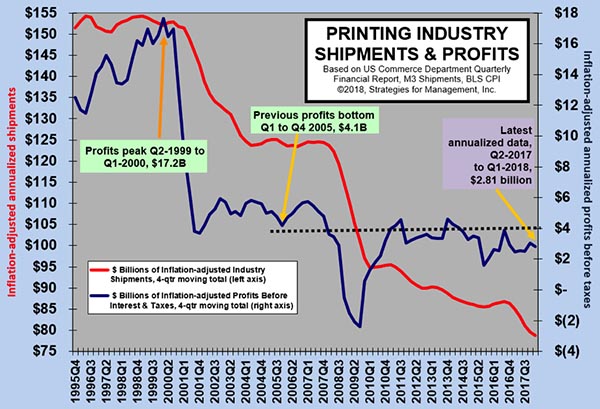
Big Printers' Writedowns and Interest Payments Are a Big Drag on Printing Industry Profits

Big Printers' Writedowns and Interest Payments Are a Big Drag on Printing Industry Profits

Writedowns in the first quarter of 2018 for commercial printers with $25 million or more in assets were $157 million, or 1.9% of sales. The assets may be written down, but the borrowing that was created to finance them remains. Interest expense was 4.8% of sales. For the quarter, losses were -1.47% of sales. That rate of loss made average profits before taxes for the industry a mediocre 3% of sales—which means that printers with less than $25 million in assets must have done well. Read More

The Final Column: The Security Guard Will Take Your Badge and Escort You to the Lobby

Back in 2002, Dr. Joe agreed to do a regular column for WhatTheyThink for “only one year and no more”...for 15 years. This farewell column explains how it started, behind-the-scenes intrigue, the problems, and why it turned out the way it did. And then…he explains the exciting adventures ahead. Read More
Full-Time Employment, Sets New Record, Up +904,000, But Does It Really Feel that Good?

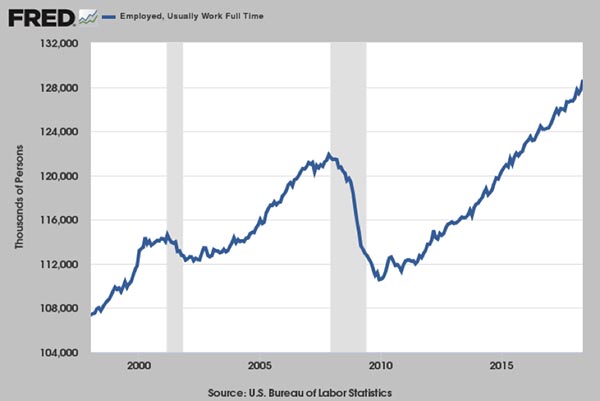
Full-Time Employment, Sets New Record, Up +904,000, But Does It Really Feel that Good?

The May employment report was regarded as good, but when you dig past the top-level numbers, it was better than it looked. However, while the 3.8% unemployment rate looks good on the surface, it really can’t be compared to when it was last attained nearly 20 years ago. So many workers left the workforce that this figure implies a tighter labor than it really is. We will really know we have a strong economy when the active labor force starts increasing. Read More

Good News Could Be a Full-Time Job, but for Most Economists It’s Only Part-Time

Some people say that the news is always bad, and they wish someone would report good news now and then. There is good news but no one seems to report it. You’d think that would be a full time job for someone. The economy has set a record for full time employment, and all we hear are crickets. The economy has been doing better lately in some key measures of employment, but the Fed is scaring markets by preparing to raise rates. TINA, meet TAMA, the result of the Fed’s actions; don’t worry, we’ll explain it. The statisticians at the Commerce Department revised printing shipments data. Revising data seems to be a full time job in the Beltway. Dr. Joe clarifies it all for one nearly last time. Read More
Consumer Durable Goods Orders Moving at Almost 2X GDP Rate

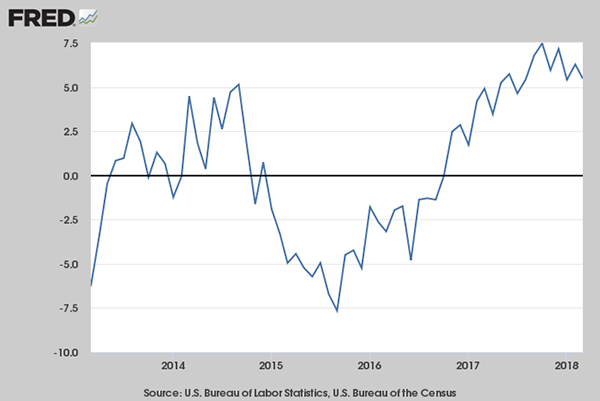
Consumer Durable Goods Orders Moving at Almost 2X GDP Rate

Durable goods orders for consumers (less transportation) are growing at a rate almost two times faster than Real GDP. This data series remains -14% below where it was at the start of the recession in December 2017, and is a critical one to monitor for indications of an improved economy. Read More