- Printed books require sustained focus, which is increasingly challenged by the pervasive immediacy of digital scrolling and “skim and scan” habits.
- A decline in literacy scores and educational attainment has prompted governments in Nordic countries to reinvest in printed textbooks and accelerate their return to schools.
- Social media has created visibility, community, debate, and cultural energy around physical books.
- Decorated edges, sprayed patterns, foil blocking, textured covers, and special collectors’ editions enable publishers to extract greater value from printed books.
By Priya Gohil
Introduction
Without a doubt, I’m a bookworm. I’d even take that a step further by calling myself a printed book bookworm. I am so biased toward printed books that the Kindle I received as a birthday gift 13 years ago has remained untouched, its whereabouts unknown. When traveling, I’d rather pack two or three 400-page books and sacrifice a layer or two.
I’m not alone. There are plenty of readers who find new and inventive ways to share their love of traditional books—the cultural phenomenon known as BookTok is a good example. Books are vessels of imagination, stories, knowledge, and power. Reading books empowers, enriches, and fuels critical thinking. That’s precisely why dictators and authoritarian regimes have historically worked to limit access to titles that they deem too dangerous, deviant, or challenging to their power.
An Uncertain Future
The UK government has declared 2026 the National Year of Reading, but recent data suggests that reading needs all the public relations it can get. Surveys indicate that fewer than a third of schoolchildren say they read for pleasure, while up to half of adults have not read a single book in the past year. Across Europe, 47% of adults are classified as non-readers.
Printed books may still account for more than 80% of publishers’ revenues, but unit sales are softening and literacy indicators are flashing amber. These books demand time and attention. They require sustained focus, something that is increasingly challenged by the pervasive immediacy of digital scrolling and “skim and scan” habits. Social media, short-form content, and even AI-generated digests encourage speed over depth. All of this is having a detrimental impact on the younger generation’s ability to retain information.
The recent Shaping the Future with Books conference, organized by Intergraf, shone an equally gloomy light on the state of the European book publishing industry and reading habits of its citizens. OECD PISA findings show declining literacy skills, with one in four young Europeans lacking basic competencies. In Germany alone, 20% of adults were reported to have low reading proficiency.
During her talk at the conference, Marte Pupe Støyva from the University of Stavanger presented research on reading practices in higher education, arguing that sustained attention is now “so valuable, and so fragile.” She highlighted research that showed students are incapable of focusing more than five minutes at a time thanks to their digital and short-form reading tendencies. She asserted that reading is not only a mental activity, but also a physical one. Students engage their bodies while reading printed books through highlighting, underlining, taking notes, and turning pages. This physical interaction helps them to engage more deeply with the content and gives them time to pause and reflect. It also drives imagination and critical thinking in ways that screens struggle to replicate.

Reading on paper supports deeper comprehension.
Print and Digital Come Together
This rationale is not anti-digital; it is evidence-based. Nordic countries like Sweden are backtracking after years of prioritizing tablets and online learning in classrooms. The decline in literacy scores and educational attainment has prompted a policy reversal, with governments committed to reinvesting in printed textbooks and the allocation of substantial funding to accelerate their return to schools. Similar shifts are occurring in Denmark and Finland.
Despite these actions, a digital culture is not the enemy of print. In fact, it has come to be an ally of sorts. Swedish book influencer Jasmine Darban described BookTok as a “large digital book club” and a powerful phenomenon, with the hashtag #BookTok already accumulating over 73 million posts. Darban emphasized that BookTok had created a new era in publishing marked by influencer marketing, We are seeing BookTok tables in bookstores, bidding wars for trending titles, and the rise of new publishing imprints tailored to viral genres like “romantasy.”
Social media has created visibility, community, debate, and cultural energy around physical books. Other cultural forms are also aiding literature. We’ve seen notable book-to-screen adaptations, especially recent film adaptations of Wuthering Heights and Hamlet, with some cinemas selling copies of the novels alongside film screenings. As Darban remarked, social media is no longer necessarily the death of literature.
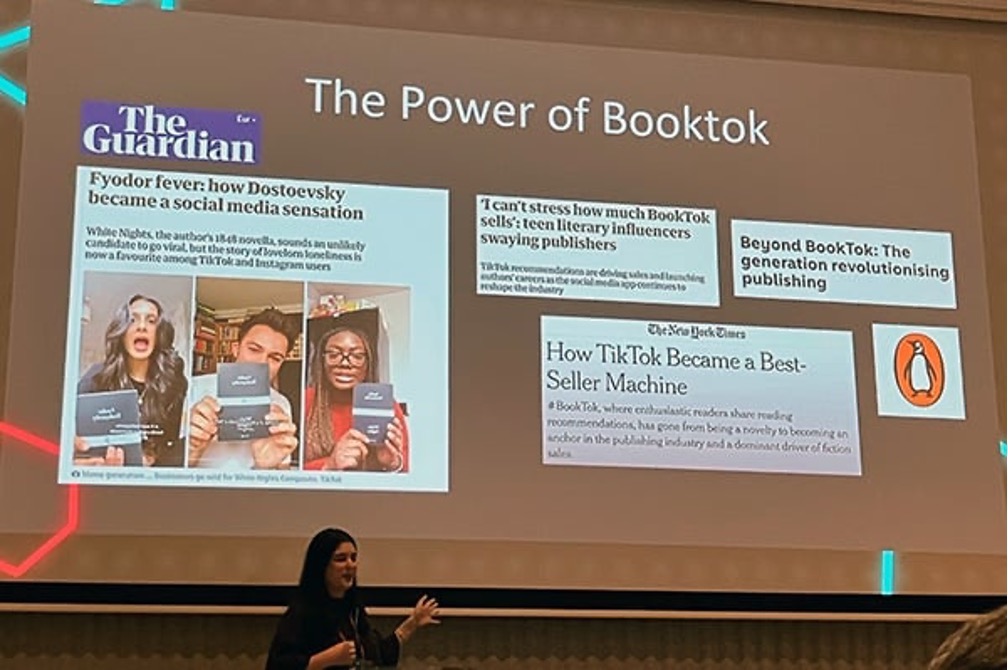
Jasmine Darban on the power of Booktok.
Moreover, publishers and printers are responding. Screens may dominate speed and convenience, but print is leaning into experience and value. Premium finishes are a clear growth area for books. Decorated edges, sprayed patterns, foil blocking, textured covers, and special collectors’ editions enable publishers to extract greater value from content. Consumers are paying more for beautifully designed physical books that are positioned as keepsakes rather than commodities.
In parallel, advancements in digital printing and print on demand models are transforming the supply chain. Digital printing accounts for a growing share of production value and enables shorter runs, reduced waste, as well as perpetual availability of backlisted titles (good for those BookTok recommendations). Fewer unsold copies mean economic and environmental gains. In other words, the industry is not standing still. It is recalibrating.
The Bottom Line
In the end, the debate is not print versus digital. It’s about balance. According to Intergraf President Ulrich Setter, a book has both a cultural and a technical dimension. Without technical excellence, there is no physical object. Without cultural value, there is no purpose in printing it.
If we hope to reverse reading decline, the answer will not lie in nostalgia alone. It will require:
- Policy support and educational investment
- Communal reading structures (e.g., book clubs, classroom reading groups, shared cultural moments)
- Using social media to promote books rather than competing against them
- Continued innovations in print manufacturing to make books desirable, tactile, and collectible
The future of reading won’t look like it did in the past, but printed books are proving remarkably resilient. And for those of us who are still willing to sacrifice backpack space for a stack of paperbacks, that feels like solid reassurance.
With over two decades of publishing experience, Priya Gohil has been providing A3, production, and wide format analysis since joining Keypoint Intelligence in 2013. While sharply focused on custom test reporting as well as high-value subscription content, she also contributes blogs and a variety of other articles across all of Keypoint Intelligence’s channels.