- Print naturally aligns with the core objectives that modern marketers and communicators are hoping to achieve.
- AI can help simplify segmentation, profiling, personalization workflows, and campaign tracking, making it easier for marketers to take advantage of high-value communications via print.
- Because print can be associated with higher costs and slower time to market, it must be sold based on value and potential ROI.
By German Sacristan
Introduction
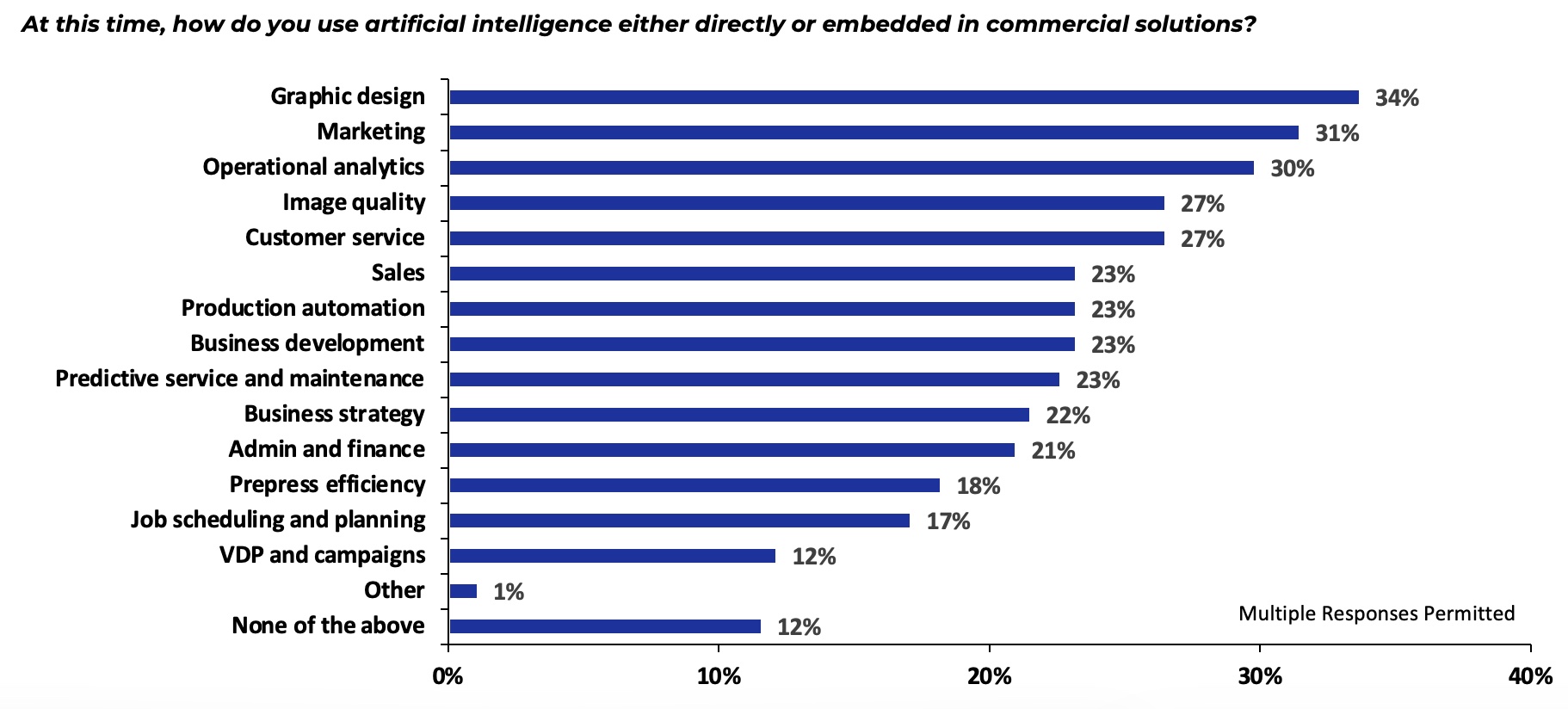
Like any other industry, the printing market is working to identify where artificial intelligence (AI) can deliver the most meaningful value. We’re no longer just seeing ideas and experimentation; real implementation is occurring across multiple areas of the print production ecosystem.
Most of today’s AI-driven solutions are focused on improving operational performance. Examples include production efficiency through automation, predictive maintenance, waste and energy reduction, enhanced operator user interfaces (UI), improved image quality, and even data security. These are all important advancements, but there is more to the equation.
Efficiency Isn’t Enough!
There’s no question that AI can help print providers operate more efficiently. Even so, higher productivity on the production floor becomes far less impactful if overall print volumes continue to decline—and they are. This is why AI must also play a role beyond operations.
To truly influence the long-term growth of digital printing, AI must also help improve campaign productivity and effectiveness. This would increase the perceived value of print and ultimately help generate larger print volumes, which everyone in the print supply chain wants and needs.
Print Still Matters…So Why Are Volumes Declining?
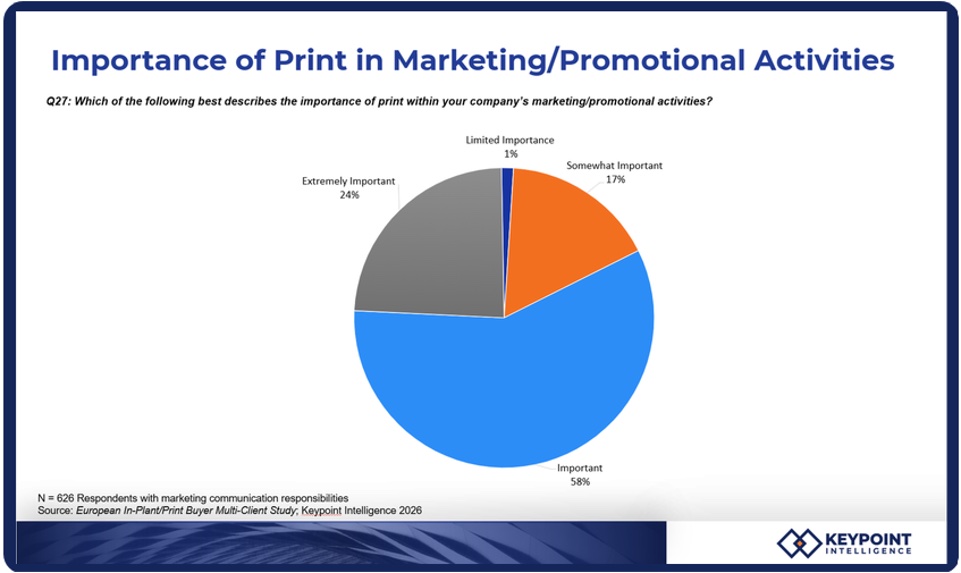
Some people (myself included) continue to believe that print remains one of the most powerful communication channels. Granted, I’ve spent much of my career in the industry, but print aligns naturally with the core objectives that modern marketers and communicators are hoping to achieve.
Print supports campaign success by enabling:
- Attention and perceived value through impactful mail experiences, embellishments, premium substrates, unique finishes, and personalization.
- Relevance through variable data printing, and improved engagement through personalization.
- The use of e-connectivity tools like QR codes, NFC tagging, and AR. These tools connect audiences directly to digital experiences, be they purchasing pages, additional content, or product education (including videos).
Print can also activate one of the most powerful channels in marketing: word of mouth. Specialty applications, tactile experiences, and highly personalized communications can create moments that people notice and share.
Marketers recognize this value. According to Keypoint Intelligence’s survey data, only 5% of respondents indicated that they would not be purchasing any specialty print applications and products in the near term.
Print certainly remains relevant and effective, but today’s media environment is increasingly complex. Many channels can reach larger audiences with fast time to market and low cost, so print needs all the support it can get to create value for buyers.
AI has an opportunity to change the equation.
AI should be able to recommend the most effective channels for promotions or communications, and print should be one of those channels. This is especially true when the printed communication can directly support core campaign objectives.
Highly targeted digital print campaigns, particularly those that include personalization, can significantly improve effectiveness. Unfortunately, these campaigns also introduce complexity and slow the time to market. AI could help simplify segmentation, profiling, personalization workflows, and campaign tracking, making it easier for marketers to take advantage of high-value communications via print.
The Problems
Print Isn’t Showing up in AI Recommendations
Despite all of its strengths, print volumes continue shifting toward electronic and digital channels. The biggest threat is that the differential value of print is not fully recognized by the marketing universe or AI. When I asked AI to name the most effective channels through which to communicate, print didn’t even appear on its list.
We all know that AI doesn’t make decisions in the human sense. It responds based on the data it has been trained on and the information it sees across the universe of content. Print isn’t showing up because, in the broader market narrative, it’s not being prioritized as a top communication channel. Instead, AI recommended channels such as e-mail, paid searches, organic searches, social media (including paid ads), events, webinars, and messaging (SMS). Print is strategically powerful because it aligns with key campaign objectives, yet it’s not recommended by AI as a top channel.
We’re Still Talking About Print the Wrong Way
We tend to communicate about and sell print’s value through products (direct mail, catalogs, brochures, etc.) and applications (variable data printing, embellishments, QR codes, etc.). We rarely promote print in terms of how it is connected to campaign strategies, methodologies, and objectives in a way that enables marketers to immediately see print’s value and potential ROI.
Most case studies only focus on printing products/applications (the channel solution), the target audience, and the outcome. This focus doesn’t strategically explain where print works best or how to use it effectively. Although it’s a very effective channel, print can be associated with higher costs, slower time to market, and limited reach. As such, it must be sold based on value and potential ROI.
Even AI’s “Print Answer” Is Too Narrow
When I switched gears and asked AI where print should be used in marketing, the response was as follows:
“Print marketing is highly effective for building brand trust and driving local engagement, particularly through direct mail, brochures, billboards, and event materials. It is best used for tangible brand reinforcement, such as high-quality brochures, personalized postcards, business cards, and product packaging, or in public spaces like retail, airports, and gyms.”
Even here, the framing is still largely driven by product, and print is positioned mainly around branding and local engagement. While print excels in these areas, it can support many other strategies and campaign objectives beyond that narrow scope.
The Opportunity
The good news is that AI can make it easier for marketers to implement high-value communications through improved targeting and personalization, where digital printing can play an important role. Despite this, a big challenge remains: Marketers have more channels to choose from than ever before, and print (with its higher cost) won’t win by default. To increase digital print volumes, we as an industry must do a better job of clearly promoting print’s strategic value (alone or complementing other channels) within the context of campaign/marketing processes and objectives.
The Bottom Line
Our natural tendency is to focus on production efficiency because it’s at the core of many of our businesses. In today’s environment, though, efficiency alone is not enough. We need print volumes to grow, and that requires a stronger focus on determining the areas where print is strategically the most effective and why.
If you’re interested in better promoting the value of print to print buyers, e-mail me at [email protected]. I’d love to hear from you!
German Sacristan is the Director of Keypoint Intelligence’s Production Print & Media group. In this role, he supports customers with strategic go-to-market advice related to production printing in graphic arts and similar industry segments. German’s responsibilities include conducting market research, industry and technology forecasts, custom consulting and development of analyses, editorial content on technology, as well as support to clients in the areas of production digital printing.