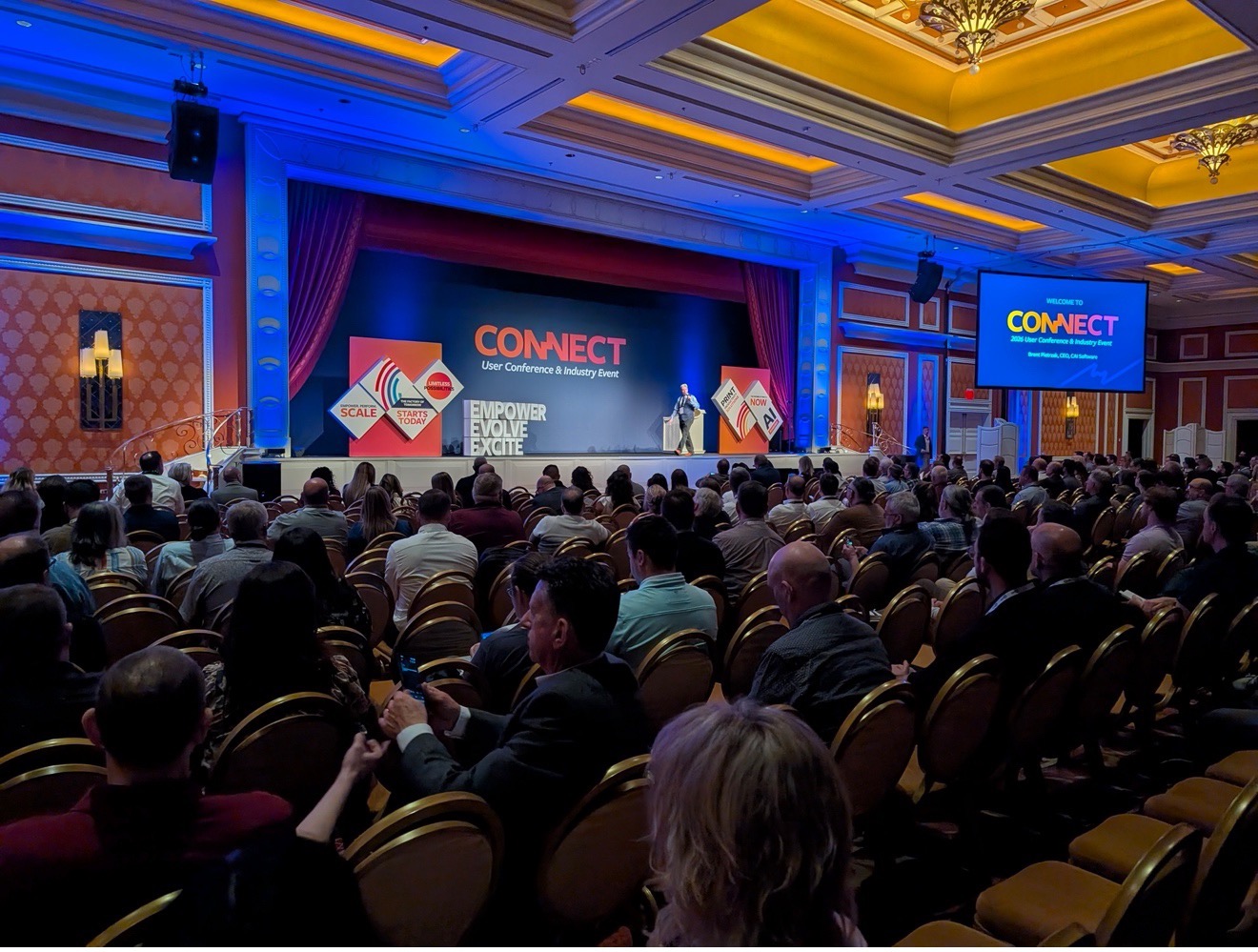
Having been to the first CONNECT 26 years ago, and many others since then, I am still impressed with the real breadth and value this conference brings to those in our industry who use the various software solutions represented. This year, there were 14 tracks and 152 sessions, 40 of them focused on packaging, attended by over 518 attendees and 16 partners. CONNECT is one of the longest continuously running user conferences in the print and packaging industry, and it has always been a true user conference with technical sessions, labs, general sessions, and, most importantly, user interactions. With the constant evolution of print and packaging markets and technologies, this type of event is an imperative.
Background
Originally known as EFI CONNECT, even with the various acquisitions and restructurings over the years, it has not lost its real value for those who use the various MIS/ERP software solutions under what are now the Graphic Communications and ePS umbrellas. If you haven’t kept up with the more recent changes, ePS is now the source for packaging MIS/ERP solutions and Graphic Communications (A CAI division) is the source for print and graphics MIS/ERP software. While they are now two separate operating companies, they do work together to align their developments to the benefit of the industry as a whole. Between them, they serve more than 4,000 print and packaging suppliers globally with various software solutions targeted to different company sizes and requirements.
Graphic Communications CEO Brent Pietrzak explained that, “CAI was formed in September of last year, and Graphic Communications is about half of our business. The CAI business was a business focused on discrete and process manufacturing, and if you think about it in those terms, Graphic Communications is a form of discrete manufacturing.” Going forward, they are going to continue to focus on a number of things that will add value to their customers, including M&A, and looking for assets that add capabilities that may not be in the portfolio today. They will also invest in their products through accelerating the product roadmaps, and by adding resources. ePS CEO Doug Braun echoed a lot of what Pietrzak said and shared that in the conference and in the state of the diversification in the industry today, “we have people who are in packaging running print solutions, and print people running packaging solutions.”
Each of the 16 partners had booths and gave presentations to educate the attendees about how their specific solutions enhance the value and productivity of the MIS/ERP solutions and their individual businesses operations.
Industry Trends
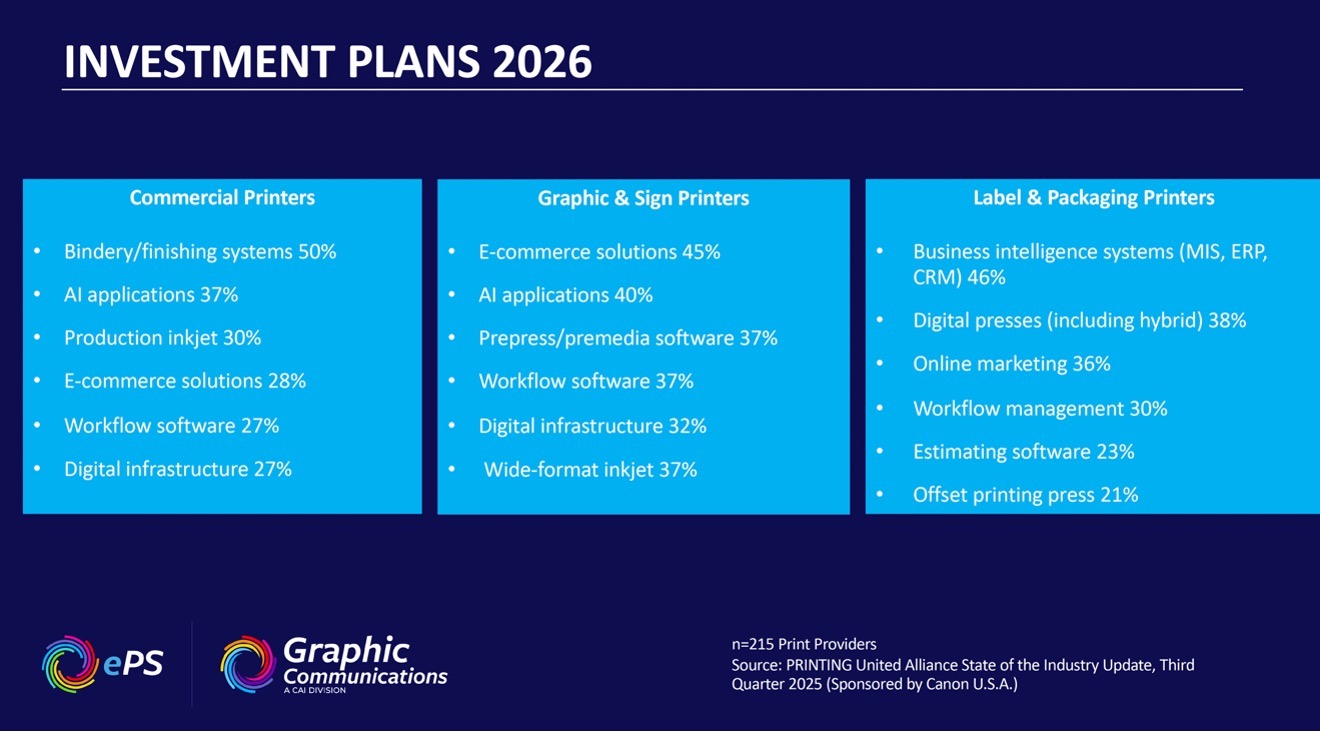
The CONNECT 2026 keynote was presented by Nathan Safran, VP of Research for Alliance Insights, a division of the PRINTING United Alliance. The keynote really mirrored the state of the industry and set the tone and topics for the event. Safran detailed the key concerns from the industry sampling in their recent PRINTING United Alliance State of the Industry Update, Third Quarter 2025. This research included sales, profitability, business conditions, labor costs, substrate costs, and the effects of tariffs as key concerns. Print providers are addressing these challenges by improving productivity, controlling costs, adopting automation, and capturing higher values and more profitable sales. Not surprisingly, in the area of capital investment objectives for 2026, 76% are targeting increasing productivity and efficiency. Over 50% include upgrading aging equipment and software systems as an important objective. Obviously, different business types have different investment priorities, as you can see below. However, solutions that increase productivity and profitability have a strong showing across the board.
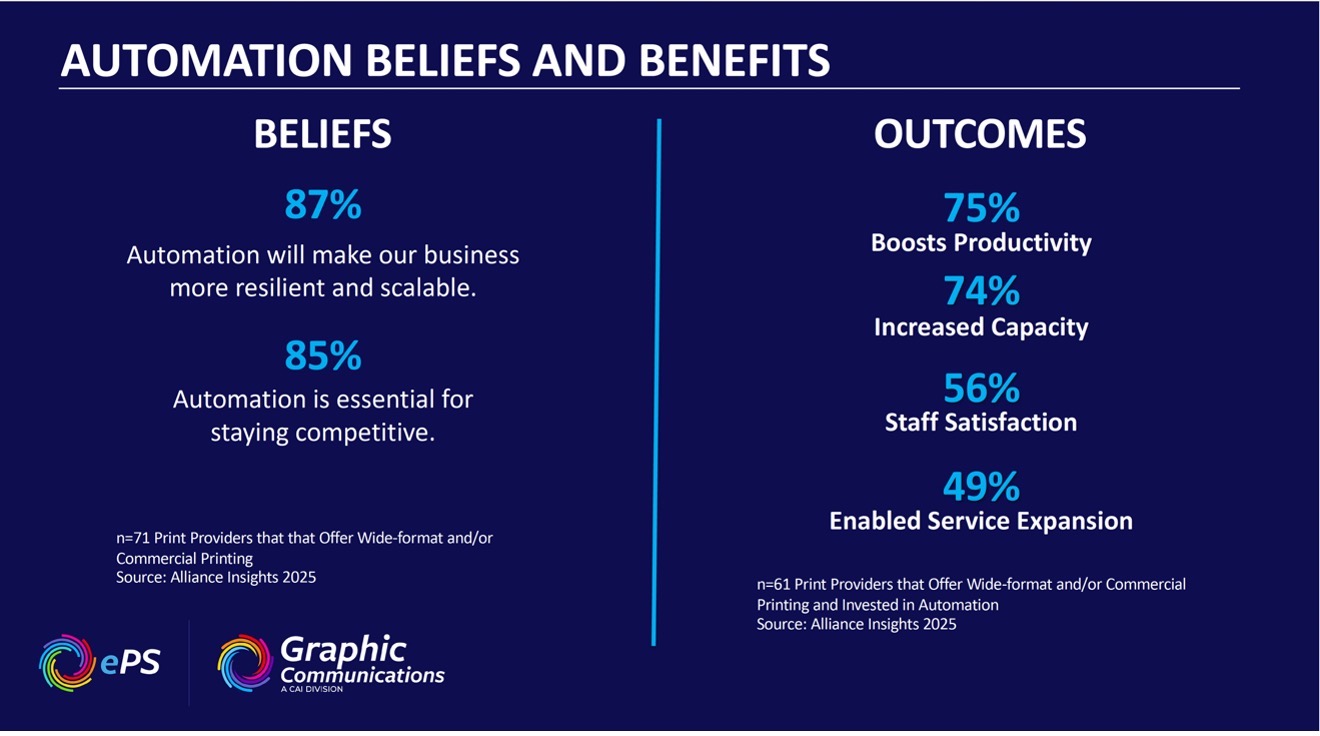
Apparently, the desire to increase efficiency through automation has been top of mind for many PSPs for a while now, and considering the resulting benefits, for good reason. Not only do they see productivity boosts, but also other side benefits like opening up capacity and even enabling service expansion. While staff satisfaction isn’t at the top of the list, in my experience that takes some time for that to settle in, since people can be somewhat adverse towards change.
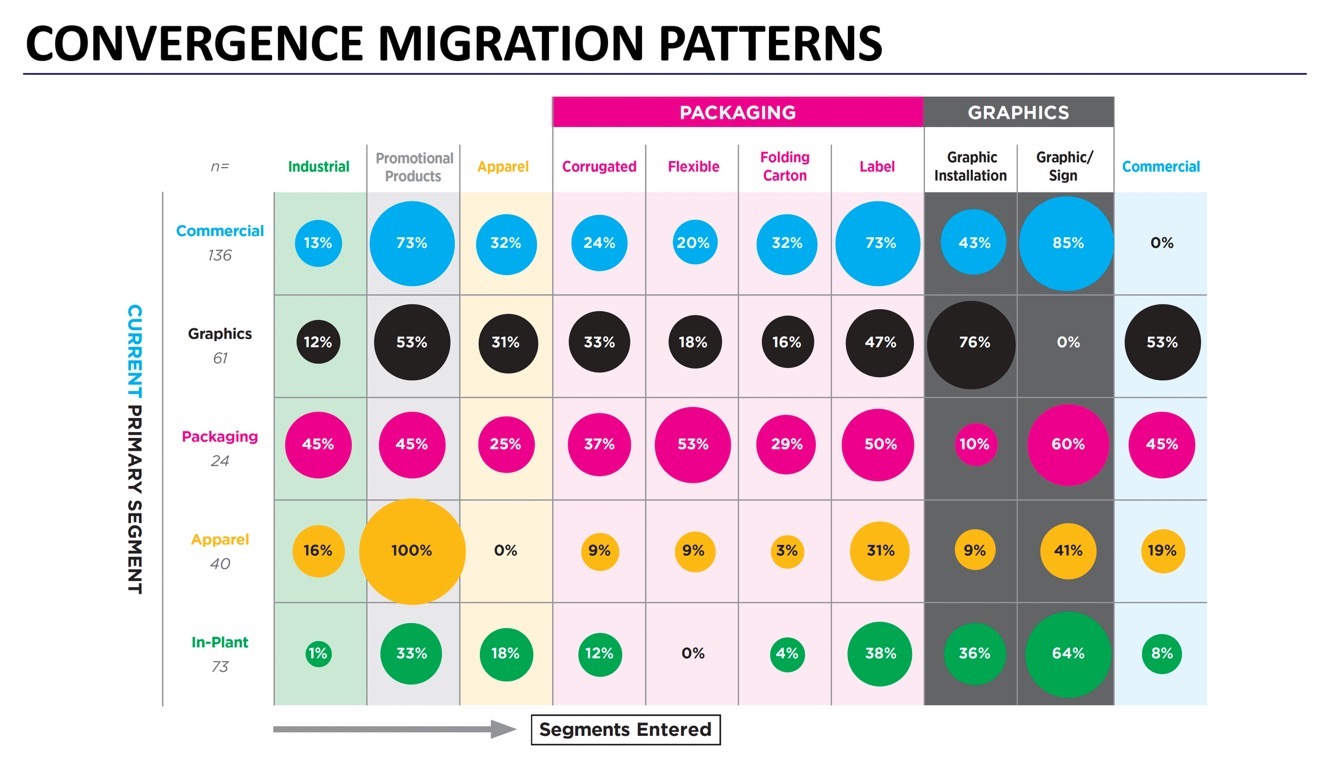
Traditional printing markets have been shrinking as a result of an increase in online technologies and shifting consumer demands. This changing landscape has a direct effect on print and packaging service providers. To mitigate this and grow revenues and profits, many PSPs are diversifying business offerings. Diversification, sometimes called convergence, in the printing industry is the deliberate expansion beyond a shop’s traditional core applications, markets, or business model to create new, more resilient revenue streams and reduce dependence on shrinking legacy work (see my recent article on diversification here). Diversification across segments means PSPs increasingly compete as multi?segment providers rather than single?segment specialists. In the graphic below, you can see the areas and rate of diversification adoption by the historic segments.
© Alliance Insights
Importantly, while the results may vary by targeted segment, on average, diversification in businesses has seen a 16.7% increase in revenues and 11.1% increase in profitability, according the Alliance Insights 2025 study.
AI
In line with the amount of general discussion about AI development in the press across the board, there was a significant amount of attention given to it at CONNECT 2026. The AI Strategy Keynote was given by Steve Metcalf, Chief AI Officer of IMAGINE LIVE. Metcalf began his talk by retitling it to “What is your AI agent strategy?” He then explained the shift from traditional AI and focused on the evolution of AI, predicting 2026 as the year of AI agents. He detailed the rapid rate of advancements in AI models like Claude AI, Gemini, GPT-5, etc., and discussed tools like Cloud Code and Codex for creating AI agents. Metcalf showed some examples of how AI agents can be used in the printing industry, including image generation and automation. He went on to explain the process of building and managing AI agents, including the importance of skills and frameworks, some of the core building blocks. Then he actually created some automation agents live to show how easy it is becoming to interact with the new tools.
Metcalf discussed the challenges of adopting AI, including the need for training the models and the potential for errors. He emphasized the importance of a human-AI collaboration model, where humans oversee and guide AI agents. Metcalf also showcased Ad Legends, an AI-driven advertising platform he created, and emphasized the potential of AI to automate various business processes, reducing costs and increasing efficiency. Metcalf encouraged the audience to explore and adopt AI agents in their businesses. He provided practical steps for getting started with AI agents, including installing tools and creating skills, and the importance of continuous learning and adaptation to stay ahead in the rapidly evolving AI landscape. Finally, he shared his optimism about the future of AI, predicting that AI will continue to evolve and become more integrated into business processes. The next day, Metcalf held a hands-on workshop to teach attendees how to build agents for their business. Participants learned how to evaluate AI tools, craft effective prompts, spin up simple apps and automation pipelines, and “think like a Chief AI Officer.”
Concluding the AI part of the event, there was a roundtable of PSPs and partners, led by Content Director for Printing Impressions Ashley Roberts, discussing their experiences and hopes for using AI in their businesses and lives. The takeaway was, while it is still somewhat early in the AI agent story, there will be increased benefits as the technologies continue to evolve. As a result, it is probably time to start to play and test to learn how to build and integrate AI Agents into your business.
Software Roadmaps
In addition to attending the many sessions supporting the current operation of their software, both Graphic Communications and ePS laid out their roadmaps for the next 24 months. Of course there was a caveat, that considering the rate of change in technology and market requirements, these plans could “adjust.” Generally, both companies discussed the evolution of the printing industry, focusing on software solutions for cost reduction, diversification, and automation. They introduced the Aha Ideas Portal for customer collaboration and feedback. They also introduced Genie, an AI-powered help and guidance feature built around their software products.
Doug Surrett, CAI’s General Manager & Chief Commercial Officer for Graphic Communications, opened the presentation with a quote from the famed management consultant Peter Drucker: “The best way to predict the future is to create it.” In line with that, he presented an overview of their efforts in platform evolution from 2025 compared with the projected roadmap for 2026. Of the almost 120 major features delivered in 2025, across the portfolio, almost 50 of them were workflow automation and integration improvements. They and their customers understand the importance of integrating their products in a seamless fashion. Another 50 or so features were really core product enhancements. This will always be something that they are actively delivering, because when customers think about their products and the development roadmaps, this is what most people focus on.
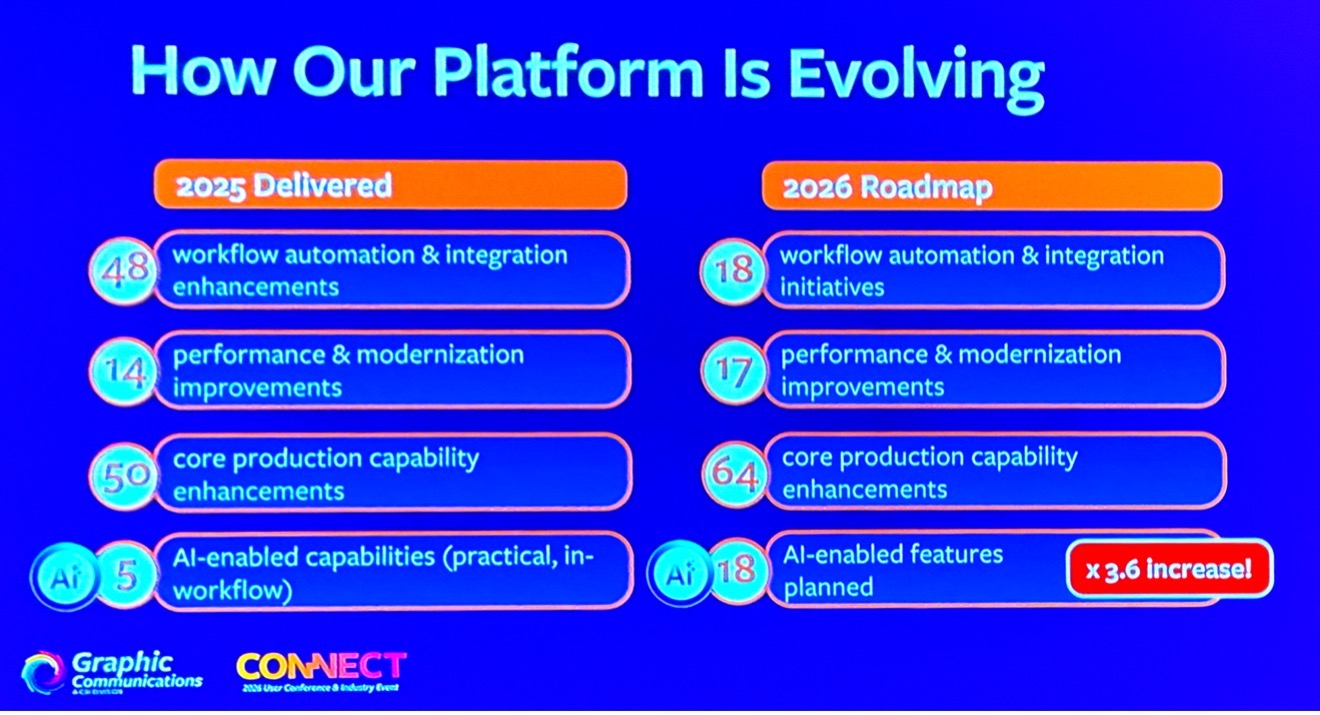
In 2025, they “sort of put our toe in the water with AI.” They used it as a solution for some of their internal purposes, and to learn how and what they could do with it. For example, they have been using AI to help developers code faster. They are also starting to use AI to develop automation test suites so they can run QA faster, more efficiently, and more thoroughly. They also started, in a few select areas, to develop some AI technologies for their products. Roughly five of the major features that were delivered in 2025 used AI specifically in the products.
Going forward in 2026, about 18 of the major features that are planned are workflow, automation, and integration improvements. Another 17 or so are performance improvements, modernization, as well as some continued development in core features. One of the tradeoffs they made in 2025 by spending so much time and energy on the integration and workflow improvements was in core capability development, and they expect to bring development attention back to that.
However, the biggest increase in development will be in the area of AI. They have 18 AI-enabled features planned for this year. Ultimately, they don’t want to be integrating AI for the sake of AI, but want to help deliver the value that their customers need for their business. While they didn’t disclose specifics, “there’s a lot of really interesting stuff” that they are talking about, and in the individual product focused sessions they were providing some hints in direction.
While this was the platform overview, there are also individual roadmap specifics for each of the products, including PrintSmith Vision, Pace, Nubium, Monarch, iQuote, MarketDirect Storefront, Tharsten, Technique, and Avanti and a new packaging suite, although generally each of them follow the same development direction. So if you look at what was delivered in 2025 and the focus of what is proposed for 2026, it gives you a real understanding of where they want the platform and products to go. Although, they constantly reiterated their desire for customer feedback, which is why they added the Aha Ideas Portal and the Genie.
In Closing
The print and packaging industries have been evolving and will continue to evolve with developments in technology and markets. While there are many expo events that present new equipment and solutions, CONNECT is a really focused event to learn about how you can help mitigate those changes and even leverage them to increase your revenues and profits.
More to Come…
I would like to address your interests and concerns in future articles as it relates to the manufacturing of Print, Packaging, and Labels, and how, if at all, it drives future workflows including “Industry 4.0 and 5.0.” If you have any interesting examples of hybrid and bespoke manufacturing, I am very anxious to hear about them as well. Please feel free to contact me at [email protected] with any questions, suggestions, or examples of interesting applications.