By David Sweetnam and Mark Boyt, Keypoint Intelligence
The print industry has reached a moment where robotics is no longer a distant concept. For years, these systems were seen as relevant only to automotive or electronics manufacturing. That view is changing quickly. In many production environments today, a robotic arm may be lifting boards onto a flatbed, stacking finished books, or moving printed textiles into drying tunnels or fold and pack stations. More print providers now see robotics as a practical way to address labor shortages, eliminate workflow bottlenecks, and maintain consistent output across long shifts.
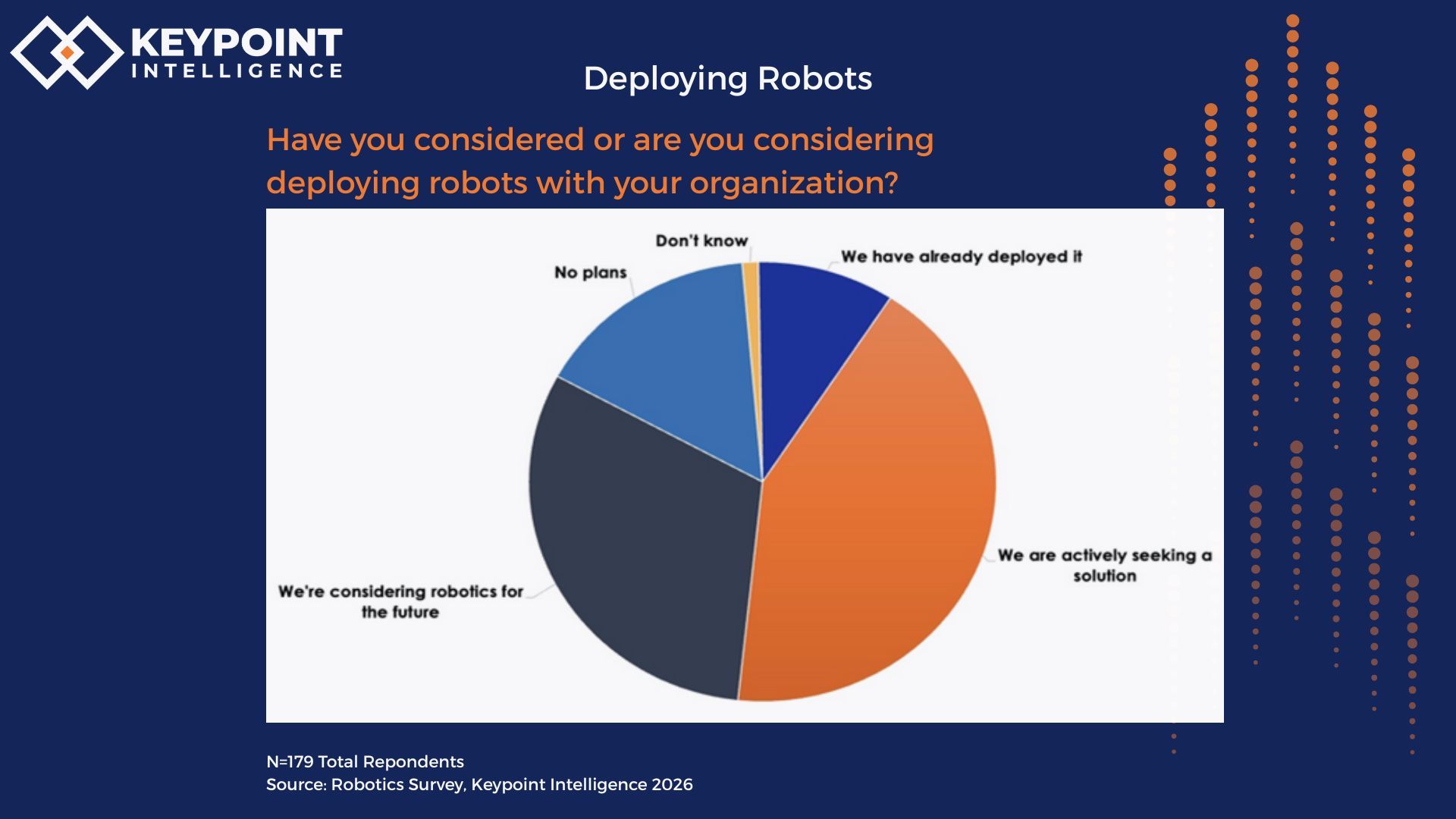
Even with this momentum, the industry still has essential questions. Who is adopting robotics? What goals are driving investment? And where do the biggest barriers remain? Keypoint Intelligence is launching a global study to answer these questions using input from commercial printers, converters, label operations, packaging producers, and wide format shops.
Why Robotics Is Gaining Momentum
Productivity has become a defining pressure point. Press speeds continue to increase, but the surrounding tasks such as loading substrates, unloading stacks, inspection, and material movement often slow the process and require skilled labor. Robotics streamlines these repetitive steps so people can focus on work that requires judgement and experience.
Across conversations with print providers, four themes appear most often.
Labor shortages remain a constant challenge: Skilled operators are difficult to recruit and retain. Robots can take on heavy, repetitive tasks and run overnight, giving shops more resilience and reducing physical strain on teams.
Predictability drives higher productivity: Automated loading, unloading, and palletizing reduce pauses between jobs. A flatbed with robotic board handling or a bindery line using automated pallet loading typically sees smoother throughput and more sellable output.
Quality improves when repeatable steps are automated: Robots do not fatigue or lose focus. With vision systems and precise grippers, alignment stays consistent and substrates are handled gently. When paired with AI-driven inspection, defects are caught earlier and quality control becomes more reliable.
Short-run and mixed-volume environments benefit more than expected: Modern robotics platforms adapt quickly to frequent job changes. This flexibility suits signage, corrugated, textile, and other markets where formats and run lengths shift throughout the day.
The Economics Behind the Investment
For most adopters, robotics is not about eliminating jobs. It is about helping the existing team produce more with fewer interruptions. Many operations report saving the equivalent of one or two full-time roles per line while improving uptime. Even small boosts in utilization can deliver significant annual margin gains. Early adopters also note that payback periods are often shorter than expected once workflows stabilize and operators gain confidence with the system.
The Barriers That Still Hold Businesses Back
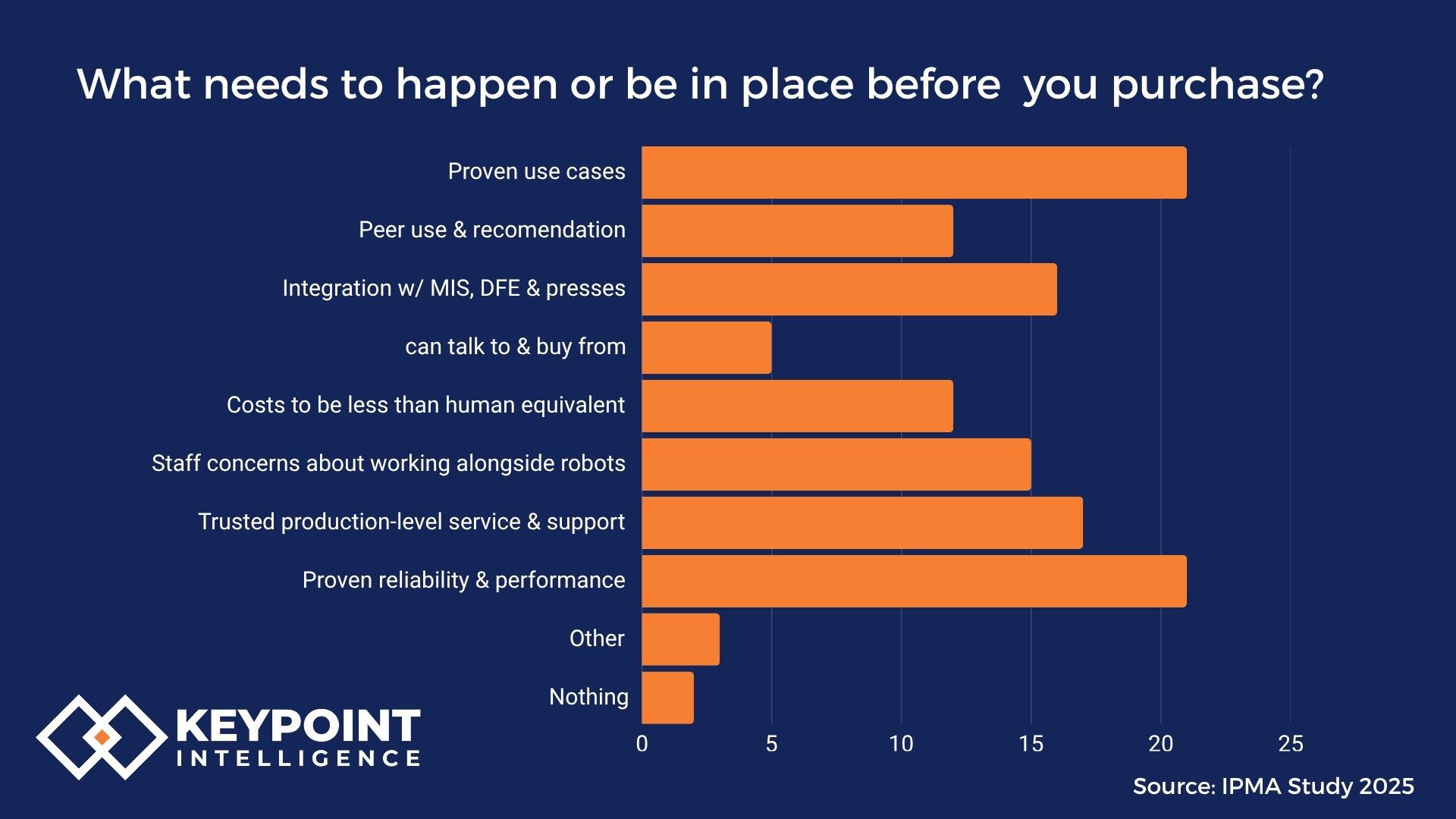
Robotics is expanding, but it is not yet standard across print. The chart below highlights the top concerns expressed by print providers. The common thread is trust. Buyers want proven use cases, proven reliability, peer recommendations, and partners who understand print workflows rather than general automation. They need to know the system will work in their environment, deliver measurable ROI, and come with dependable long-term support. These expectations present a significant opportunity for OEMs and workflow providers to close the trust gap and demonstrate real-world performance.
Your Experience Matters
The upcoming Keypoint Intelligence global robotics study will examine adoption trends, investment plans, motivations, obstacles, ROI expectations, and lessons learned. Wherever you are in your automation journey, your perspective matters. If robotics is already part of your workflow, we want to hear what you have learned. If you are evaluating it, your questions are important. And if robotics is not under consideration, your reasons provide essential industry context.
Help shape the industry’s next chapter. It takes just 15 minutes to complete the survey and, in return, all respondents will receive $80.
About the Authors
David Sweetnam, Director of Research and Lab Services EMEA/Asia
David has over 21 years of experience in the imaging industry, spanning lab analysis, research, and technical services roles in the USA and Europe. He established Keypoint Intelligence’s European lab in 2007 and has led its growth ever since. Earlier in his career, he advised corporate and public sector clients on office imaging and software solutions. David holds a Bachelor of Science in Chemistry from the University of Reading.
Mark Boyt, Principal Analyst Production Workflow Software
Mark Boyt is the Principal Analyst for Production Workflow Software at Keypoint Intelligence, where he examines market trends, evaluates emerging technologies, and provides practical guidance to help clients optimize their production workflows. His expertise draws on years of leadership in software marketing and automation, including his role as Global Head of Software Marketing at Xerox. Known for translating complex software concepts into clear, actionable strategies, Mark brings a strong blend of technical insight and market experience. He is based in the UK.