By Advanced Printing Technology Centre (APTEC)
Calibration is an indispensable step in today’s print production workflow, especially in the area of color management. Within the entire color management process, calibration is the first step, and it is particularly critical for ensuring color consistency and accuracy in the printing production process. Calibrated equipment can maintain consistency when printing various materials, ensuring that the printed products meet customers’ high-quality requirements.
Calibration requires adjusting the color settings of printing equipment such as printers, monitors, and cameras to ensure that the correct colors are consistently produced every time. Therefore, calibration is an important process for fine-tuning the colors of the equipment, allowing for consistent and accurate color reproduction each time the equipment is used.
Calibration is usually performed in two ways:
- Changing the output control or settings of the equipment
- Outputting application curves
The objective of calibration is to keep the equipment stable and consistent when outputting colors, so calibration is often used as a method to control and monitor the daily production of the equipment.
Calibration is to adjust the equipment to an optimal, quantifiable, and repeatable state. Calibration should be quantifiable, meaning that measurement instruments, such as spectrophotometers and spectrodensitometers, need to be used during the calibration process. If calibration is measured using instruments and achieves quantifiability, it indicates that the same optimal state can be repeatable, which is very important because when equipment has a high utilization rate, parts will wear out and cause deviations in printing. Quantitative data can be used to recalibrate the equipment to restore it to a previously recorded and optimal state. Therefore, calibration by using measurements is currently the mainstream approach.
Calibration of Prepress Equipment
Monitor Calibration:
- White Point (Color Temperature): The unit of color temperature is Kelvin (K); lower color temperatures are reddish, while higher color temperatures are bluish. Different light sources yield different effects: D50 (5000K) is warmer, and D65 (6500K) is cooler. A color temperature of 6500K is the standard for general computer use, as well as the standard color temperature for sRGB. D50 (5000K) is the standard color temperature used for printing or publishing.
- Brightness: The brightness setting of the monitor affects how light or dark images perform. A brightness of 120–140 cd/m² is typically used.
- Gamma: This refers to the brightness of midtone. A lower gamma value displays brighter images, while a higher gamma value results in darker images with higher contrast.
Calibration of Digital Proofing Systems
The digital proofing calibration process requires adjusting the configuration between ink and the substrate, such as ink coverage settings and drying conditions, requiring specific ink volume for each color and overprint. Additionally, it is important to ensure smooth gradations and tonal transitions, using test charts of 5% or 10% for adjustment. Upon completing calibration for each device, it is necessary to record data for each device, including ink, substrate, and RIP software settings.
Calibration of Press Machine
During the press calibration process, it is essential to understand data such as the adjustments of the water roller, ink roller pressure, rubber blankets, paper backing adjustments, and fountain solution configurations. There is also a need to understand the target parameters for press calibration, such as substrate and solid inks (including primary colors and overprints). The LAB color values for different substrate types vary, and the tone value curves (TVI) differ for various substrates, which should be paid attention during calibration.
Apart from TVI and near-neutral calibration method, Color Tone Value (CTV) is another effective calibration method. It can eliminate the need to consider different tone value curves for various substrates, as CTV employs a linearization approach that does not calculate dot gain, but rather directly reproduce the original tone value (e.g. 50% tone in the file equal to 50% dot in printing), reducing errors caused by incorrect tone value target curves. CTV can be used for any printing methods, any materials, any screening method, 4C and even 7C printing. APTEC had conducted extensive press runs for CTV. The printing companies reflected that CTV can help to improve efficiency especially shorten the make-ready time and can lead to better print quality.
After calibration, all relevant data must be documented in detail. When color deviations occur, these data will be the crucial basis for inspection and calibration of press machine, enabling quick corrections.
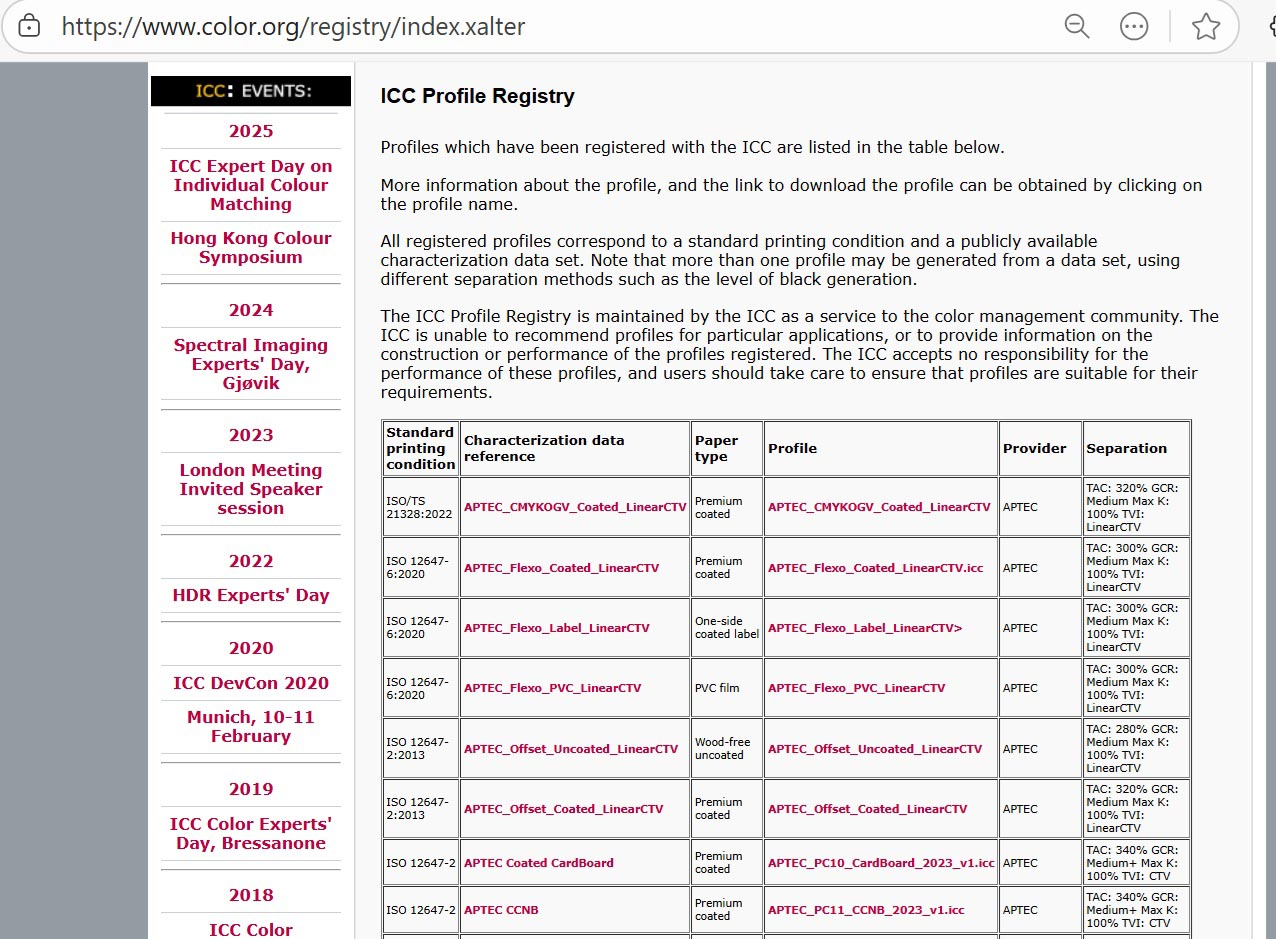
Once the equipment with various substrate have been calibrated, the next step is characterization, that is the creation of ICC profiles. APTEC had created eight ICC profiles/characterization datasets by using CTV for offset and flexography and have been uploaded to ICC website (https://www.color.org/registry/index.xalter).
- Offset – CCNB (Clay Coated News Back)
- Offset – Coated white board
- Offset – 7C (CMYKOGV)
- Offset – Coated paper
- Offset – Uncoated paper
- Flexography – Coated paper
- Flexography – Label
- Flexography – PVC (Polyvinyl Chloride)
For more information, please visit:
CTV: https://www.ctv-aptec.org/en/
APTEC: https://www.aptec.hkprinters.org
Next in this series: CTV in offset.