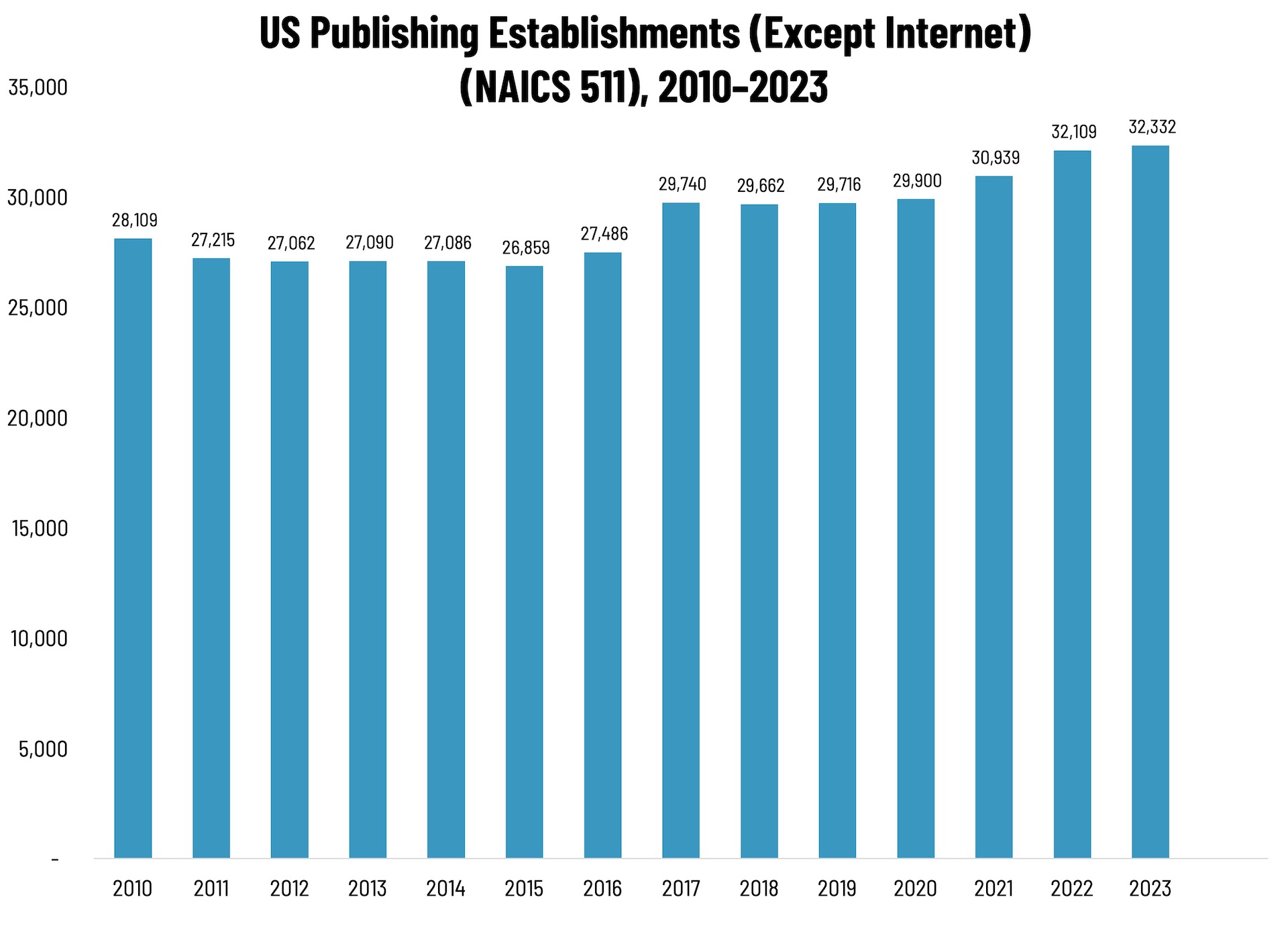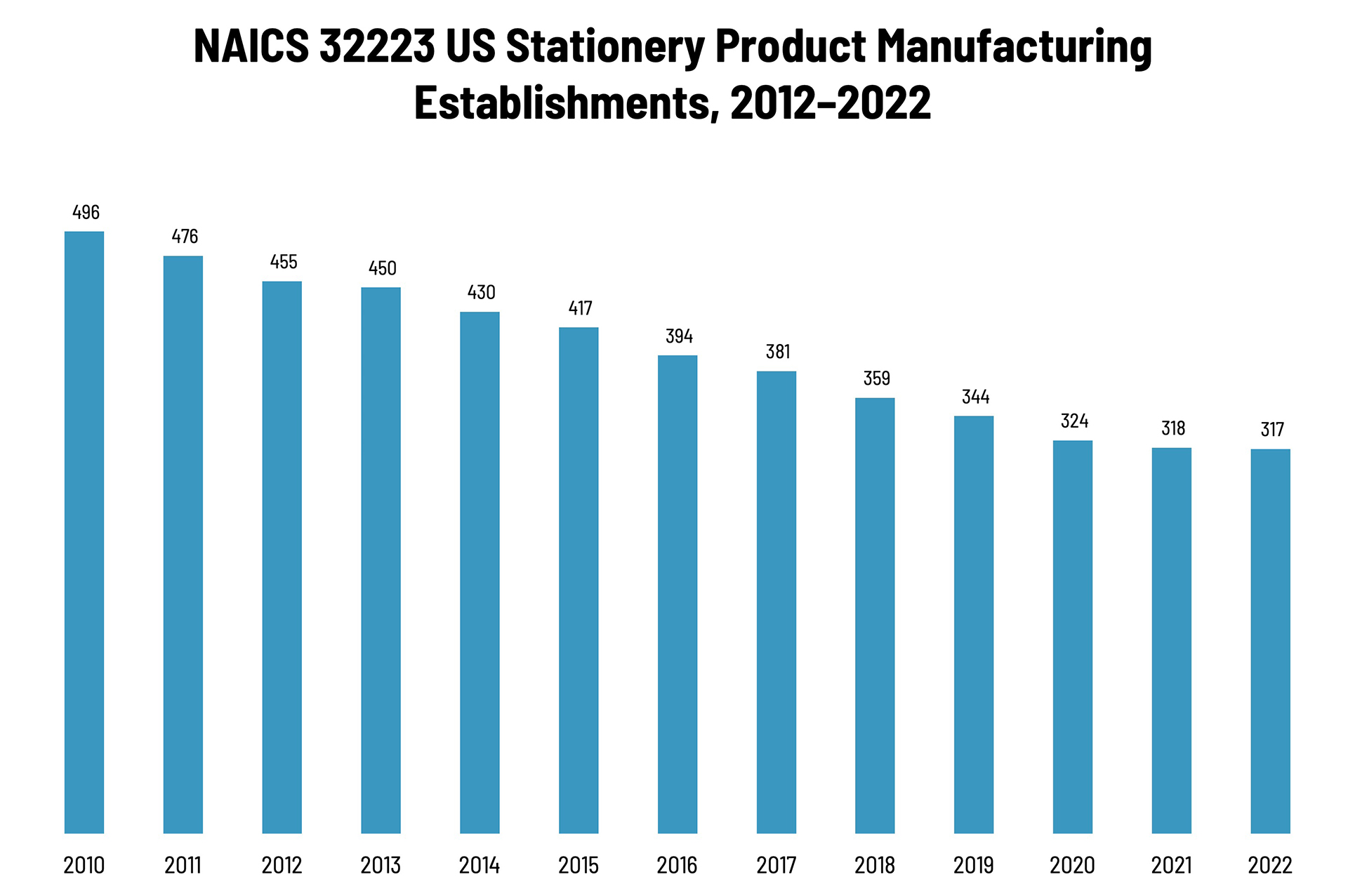
According to County Business Patterns, in 2022, there were 317 establishments in NAICS 32223 (Stationery Product Manufacturing). This NAICS category has declined steadily over the course of the decade.
The Bureau of the Census definition for this business classification:
This industry comprises establishments primarily engaged in converting paper or paperboard into products used for writing, filing, art work, and similar applications.
Think about how much stationery you use these days and you can probably explain much of the decline in this category. Still, it was circa 2016 that industry watchers had been noting a renewed interest in stationery and related products. Said Stationery Trends magazine in 2016: “There is a strong resurgence in consumers’ passion for stationery and specialty paper products. From journals to cards to prints, the written word and personal sentiments are returning stronger than ever—and in new ways.” Traditional print greeting cards remain fairly strong (a common theme of them has been “I got you a real card” although were seeing less of those these days) while LEDs, audio, and other electronic/rich media elements have made their way into printed greeting cards.
Journals with unique uses also stand out, from blank journals, to travel diaries, self-exploration journals, and journals that track family memories have been trending subjects. For fitness buffs, “workout diaries” (“WODBooks”) are also popular items. The classic Moleskine notebook had a resurgence mid-decade and pictures of note-filled Moleskines are shared on social media.
Although these data points are a few years old (as is typical for CBP), it is interesting that the decline in these establishments slowed in the post-pandemic years.
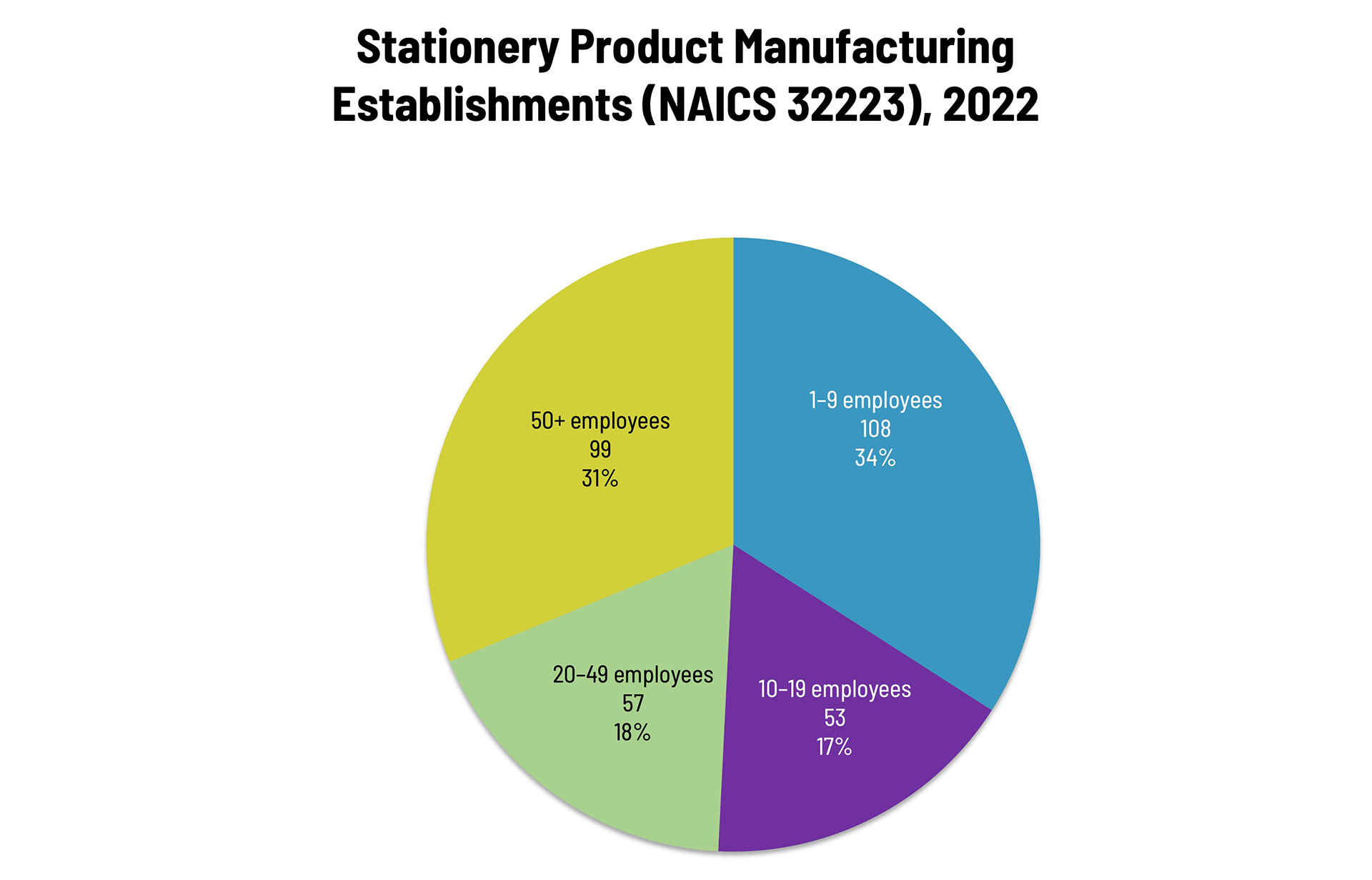
Establishments in this category are pretty evenly distributed. Small stationery product manufacturers (1 to 9 employees) account for 34% of all establishments, large manufacturers (50+ employees) account for 31% of establishments, and mid-size establishments (10–49 employees) account for 35%.
These counts are based on data from the Census Bureau’s County Business Patterns. Every other week, we update these data series with the latest figures. These counts are broken down by printing business classification (based on NAICS, the North American Industrial Classification System).
Next up, we’ll continue through the converting NAICS categories:
- 32229 Other Converted Paper Product Manufacturing
- 322291 Sanitary Paper Product Manufacturing
- 322299 All Other Converted Paper Product Manufacturing
To clarify what is included in the 2022 CBP, establishment counts represent the number of locations with paid employees at any time during the year. If an establishment existed at any point during the year, it would be included in the CBP count of the number of establishments for 2022 CBP.
These data, and the overarching year-to-year trends, like other demographic data, can be used not only for business planning and forecasting, but also sales and marketing resource allocation.
This Macro Moment…
One of the consequences of the ongoing government shutdown is the lack of government data releases and—of more concern—actual data collection. Econbrowser highlights the data releases we have already missed, what else we are likely going to miss, and what the impacts may be.
The macroeconomic betting market is predicting a 34.5-day shutdown, which means it will run through November 3–4. Ergo:
At this rate, of the NBER BCDC [Business Cycle Dating Committee] key variables, we will miss consumption and personal income, and the August manufacturing and trade industry sales releases, as well as the Q3 advance GDP release. We’ve already missed the employment situation and industrial production releases.
… One question is whether we will ever get the October employment situation release, given that interviews were to be undertaken this week, for last week’s reference period. Unlike the case of the CPI release, there’s been no stated recall workers to conduct the surveys for the employment situation release.
As for the CPI release, Marketplace adds:
there will be a delayed version of the Labor Department’s Consumer Price Index this Friday [i.e., today].
…“The Bureau of Labor Statistics, the BLS, which puts out the CPI, their operations have essentially been curtailed,” said Liz Ann Sonders, chief investment strategist with Charles Schwab, a Marketplace underwriter.
Sonders said the big concern is government workers haven’t been collecting price data this month. Same goes for jobs numbers.
Of course, the worst-case scenario beyond simply not having data is that the data may not be reliable. And if the various players in the economy are skeptical of the quality of government data, that’s a bad thing.
“If we don’t know what the quality of the data will be. Maybe it’s good, but maybe it’s not. Well, that’s uncertainty. That’s risky,” said Laura Veldkamp, a finance professor at Columbia University.
That can cause companies to freeze up.
“What firm wants to say, ‘Let’s engage in a risky and costly new investment project, that has uncertain rewards, in an environment where you don’t have clear information about what the current state of the economy is,’” said Veldkamp.
She said that’s why unreliable data can take a toll on the broader economy.
As we said above, “These data, and the overarching year-to-year trends, like other demographic data, can be used not only for business planning and forecasting, but also sales and marketing resource allocation.” To accurately plan a business and forecast, as well as allocate sales and marketing resources, you need accurate data. This applies to the economy as a whole. Operating in the dark is a recipe for economic disaster.