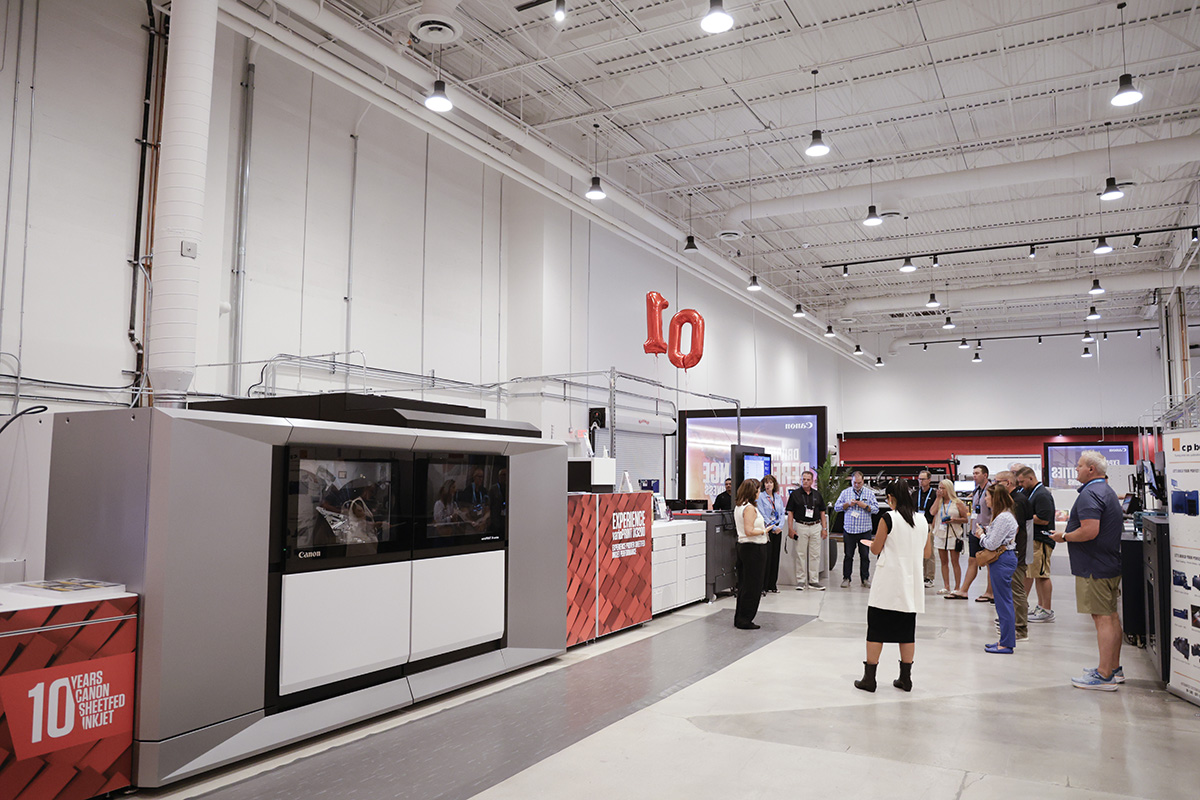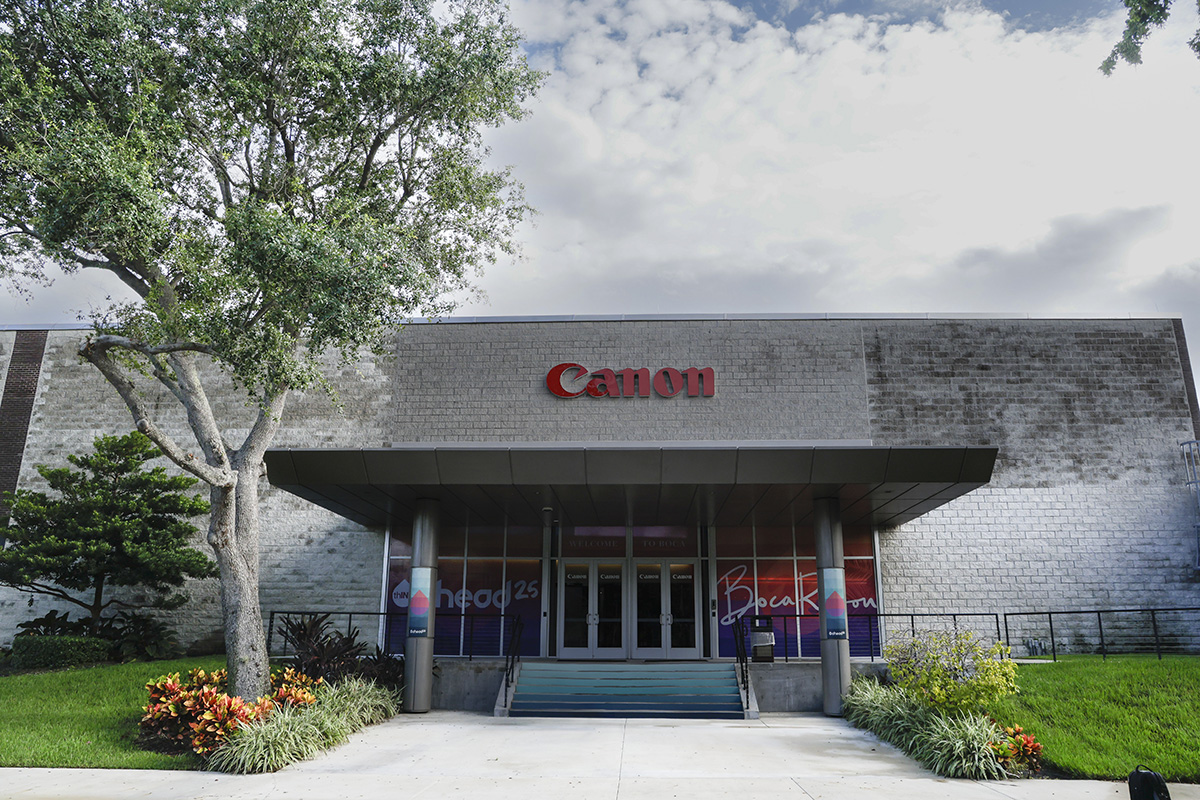
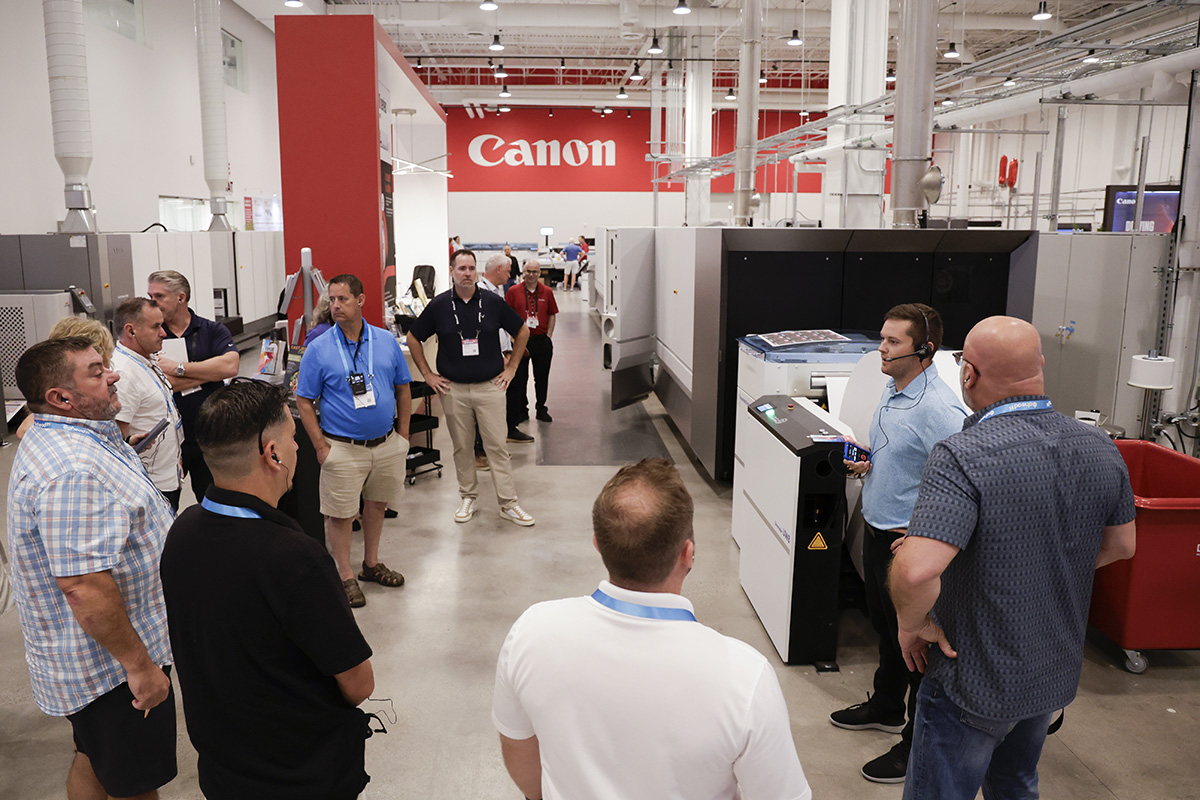
Canon’s service training facility in Boca Raton, Fla.
We spoke with Robert Reddy, Senior Vice President Sales, for Canon U.S.A., Inc. about the desire for print businesses to diversify into new applications, the evolution of Canon’s service program, and the company’s—and customers’—outlook as we head into PRINTING United.
WhatTheyThink: Let’s start with the old chestnut question, what do you see the latest trends and how have they changed over the last couple of years—if they in fact have?
 Robert Reddy: That’s a great place to start. What makes it such a broad question—especially in light of my new role—is that the pace and nature of change can vary significantly between segments, like large format and production print. However, one thing that’s consistent across the board is that customers continue to seek growth, innovation, and competitive advantage. But I would argue that the pressure to change has increased really in the last year or two. I find through discussions with customers that the desire to change seems more urgent than it has been in the past. That could be because their current business is under attack because things are changing, but I think most of the forward-thinking customers just see real opportunities because the buying habits are changing for customers, the applications are changing. There’s no doubt that as more and more applications become digital, it creates this opportunity for businesses to look at what they’re doing. We have a lot of customers that are looking to diversify and offer new applications. But I also talk to customers that are not looking at anything new. They’re just looking to get better and better at what they’re doing today because there’s no question the turnaround times get shorter every year. They used to have five days or a week, now they want it printed and sent out tomorrow. Across all the different segments that we support, the desire is to do things faster. If you’re a transactional printer doing statements, you still have cost pressures as costs go up, whether it’s media, postage, or something else.
WTT: And of course the perennial labor shortage plays into all that as well.
RR: Labor is a huge part of it. Finding enough good quality people is hard, but this is nothing new. We’ve been talking about this for years. But how it manifests itself, whether it’s AI discussions—a year ago we never would talk AI in a sales call, and now AI is in almost every sales call. I’m not convinced anyone has great answers yet. We are also having an increase in automation discussions. At thINK Ahead 2025, we showed some new automation on the large-format side for the Texas printer, and it’s amazing how much attention it drew.
We also have discussions with customers about automation and third parties, and being knowledgeable not just about your own product but also being knowledgeable about the things that plug into your system. Every year we see more and more that you have to be an expert not just on what Canon makes, but on third-party products, whether it’s hardware or software, and really understanding people’s businesses. I’ve been saying this for a few years with my sales teams, but it’s critical to be able to demonstrate to the customer that you can help them support their business. The days of just having information in Salesforce being enough are over; it’s about applying that information. Understanding the whole ecosystem of the end user and figuring out what they want and how to best support that is the important thing.
The exciting part from our side is that any time there’s change, it’s good. As a supplier to the industry, we want change. If everything was the same and nothing changed, people would keep things forever and they wouldn’t buy equipment.
I do love the idea of learning more about our customers’ businesses, and what we can do from a product standpoint. And I use the term “product” very generally, because I believe that “service” is actually the number one product we sell. The hardware is secondary. And I do think customers are interested in having those discussions on how they and Canon can partner together so that they can be more competitive in the marketplace.
WTT: It seems a part of that how you’ve configured, for example, the Colorado and the Texas to help users get into packaging and wallcoverings and things like that.
RR: There’s no doubt, and it’s been fun to watch that. The Colorado is so well-positioned for décor or wallcoverings especially. Watching wallcoverings explode has been fantastic, but it’s also been wonderful watching them grow their business because of the capabilities that Colorado has brought to them. What else can we do? What other medias, what other applications can you find? And we go back to our users and say, “Good news, you’ve already invested and these are the things you can do.” It’s just understanding new applications and then educating our customers on it. And we’ve got customers who are using the Texas to start doing a lot of small-run custom packaging type applications. It’s been exciting to watch that product really take off. The days of how fast can you produce a banner are over; more likely it’s “what else can I do with this investment that I've made?”
WTT: The Arizona UV flatbed also is a part of that.
RR: Yes, the Colorado, the Texas, the Arizona very much fit in that. It seems like every day I hear about a new application someone’s figured out that you can do on it. One of the most fun parts of having a flatbed portfolio is watching people come back to us and saying, “Hey, now look at what I’m doing.” We’ve got a customer who prints on little plastic rings. It’s amazing to me that when we talk about large format, a lot of times the output is not large. From a Canon perspective, it’s part of the reason we went through this big reorganization is that we had a large-format group, we had an inkjet group, we had a toner group, and merging all three is the concept of Canon solutions. What we’re doing with the production technology group is trying to optimize how we go to market for our customers. Some of it is eliminating customer confusion, some of it is productivity, and some of it is just making sure that the customer knows all the things that Canon does.
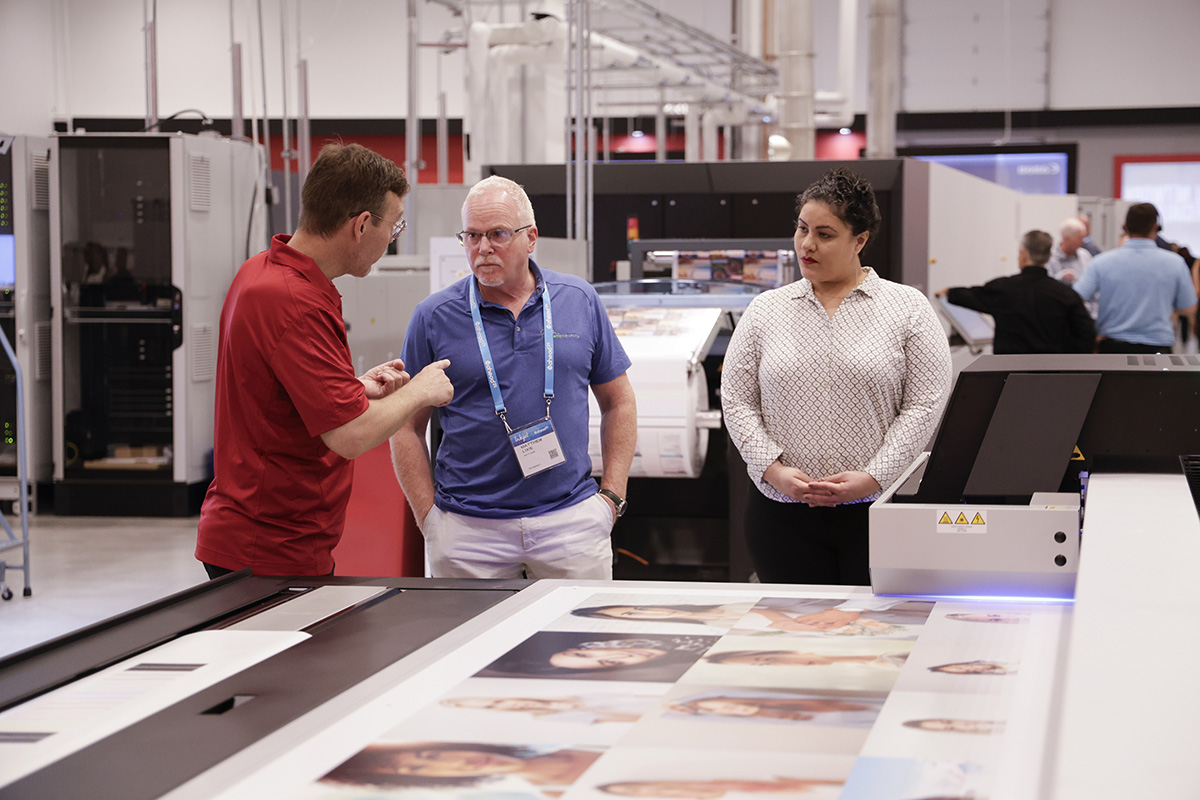
WTT: You had said that “service” is also a major Canon product. One of the big pieces of news that came out of thINK were the newest service plan options for inkjet customers and the new service training facility.
RR: Uptime is always an issue, but especially since I took over the production side, I’ve made a lot of calls to customers and every discussion we have is about service and uptime and what can we do. I think there are a lot of reasons for that. As I said, turnaround times are shorter. Customers are looking to do more with less as far as equipment goes. Some of it is the consolidation of multiple units into one. We also understand that one service organization—one size—does not fit all. You’ve got customers that have dedicated service people in their shop, and then you have some customers, such as a bank, doing transactional printing and that’s the last thing they want to do. They don’t want to touch it. So as an organization, we’re trying to find ways to come up with different plans, not just sell vanilla and chocolate, but a little bit of strawberry and Rocky Road as well. So we developed new service options, and there are three parts to it. The first is the Operator Pro program, which is where we train the operator to do some of the preventive maintenance themselves, which allows them to do it on their schedule. We know that the equipment runs better when there’s preventative maintenance. On the other hand, when you do preventative maintenancethat means we’re taking the equipment down. So when we talk about turnaround time and uptime, it’s the battle we always have. We’ve got a lot of data that shows that uptime isn’t just about the technician. It’s also how the operator uses the equipment, the environment it's in, all sorts of things. So it starts with having an operator who can do a little bit more and really understands the equipment.
The next level up from that we is the Customer Technician program, which provides training where the operator can handle some of the common service issues. We put parts kits onsite, they have help desk support, and there’s local service available if they encounter something they can’t manage. So it's kind of a “partial” as far as doing some of your own service.
The highest level of customer commitment would be a self-maintenance program where they really take it all on themselves and they become a service center for the product themselves. A lot of our customers have that capability. We’ve seen it on third-party products. It’s also sometimes used in more remote areas—it’s hard to have a dedicated service technician in some parts of the country.
These programs benefit the customer in that they provides growth paths for their operators. As they learn more about the equipment, it allows them to feel like a greater part of this partnership and take on more control.
We also just opened up a new service training facility in Boca Raton, Fla., to support the customers and technicians that are going through the training. Our vision is that, whether the customer is providing certain portions of labor or a Canon employee is, nothing really changes. They have the same data, the same training, the same support. It’s really just a function of who does a customer feel is the best person for executing on this? And we’ve got some really great companies helping us. We don’t want to tell a customer how to do it. We want a customer to work with us, and we have the programs that are right for them. I think it can help customers experience increased uptime and potentially lower some costs on that side.
WTT: Finally, what's the general outlook both from Canon as well as Canon customers? Is there optimism? Concern?
RR: When talking with small and mid-sized business owners, they tend to be realistic and grounded. There’s always something on the horizon—an upcoming election, changing in regulations, or shifts in the market—that keeps them cautious. That said, it does feel like an interesting year. We’ve seen a lot of change—0 whether it’s trade policy, cost fluctuations, or supply chain dynamics. Economically, it’s a bit of a wait-and-see moment for many. But there are positive signs: we're seeing some volume increases and even some production that had been offshored starting to return to the U.S., which is encouraging for us and our customers.
Ultimately, I think most of our customers are actually pretty optimistic, but understand that pressure to change, that desire to do something new. They want to become more competitive. They want to find ways to squeeze costs and increase productivity in what they’re doing. From a Canon perspective, I don’t remember a time we’ve been more optimistic in what we’re doing. Which is a little bit scary, because with optimism comes big expectations.
A lot of it starts with people. We’ve really invested in people over the last 5, 10, 15, 20 years. And from a technology perspective, we’re excited. As I said, we’ll see a new large-format product [at PRINTING United], which is not just an innovative product, but new technology. We also have the the varioPRINT iX1700 at PRINTING United. We’ve already announced a new B2 press, the varioPRESS iV7 coming out next year, and we’re also making investments in labels and in packaging and in other high growth areas. Over the last couple years, we began a period where almost every product has either been refreshed or is brand new. So it’s a very exciting time for Canon technology.
We strive for innovation. We are very excited about new products. Canon has a lot of great things coming that we’re excited to offer our customers to help them meet new challenges. And when we help our customers do well, their volumes grow, which then helps our volumes grow.