By Shivam Gusain, Founder, Decypher
Corporate climate pledges have become the ambient noise of our time. They flash across reports and websites like antivirus pop-ups on a machine already infected. Beneath these declarations of responsibility lies a deeper failure, not just in implementation but in architecture. The system itself is misaligned. Emissions are not the core virus. The real malware is the logic that governs the system: delay action, externalize risk, and protect short-term performance at all costs.
This logic is not confined to press releases or sustainability reports. It lives inside the financial DNA of the modern corporation. It is encoded in accounting standards, earnings calls, executive incentives, and the quiet compulsion to maximize returns within the current quarter. That logic has remained untouched even as pledges proliferate. And so, year after year, companies continue to degrade planetary systems while producing the illusion of progress.
What enables this illusion is not just language. It is accounting. It is the way corporate value is measured and presented to the world. A company can release millions of tons of carbon and still report a strong quarter. Its emissions may be noted in a footnote or sustainability appendix, but they have no impact on the core financial statements. They do not reduce the profit line. They do not threaten dividends. They are treated, at best, as external context rather than internal cost.
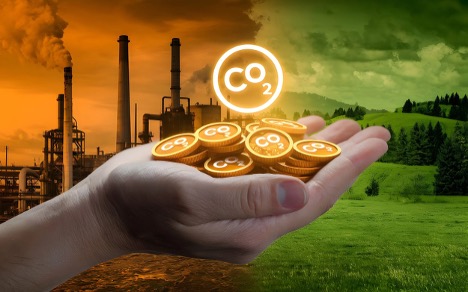
This is a form of fantasy that markets have accepted as normal. We have allowed balance sheets to remain clean by allowing the atmosphere to absorb the mess. The true cost of emissions, including rising climate volatility, infrastructural strain, and ecological disintegration, has been rendered invisible to the one audience that matters most in this system: capital.
Until this illusion is broken, the pledges will continue to fail. Not because companies are insincere, but because they are incentivized to perform concern while preserving advantage. What we need is not another layer of voluntary targets. What we need is a line item.
Imagine if every company was required to report not only their earnings but also a second number alongside it, a carbon-adjusted profit figure. This number would simulate the cost of their emissions using a standardized carbon price. It would not be theoretical. It would be calculated, verified, and placed within their official financial disclosures.
No penalties. No new taxes. Just visibility. Cold, sharp, unavoidable visibility.
This would not require belief. It would not rely on virtue. It would simply let investors and markets see what has been hidden. And once they can see it, everything else begins to shift.
The beauty of the financial system lies in its simplicity. Profit is profit. Risk is risk. Disclosure is disclosure. What enters the system with credibility becomes the basis for action, for investment, divestment, pricing, credit, and capital allocation. The problem with carbon is that it has remained conceptually urgent but financially irrelevant. It has not been priced into the core machinery of decision making. It sits in a parallel world of ESG frameworks, impact reports, and reputational assessments. These are soft metrics, often unaudited, and easily ignored.
But imagine something different. Imagine carbon exposure being integrated into the very fabric of financial reporting. Not as a side note. Not as a footnote. But as a requirement.
Under this proposal, every company would be obligated to include a carbon-adjusted profit and loss line within their quarterly and annual filings. This figure would be calculated using a globally standardized shadow price for carbon, for example, $200 or $250 per ton of carbon dioxide equivalent. The number would reflect the full life-cycle emissions of the company’s operations, supply chains, and products. It would be audited independently, just as revenue is. And it would be published alongside all other key financial indicators.
There is no need to enforce behavioral change. There is no need to ban high-emitting activities or impose immediate penalties. The act of disclosure alone begins to shift the terrain. Because this is not a symbolic gesture. It is a new lens focused on value itself.
By forcing carbon risk into the structure of reported profit, this approach does what sustainability pledges never could. It creates a financial map of climate exposure, legible to the actors who move markets. Boards cannot ignore it. Shareholders cannot disregard it. Ratings agencies must respond to it. Banks must factor it in. Investment committees must begin to weigh it.
This is not a climate policy disguised as accounting. It is an accounting reform that restores climate reality to the language of finance.
- Carbon, in this model, becomes not just an externality but a form of financial gravity. Invisible before, suddenly present. Pulling value downward, distorting balance sheets, and ultimately reshaping the flow of capital not through regulation but through recognition.
- Markets do not require moral imperatives to act. They require data. They require comparability, materiality, and risk-adjusted visibility. Once carbon-adjusted financials are made mandatory, that visibility arrives with unmistakable force. And the system, trained to chase returns and minimize risk, begins to rewire itself.
A company that once appeared efficient may now look fragile. A firm that boasted record profits may now reveal those earnings to be deeply carbon-dependent. A high-performing fund manager may discover that a significant portion of their portfolio is exposed not just to transition risk, but to an unpriced reality that can no longer be ignored.
Investment strategies change. Pension funds, tasked with long-term stability, begin reallocating away from industries that show persistent carbon deficits in their simulated profit models. Banks tighten lending criteria. Insurers increase premiums on emission-heavy assets. Procurement departments, especially in large institutions and governments, begin weighting carbon-adjusted profitability in vendor decisions. None of these outcomes are mandated. They are simply possible.
This is how change occurs in systems governed by capital. Not through confrontation, but through internal contradiction. Carbon-adjusted reporting does not tell the market what to do. It tells the market what it has refused to see. And once the numbers are exposed, the system does what it always does in the face of risk. It moves.
And in that movement, something remarkable begins to happen. Clean business models start to outperform; not because they are virtuous, but because they are less exposed. Low-emission operations become more attractive; not because of pressure, but because of price. This is not about rewarding good behavior. It is about recalibrating what good actually means.
What the carbon-adjusted disclosure hopes to accomplish is subtle but seismic. It does not force divestment. It does not impose bans. It simply restores a broken connection between cost and consequence. In doing so, it shifts incentives without rewriting them. It asks no one to change their beliefs. It only changes what they can afford to ignore.
No idea that touches capital will go unchallenged. Carbon-adjusted financial disclosure, though it introduces no tax, no fine, no regulation of behavior, will nonetheless be seen by many as dangerous. Not because it overreaches, but because it reveals.
The first line of resistance will predictably be technical. Questions will be raised about carbon pricing variability, about life-cycle calculation methodologies, about sectoral fairness and double-counting. These concerns are not trivial. Carbon accounting is complex. But complexity has never stopped financial innovation before. The global system tracks derivatives with multi-variable dependencies and reconciles currency risk across time zones. It can, if it chooses, track the carbon cost of goods sold.
The second resistance will come from those who sense the deeper threat. The moment carbon is placed inside the financial statement, the game changes. Emissions can no longer be hidden behind offsets or buried in supply chains. They become numbers with weight. Numbers that can be ranked, compared, penalized, and priced. For companies whose profitability depends on externalizing those costs, this visibility becomes existential.
There is also the risk of simulation gaming. Companies may attempt to manipulate their carbon models. Consultants may emerge who promise to finesse the figures. Just as with tax optimization, there will be efforts to shape the appearance of compliance without its substance. But the very act of anchoring carbon risk to official financial reporting raises the bar for scrutiny. Once it is in the books, it is in the crosshairs of auditors, analysts, regulators, and markets.
Perhaps the greatest risk, though, is that this measure will be mistaken for enough. That by adjusting the lens, we have somehow addressed the landscape. This would be a failure of imagination. Carbon-adjusted disclosure is not a solution. It is a diagnostic. It does not reduce emissions. It reveals their true cost. What happens next depends on the willingness of capital, policy, and culture to respond.
But that first act of revelation matters. Because systems do not reform under pressure alone. They reform when their internal logic begins to unravel. This proposal does not demand new values. It does not require an uprising. It simply takes the world as it is and inserts a new variable into the equation, one that makes denial expensive and delay impossible to ignore.
Carbon, once hidden, becomes undeniable.
Not because we forced anyone to look. But because we placed it where no one can afford not to.
That is how the machine begins to change. Not all at once. Not in revolt. But in recognition.
Shivam Gusain, founder of Decypher, helps organizations reduce risk and move with clarity in complex sustainability and innovation landscapes. His work focuses on cutting through noise, identifying blockers, and building the right capabilities to drive impact. If you’re navigating uncertainty or making decisions with long-term consequences, Gusain can help you move forward with confidence.