By Shivam Gusain, Founder of Decypher
(Read Cary Sherburne’s article on the partnership between Arvind and Fashion for Good here.)
What if I told you that the most climate-effective investment in fashion today isn’t a blockchain traceability app, or a next-gen fiber startup, or even a fancy recycling machine, but a wastewater heavy, dye-stained, steam-spewing Tier 2 textile factory in India?
That’s not a rhetorical provocation. It’s math.
Arvind Limited, one of India’s largest textile manufacturers, is building what it calls a “near carbon neutral” wet processing facility, a part of the supply chain typically ignored by brands, underfunded by VCs, and misunderstood by climate advocates. But the numbers behind this factory make it look less like a sustainability initiative and more like a carbon abatement powerhouse.
Let’s break it down.
According to Carbonfact, the average T-shirt made in India emits 8.6 kg of CO2e.
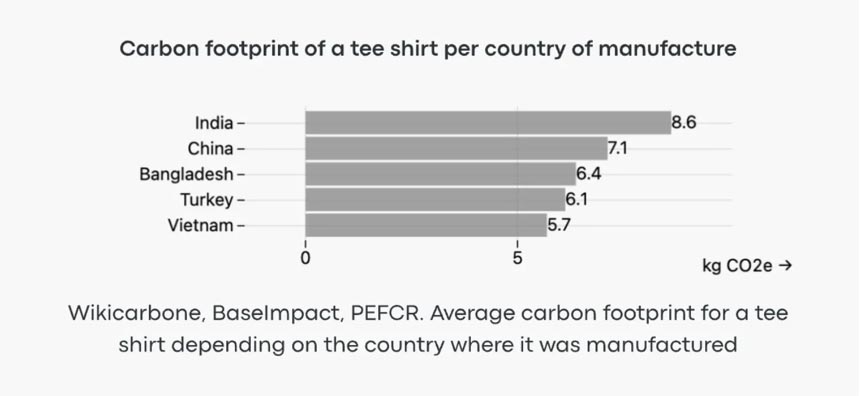
That number might not sound outrageous until you scale it across the billions of garments churned out each year.
Crucially, 53% of that footprint comes from the wet processing stage, where fabric is dyed, washed, treated, and finished. That’s roughly 4.56 kg CO2e per shirt, just from one production step.
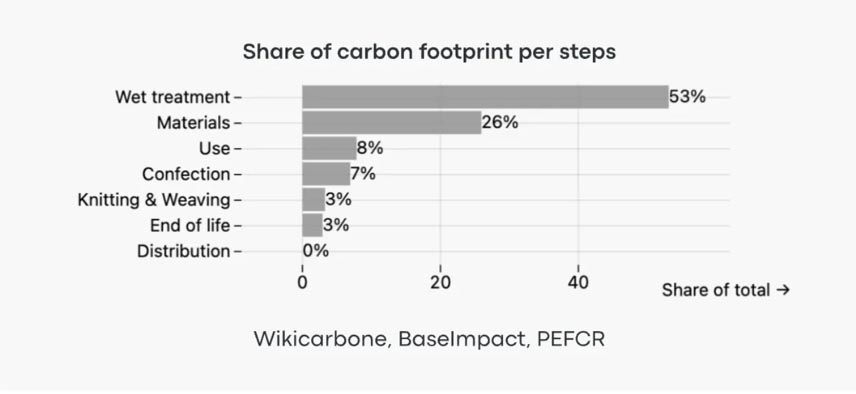
The rest of the emissions make up the remaining 4.04 kg CO2e.
The new Tier 2 facility aims to cut emissions from wet processing by up to 93%, using a portfolio of technologies: low-temperature enzyme pre-treatments, waterless dye carriers, closed-loop chemical recovery, and heat/water recycling systems.
But let’s be conservative. Instead of the full 93%, let’s model for an 80% reduction in wet processing emissions, a more cautious figure to stress test the economics.
With an 80% emissions reduction in wet processing:
- New wet processing emissions = 4.56 kg × 20% = 0.912 kg CO2e
- Total new per-shirt footprint = 0.912 + 4.04 = 4.95 kg CO2e
That’s a 42.4% reduction in total emissions per T-shirt, from 8.6 kg to 4.95 kg CO2e.
The new plant will process 36 million meters of fabric annually. At ~0.6 meters per T-shirt (industry average), that equates to 60 million T-shirts/year, each one saving 3.65 kg CO2e, leading to 219,000 tons of CO?e saved per year.
Building this factory costs €30 million. So: €30,000,000 / 219,000 tons CO2e = €137 per tonne CO2e abated.
Compare that to (purely for context and not as a suggestion that they are interchangeable):
- EU ETS carbon price: €70/ton (and rising)
- Voluntary offset market: €10–50/ton (low quality, often unverifiable)
- Direct Air Capture (DAC): €500–€1,000+/ton (recent Climeworks failure)
- Fashion’s most popular solution (Recycling): €1,000–€1,500
So, yes, €137 per ton is a steal, especially for real on-site supply chain scope 3 carbon reduction.
While climate-friendly wet processing struggles to scrape together €30 million, hundreds of millions are flooding into textile-to-textile recycling, despite its:
- Technological immaturity
- High energy demands
- Narrow feedstock requirements
- Minuscule actual market penetration
- Limited carbon savings compared to the volume of material processed
As I argued in an earlier article, we’re paying premium prices for minimal climate returns. Fashion’s recycling obsession risks becoming a distraction from more scalable, foundational, and systems-based interventions, like this one.
In contrast, Arvind’s Tier 2 solution tackles a known, quantifiable emissions hotspot. It’s not sexy, but it’s shovel-ready and backed by real operational expertise. It's not trying to reinvent the fiber; it's trying to fix how we use it.
Carbon isn’t even the full story. Arvind’s factory will:
- Save 60 liters of water per kilogram of fabric
- Improve wastewater quality
- Create a training ecosystem for workers transitioning into higher-skilled roles—an actual “just transition” in action
This isn’t sustainability theater. It’s industrial climate engineering.
Arvind’s new factory plan raises a fundamental question: Are we serious about decarbonizing fashion, or just funding what looks good on an investor deck?
Because if we’re serious, €137 per ton of CO2 removed at a high-volume industrial scale is a no-brainer. It’s the kind of investment that turns rhetoric into results, and incrementalism into impact.
If fashion wants to be climate-aligned, not just climate-themed, it needs fewer next-gen fibers and more infrastructure plays like this.
- We don't need more hype
- We need more heat recovery systems
- More enzyme pre-treatments
- More waterless dye carriers
- More factories like this…
Because the most effective climate tech in fashion might not be in a lab or a VC pipeline. It is already on the factory floor, waiting for funding.
Shivam Gusain helps organizations reduce risk and move with clarity in complex sustainability and innovation landscapes. Gusain’s work focuses on cutting through noise, identifying blockers, and building the right capabilities to drive impact. If you’re navigating uncertainty or making decisions with long-term consequences, he can help you move forward with confidence.