The market proposition for pre-print corrugated changed drastically with the launch of the T1100S in 2015, featuring a web width of 2.8 metres – a width suited for the most productive corrugators. In its subsequent iterations HP added a fifth and sixth colour (orange and green) and lifted the top speed to 305 m/min or 1,000 fpm - among other productivity and quality improvements.
However, the press has not only an incredible productivity it also has an incredible size. Accordingly, the number of companies able to shoulder the investment and make good use of the productivity is limited. Although some companies, or groups, have multiple presses now, about 20 installations of the T400S-Series and the T-1100S have been made in packaging print so far.
Enter T700i
The Pagewide T700i was announced in 2022 and HP has kept a low profile on the product since. A few weeks after drupa 2024, the T700i was finally launched on July 10th in Würzburg.
[caption id="attachment_7404" align="aligncenter" width="587"]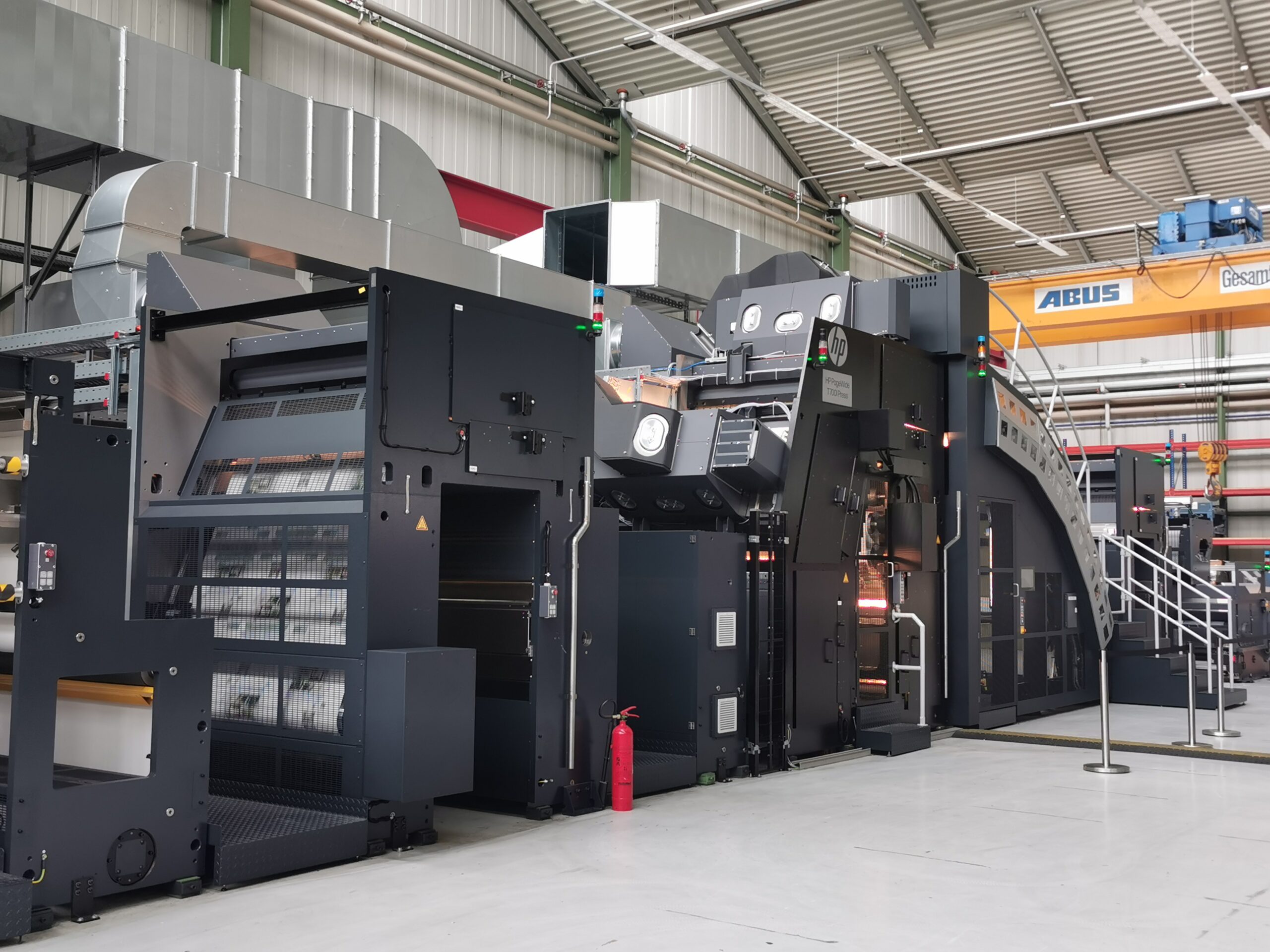 HP T700i in production at launch event[/caption]
In many aspects, the T700i is the smaller sibling of the T1195i, the latest model in the T1100-series. The T700i uses the same inks and inkjet heads as the T1195i, leading to the same resolution, number of colours, and maximum speed. The native 1,200 dpi resolution of the inkjet heads is sampled down to 600 dpi in production. The maximum print speed of 305 m/min is impressive and is reached by very few inkjet presses. This speed was demonstrated at the launch event, however depending on substrates, quality, coverage, and other factors the typical print speed is lower. The built is also similar using an anilox primer station, an arched print unit with driers behind and underneath. Two print bars per colour with 16 heads across the width are used plus the jettable bonding agent. The press features the latest 5th Generation heads, which have the same base specs but a better overall performance than the previous ones. A vision system for press calibration and an anilox overprint varnish follow. Unlike the press at launch, a turret rewinder for non-stop production will be shipped.
The main difference is the reduced width of 1.7 m or 67” web widths, which is well suited to litho lamination applications. Accordingly, the footprint and height of the press are somewhat reduced but still command a dedicated production space.
[caption id="attachment_7403" align="aligncenter" width="646"]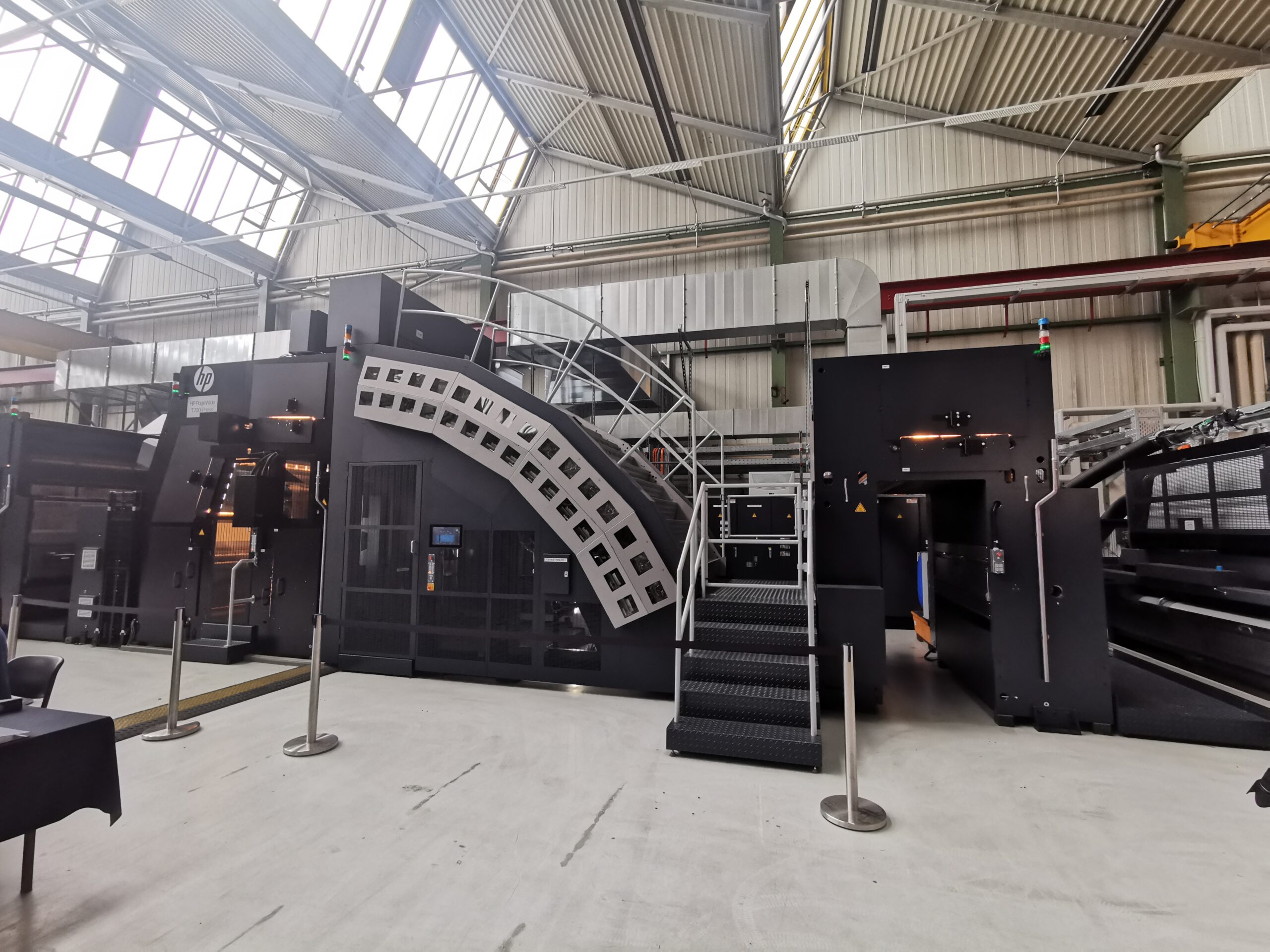 HP T700i print and primer units[/caption]
Originally announced as a corrugated and folding carton solution, the prospects for the latter will need to exercise some more patience. Like the T1195i the maximum rated weight is 250 gsm for now. Heavier weights will need some modifications in the paper transport and HP plans to get some experience with the T700i in the field first. Ultimately targeted is a maximum weight of 500 gsm, which is a quite good range for a webfed press and surpasses the range of the T470S. With a web width of 1.7 m and a print frame length of up to 2.7 metre the T700i would offer considerable productivity and a very large sheet size. Both cannot be reached with other digital presses in folding carton.
Pratt Industries in the US has been announced as the first T700i customer, with a planned delivery in September/October and being fully operational in spring 2025. The company already operates a T470S in the Lewisburg site for litho lamination replacement.
Partnering
A press can only be as effective as the ecosystem around it. HP presented several partners with solutions adapted to the T700i or providing a good match.
Like with the T1100-Series, Koenig & Bauer is the strategic partner for manufacturing the press base, with its foundry-to-product capability. Accordingly, the press has been presented at the Koenig & Bauer factory in Würzburg, Germany. Moreover, Koenig & Bauer is also a partner for web logistics with its well-established PATRAS roll handling and logistics system.
More partners are onboard for the new press, like BST as full-web inspection partner. Hybrid Software provides the Packz PDF editor and Cloudflow – the basis of the HP One Package workflow package. Erhard + Leimer provides the Smartline workflow for an automated and integrated roll finishing.
Interesting is the Fosber Quantum corrugator which is available for a width of 70” or 1.78 metre. The Quantum can be used as laminator replacement. Moving roll-to-roll with a corrugator has advantages compared to a litho lam replacement, such as faster lamination and easier handling. As an alternative, when roll-feed to lamination is not an option, BW Papersystems presented the Questec sheeter. The sheeter is ideal for T700i with a speed of 400 m/min and a max web width of 1650 mm.
Where the T700i could be heading
For HP the T700i marks the next chapter and completes the portfolio of corrugated options. It fits right into the middle between the 1-metre and 2.8-metre-wide printers. HP is the only vendor as well active in preprint and postprint corrugated. The sheet-fed postprint solution, the HP PageWide C550, is in its second generation already. There are a bit more than 20 solutions in the market today, close to the number of preprint webfed installations. (to keep up to date on inkjet installations, please see our regular Inkjet Insight Installation roundups). The demand for both approaches has been stable but not a tidal wave, which is understandable given the size of the presses and some insecurities on the growth in corrugated packaging.
The corrugated market slowed down after the incredible growth during the pandemic. More recently the uptake of online shopping stalled and partially consumers went back to in-store shopping, leading to declining corrugated volumes in many markets. More bad news are the increasing costs of corrugated board. For the first half of 2024, the German association for corrugated products just reported a 15% increase in recovered fibre costs – the main raw material for corrugated liner.
Considering the small amount being printed in digital, the growth potential is still big as the market is moving to shorter runs. For a typical set of boxes, HP calculated a breakeven of the T700i against a litho lamination workflow with 186,664 boxes or about 31,000 sheets on the large format offset press. In addition, digital print avoids waste, reduces the environmental impact, and saves production time. Customers in the panel conceded however that a digital print business model is bigger than replacing a press with a press. There are many changes in the processes necessary. Also, colour is still difficult to pin down with customers, and much is still subjective. The T700i lowers the entry barrier somewhat and by addressing both, litho lamination replacement and smaller width corrugation, could appeal to mid-market corrugate producers.
Moreover, the corrugated space is not only slowing its growth, it is also getting crowded in terms of inkjet solutions. There are 10 vendors shipping inkjet corrugated presses plus several Chinese companies waiting in the wings.
Accordingly, the alternative application field in folding carton could be interesting. Few inkjet folding carton solutions exist so far, especially for high volume demands. HP has no inkjet folding carton solution so far but this might change. Most recently the T470S moved into folding carton print with one installation at Zumbiel Packaging. With a maximum rated substrate weight of 350 gsm or 18pt stock only lighter folding carton grades can be addressed, however. The T700i would allow for stocks up to 500 gsm, which would bring a decent portion of the market into reach.
For more coverage see HP PageWide T700i Packaging Press: The Inkjet Carton Solution by David Zwang