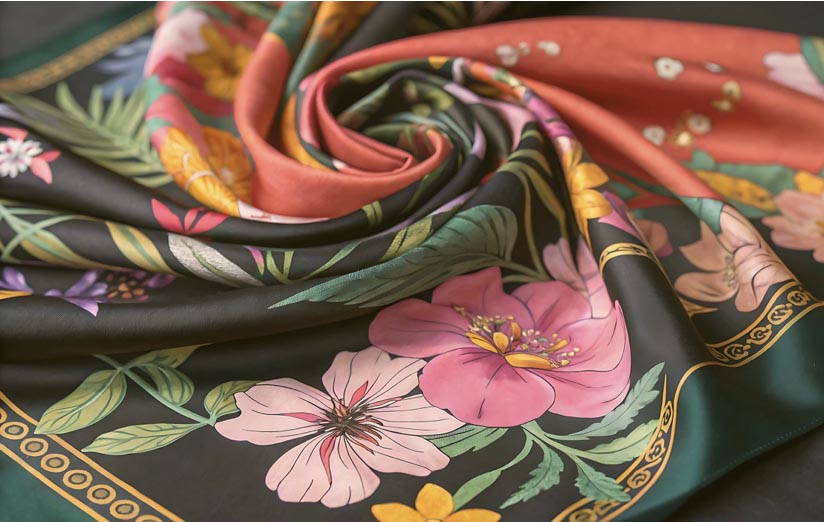
(Image courtesy of Texintel)
By Jos Notermans, The Note Consultancy B.V.
In the last couple of years, new pigment ink formulations have been introduced by major ink manufacturers—and this time it looks like the pigment application is here to stay!
It has been almost two years since the textile industry met at ITMA 2023 in Milano, Italy. Everybody will remember that “sustainability” was the main theme from this largest textile trade show in the world. All companies that are somehow involved in digital textile printing will also remember that the buzzword associated with this theme was “pigment.” Whether it was machine OEMs or ink manufacturers, virtually all exhibitors showed products associated with digital pigment printing.
Meanwhile we are halfway to the next ITMA in 2027 in Hannover, Germany. How far has digital pigment printing progressed since then? In this article, I provide an overview of where the digital textile printing industry stands regarding pigment printing.
A Bit of History
Ever since the first digital textile printer was shown in 1991 by Stork, the market has been asking for a pigment solution. Driven by the fact that conventional pigment printing covered roughly 50% of all textile printing in the world, this was a logical request. The first trials for digital pigment inks were done in the late 90s, but no reliable solution could be found: colors were extremely dull, inks were extremely expensive, and, worst of all, inks were clogging the inkjet heads almost instantly.
The second wave for pigment came in the early 2000s, when BASF launched a solution that could be used in the Epson DX-series heads. This never really came to fruition, as still all expectations of the textile industry regarding pigments could not be fulfilled: the process was not simple, the color depth was not acceptable, the fastnesses were very poor, and, last but not least, it was much more expensive than printing with reactive dye inks. After the arrival of the Kyocera KJ4B heads, there was another short time where companies like Mexar from the UK introduced pigment inks for those heads. It was a big step forward compared to the previous formulations, especially in terms of runnability and reliability, but still the overall printing quality was limited and the total costs were still much higher compared to printing with reactive inks.
In the most basic process, digital pigment printing can be done on any PFP fabric and, after drying the printed fabric, a curing step is needed to polymerize the pigments. This normally happens at a temperature of 160 degrees during 2-3 minutes. In many cases, however, a pre-treatment is applied to improve the color depth of the final pigment printed result. Also, a post-treatment is often applied to improve the fastnesses of the pigment print result.
Recent Situation—The COVID Years
In the last couple of years, new pigment ink formulations have been introduced by major ink manufacturers, and this time it looks like the pigment application is here to stay. Supported by the sustainability push from major fashion and home textile brands, pigment ink improvements followed each other quickly, and, meanwhile the major drawbacks have been reduced to a level so that commercial production printing with pigment inks has become feasible. According to WTiN, in 2021, the pigment volume amounted to 1.9 million kg sold. This grew to 2.4 million kg in 2023, meaning a CAGR of 12% per year. In that same period, the reactive volume declined from 14.7 million kg to 14.1 million kgs, a decline of 2% per year.
The Sustainability Contribution of Pigment Inks
In 2020, the Spanish institute Technical Advice did a study at a major Western European printing mill to compare the environmental impact of printing with pigment inks compared to printing with reactive inks in rotary or digital.
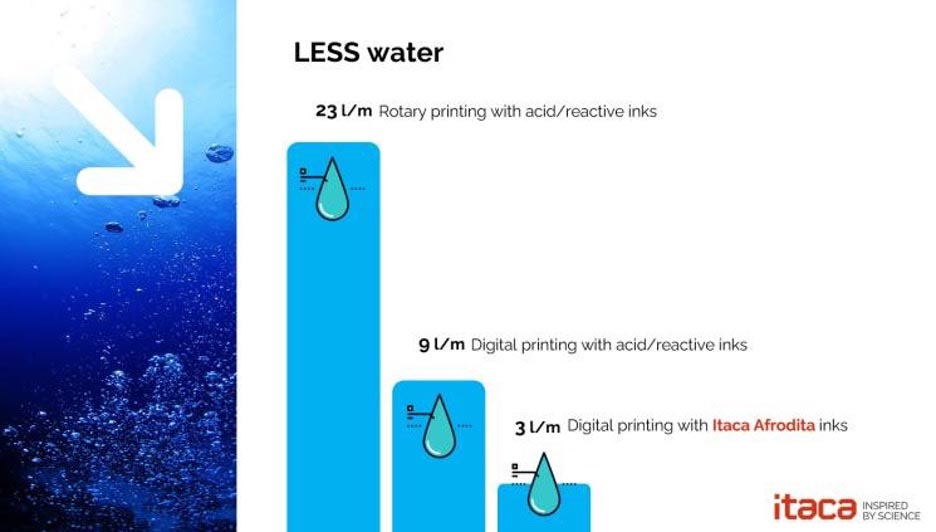
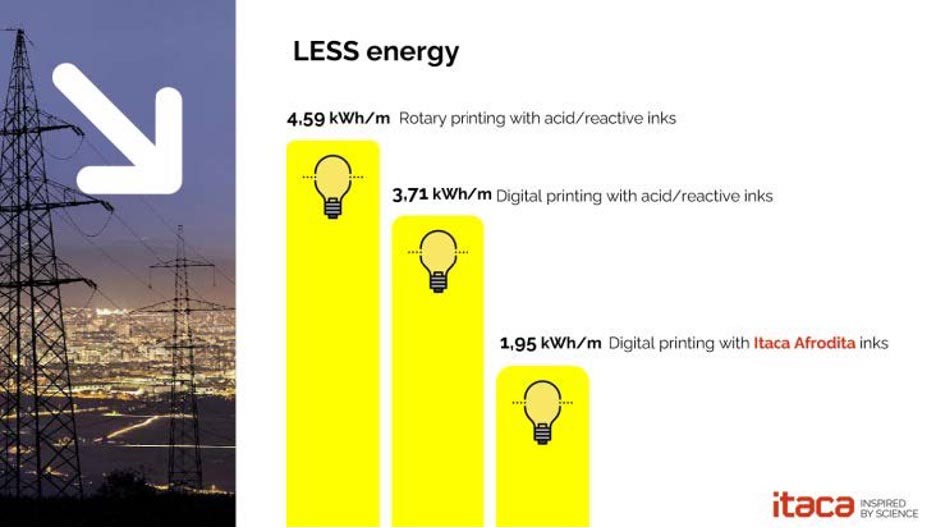
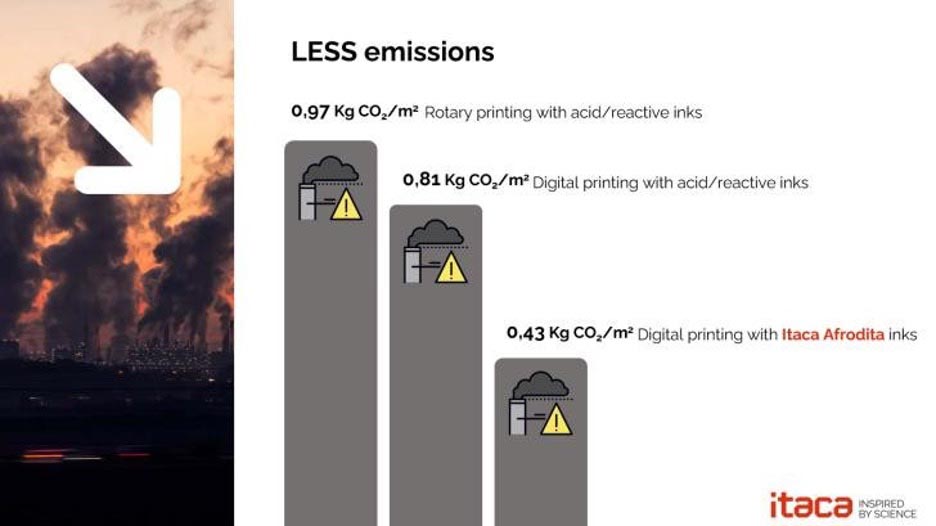
Figure 1: Sustainability study on textile printing technologies—Technical Advice 2020 European textile company with 1.4 m fabric width. Itaca Afrodita numbers are with pre- and post-treatment.
From this study, we learn that the water consumption in pigment inks can be reduced by 86%, the energy consumption by 58%, and CO? emissions by 56%. This definitely underscores that digital pigment printing contributes to a more sustainable method of printing fabrics.
Fulfillment of the Expectations
During ITMA 2023, it became clear that the industry is expecting fulfillment of four areas of expectations regarding pigment printing.
Expectation 1: Reliability
Over the past two decades, digital printing with reactive, acid, disperse, and sublimation printing has set a standard of reliability that makes high-volume printing in an almost unattended production operation possible. Digital pigment printing, however, was still requiring a high level of operator attention, combined with frequent preventive maintenance in order to keep the quality constant. Over the past 2–3 years, however, several major pigment ink brands have reached a quality level that makes pigment inks at least equally reliable as the other ink chemistries, and concerns about a limited printhead life have virtually diminished.
Expectation 2: Color Brilliance
The first generations of pigment inks consisted of rather dull colors. Meanwhile, most ink manufacturers have been able to improve their formulations to a level where deep colors are possible. A few years back, the general assumption was that digital pigment printing would be limited to home textiles, because there are less bright color demands in these applications. However, today, even for the demanding fashion printing industry, where deep black tones and pepper red blotches are an absolute must, there are solutions of inks in combination with pre- and post-treatments that yield color brilliance that is meeting the fashion printing requirements.
Expectation 3: Fastnesses
Pigments are known for high lightfastness, so that has been a no-brainer for many years now. The main challenge for pigment inks, however, has always been the rub fastness, in particular the so-called “wet rub fastness.” The Spanish ink manufacturer Itaca has recently launched a new ink set called Afrodita that gives wet rub fastnesses of 4-5, a property that opens up a lot of applications that were doubtful for digital pigment printing in the past.
Expectations 4: Printing Costs
As mentioned before, digital pigment inks have been a lot more expensive than other ink chemistries in the past. This was not only due to the limited volumes, but also due to the complex and therefore more costly process of producing digital pigment inks, also compared to the costs of producing conventional pigment printing pastes. Recent developments, however, done by experienced pigment ink producers for non-textile inks, have reduced those production costs dramatically.
Furthermore, the economies of scale are starting to kick in, which make digital pigment inks substantially cheaper than a few years ago. Having said this, the digital pigment ink prices are still higher than reactive inks. Combined with the fact that for the same design the ink consumption with pigments is higher, one tends to think that digital pigment printing is still less economical than reactive printing. This needs to be nuanced by looking at the total cost of ownership and thus, the total process.
By cutting out the need for steaming and washing, and in many applications even the need to mercerize the fabric, one does not need the energy, water, labor, and even machinery (with their associated depreciation costs). This leads to considerable cost savings, that compensate for and sometimes surpass the higher ink and consumption costs. A large home textile producer in Pakistan that has been printing with digital pigment inks now for over a year told me that he saves on average 10–15% with digital pigment printing over digital reactive printing.
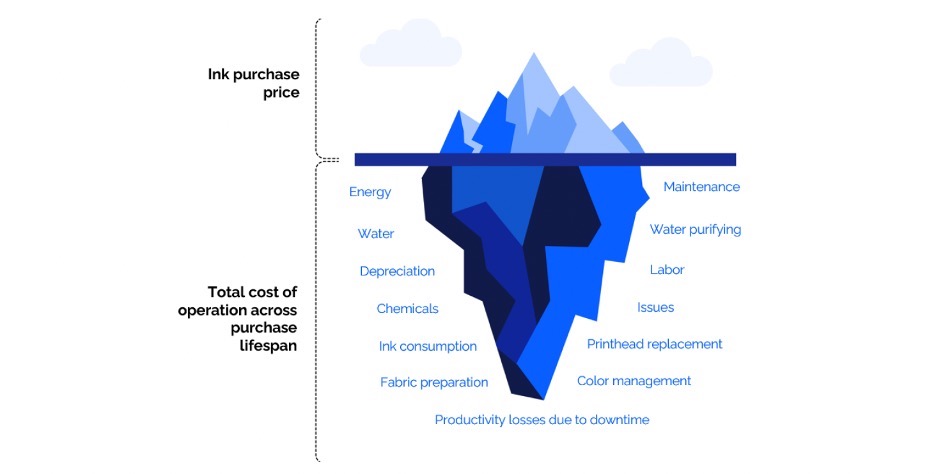
Figure 2: The total cost of ownership of digital printing.
Conclusion
Digital textile printing with pigment inks has reached the technical and economical maturity that is need to fulfill the sustainability expectation from ITMA 2023.
In the next two years, as we head towards ITMA 2027, it is expected that more and more companies will convert at least a part of their current digital printing with other digital ink chemistries to digital pigments. This will contribute to substantial water and energy savings and lower CO? emissions.
About Jos Notermans
Experienced Commercial Manager with a technical background but proven track record in marketing, sales, and business management in the graphics and textile digital printing industry. Initiator of numerous developments based on strategic insight in the fast developing world of digital printing, he has set up joint venture cooperations, managed a printing production company, and is a well-known and appreciated speaker at global conferences and seminars about digital printing. After over 35 years working for Stork/SPGPrints, he decided in late 2024 to fulfill his dream of working as an independent consultant.