New Winterberry Study Indicates 80% of Brands Increasing Direct Mail Spend: Is Your Print Business Ready?
The direct mail marketing industry is redefining its value proposition for 2025, shifting from traditional volume-based metrics to a new value equation centered on data-driven personalization, omnichannel integration, process automation, multi-touch attribution…and the judicious application of AI.
This article gives print service providers an overview of key insights from Winterberry Group's recently released whitepaper, “Performance 2024: Direct, Digital and the Dynamics Shaping the Future of Omnichannel Marketing.” It also provides guidance for investment priorities required to capitalize on projected growth in demand for innovative direct mail solutions.
Direct Mail (DM) is evolving to bridge the physical and digital worlds in an exponential consumer data growth era. Long-established data providers are investing in new data categories, identity graphs, device graphs, and AI tools for advanced audience segmentation, creative optimization, and multi-touch attribution. In addition, consumer data marketplaces like AWS Data Exchange and Datarade.ai provide marketers access to over 600 consumer data categories.
According to recently released research from the Winterberry Group, the evolution of demand is generating a direct mail investment resurgence by major brands building on the 2.6% growth of U.S. direct mail advertising in 2024 to $37.3 billion—reversing last year’s double-digit decline.
Omnichannel marketers are seeking print service providers who can help them leverage this data in new ways beyond targeting or superficial personalization to encompass high-touch, high-value programmatic direct response mail solutions. What will it take for you to capitalize on the demand?
The Stakes
Over 80% of U.S. brands surveyed by Winterberry plan to increase their direct mail investment in 2025, signaling growing confidence in direct mail’s evolving role in omnichannel marketing.
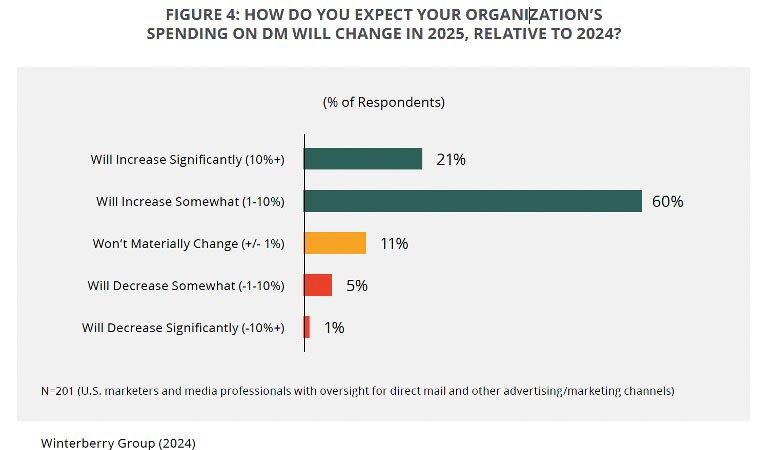
The Winterberry report provides actionable recommendations for how brands can optimize their direct mail investments. It emphasizes the print medium as a performance vehicle, advocates for a cross-channel measurement and testing strategy, promotes data-driven technology investment, and encourages the integration of generative AI and machine learning into strategy, creative development, and measurement processes. The U.S. Postal Service supported the study as presenting sponsor, with Canon and RRD as premier sponsors; and Alliant, Modern Postcard, Moore, Who’s Mailing What? and Wilen Group as founding sponsors. It is based on interviews with more than 200 U.S. brand, agency, and marketing executives, revealing fundamental shifts in how companies view and utilize direct mail.
A full copy of the Winterberry study is available for download here.
“The findings of the report highlight an important evolution in direct mail’s role within the marketing mix,” says Stefanie Cortes, Director of Strategic Analysis & Business Development at RRD, a study sponsor. “Many marketers rely on direct mail as a flagship touchpoint for customer acquisition and retention due to its proactive, highly targeted nature. Coordinated, multichannel campaigns consistently deliver stronger results compared to standalone print or digital efforts.”
What’s Driving This Growth of Investment in Direct Mail?
Three key factors are reshaping direct mail’s position in the marketing mix. First, expanding marketing budgets supported by macroeconomic growth enables brands to invest in innovative direct mail strategies while maintaining their digital presence. Second, growing challenges in digital advertising—particularly around cookie deprecation and privacy regulations—have diminished the efficiency of traditional performance channels like search and programmatic display. Third, improvements in data quality, data accessibility, identity graphs, device graphs, and AI have created new opportunities for sophisticated segmentation, personalization, optimization, and attribution.
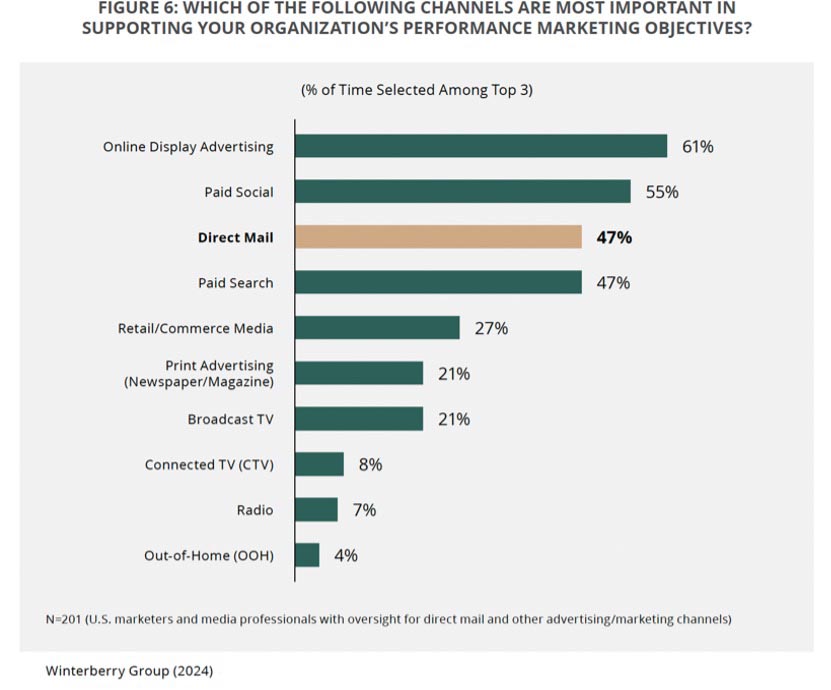
Brands are emphasizing performance-oriented marketing use cases—including those closely tied to activating core marketing objectives like new customer acquisition, incremental sales, and customer re-engagement—and looking to optimize the mix of tools and media at their disposal. Direct mail (DM) is now commonly cited among the top five channels marketers rely on to provide such support.
When it comes to digitally native brands, RRD’s Cortes points to digital saturation as one of the key pain points driving brands to add direct mail to their marketing mix. “Direct mail cuts through the noise with a tactile, personal touch that grabs attention in a way digital often can’t. These brands are also looking for ways to improve customer engagement and retention. Direct mail delivers a more memorable experience and often achieves higher response rates, complementing their digital efforts and enhancing overall ROI.”
The ability to trigger, automate, and integrate the rapid insertion of personalized direct mail into the mail stream for support of multi-touch attribution will be essential to capitalize on the projected new wave of demand for direct mail.
How Does Omnichannel DM Integration Work?
The integration of direct mail with omnichannel digital media “touches” enables real-time campaign analysis and detailed attribution reporting. Print service providers can become integral partners in direct mail’s omnichannel renaissance by developing proficiency in the management and analysis of large volumes of complex data, establishing API connections with marketing automation and mail “sending” platforms, implementing sophisticated programmatic personalization and mail tracking systems; staying abreast of relevant USPS promotions, and supporting the development of effective multi-touch attribution.
The “Attribution Gap” Challenge
Direct mail attribution remains a critical challenge for marketers. “While silos among media channels are diminishing, there remains for many marketers an ‘attribution gap’ when direct mail is deployed in the media mix,” explains Jonathan Margulies, managing partner at Winterberry Group. The report indicates that marketers identified cross-channel media measurement as the most important initiative to address for advancing direct mail’s value. (A notable marketing industry association effort to conduct research, develop guidelines, and close the attribution gap is the MMA Marketing Attribution Think Tank.)
The Solution to Attribution
A key tactic in addressing the attribution challenge is connecting direct mail to digital campaign touchpoints through device and identity graphs. These connections can be achieved using pre-campaign audience insight research coupled with “smart mail” elements such as QR codes, PURLs, NFCs, promo codes, and business reply cards, combined with multi-touch attribution and match-back analysis.
What About Data Management and Data Security?
The foundation of modern direct mail effectiveness rests on sophisticated data management. Print service providers must be prepared to handle significant volumes of multiple data types, from customer demographics and behavioral intent data to transactional records and life event triggers. This data comes from various sources—such as zero-party data shared directly by customers through surveys, first-party personally identifiable information (PII) data or transaction data collected from owned channels, permission-based second-party data secured from partners, and third-party data sourced directly from external data providers such as Bombora, Claritas, and Experian, or through data marketplaces.
The Postman Rings Twice
The USPS is supporting the value-based transformation of direct mail in two critical ways. First, through promotions that help mailers and print service providers develop innovative direct mail applications that can enhance the value of innovative direct mail applications while also reducing postage costs. These promotions provide discounts of 3% or more for direct mail applications that employ innovations such as personalized color transpromo elements; tactile, sensory and interactive elements; Informed Delivery; retargeting; and emerging and advanced technology such as AI; as well as reply mail employing IMbA Intelligent Mail barcode accounting. Second, the USPS provides PSPs and marketers with postage cost savings through its Mail Volume Growth Incentive Program.
According to RRD’s Stefanie Cortes: “The USPS Mail Volume Growth Incentive and additional promotions are timely opportunities for marketers to optimize their direct mail strategies. With postage costs accounting for a significant portion of campaign budgets, these incentives offer a way to mitigate rising expenses while enhancing performance. At RRD, we’ve seen how integrating postal promotions—such as those encouraging tactile, tech-driven, or innovative formats—can not only reduce costs but also boost engagement. Marketers who strategically align their messaging and leverage these promotions will amplify customer engagement and achieve stronger ROI in their omnichannel campaigns.”
The USPS provides comprehensive resources about its 2025 promotions through its PostalPro platform, offering guidance on implementing technologies that qualify for promotional discounts. While postage now accounts for roughly half of direct mail costs, brands are leveraging USPS promotions to reduce postage costs and increase direct mail’s value.
Beyond the AI Buzz: Data Security & Governance Foundations
Artificial intelligence is a trending topic that warrants attention and caution. Marguiles says, “While machine learning and AI [artificial intelligence] may have long-term disruptive potential, most of today’s most significant gains are generated through innovative tactics that have been in the works for some time.” Accordingly, Winterberry’s research found that 60% of marketers surveyed said their organizations have already deployed tools and methodologies—such as retargeting based on transactional and/or identity data, integration with third-party marketing technologies, use of behavioral triggers, and integration of QR codes—aimed at driving more significant impact of their direct mail efforts and complementing their online marketing efforts
Foundational priorities for PSPs should include establishing secure data processing infrastructure, obtaining data security certifications, developing automated content personalization capabilities, developing the ability to interface their print and mail solutions with the APIs of leading account-based marketing solutions CRM systems and sending platforms, as well as implementing enhanced quality assurance systems capable of addressing personalization and near real-time mail stream insertion at scale.
According to RRD’s Cortez: “At RRD, we are leveraging AI mostly for consumer insights. AI allows us to take large amounts of data and glean insights that make the customer experience more timely, relevant, and targeted. For example, by analyzing digital engagement signals—like email opens or website visits—machine learning helps us predict the best time to send direct mail, synchronize it with digital efforts, and personalize offers based on individual preferences. This ensures a seamless and impactful omnichannel experience.”
2025 Action Plan: Delivering on the New Value Equation
As direct mail continues evolving into a sophisticated omnichannel media choice, print service providers who invest in the value-based future of direct mail will be well-positioned to serve brands seeking integrated omnichannel marketing solutions. The challenge will be balancing the need for security and regulatory compliance while delivering the speed, security, personalization, enhanced print quality features, and digital integration that marketers will increasingly demand in 2025.
The Bottom Line
Twenty-two years ago, Nicholas Negroponte, the MIT Media Lab co-founder, wrote the now-classic book Being Digital about the digital revolution and the shift from atoms to bits in media that stated, “It makes no sense to ship atoms when you can ship bits.” However, contrary to Negroponte’s binary choice between atoms or bits, the findings of the Winterberry study suggest that the immediate future holds great promise for print services providers who develop the ability to deliver hybrid “phygital” solutions that integrate the physical atoms of direct mail with the digital media touches, AI-enabled optimization, and attribution measurement that omnichannel marketers are clamoring for.
When it comes to the application of AI to omnichannel marketing and direct mail business processes, Rex and Caleb Briggs, co-authors of the recently published book “The AI Conundrum” recommend engaging a diverse coalition of industry associations, academia, elected officials, and other stakeholders to articulate a shared vision and guidelines for the effective yet ethical use to maximize the productivity benefits of AI as well as to mitigate the risks of AI displacing human talent. According to the authors: “As much as AI can operate in faster cycles automatically, we suggest that humans guide the broader strategy… we recommend that businesses collaborate with industry associations to learn more quickly and benefit from a broader range of data. There is value in collaborating with peers on the strengths and weaknesses of AI.”
One of the most effective ways to balance the challenges and opportunities presented by growing demand for programmatic direct mail solutions, multi-touch attribution, and the increased adoption of AI in marketing and production is for print service providers to work with their industry peers across the omnichannel value chain to conduct pre-competitive research, advance best practices, publish benchmarks, and develop standards that will elevate awareness of critical issues and ensure that the benefits of AI adoption outweigh the risks.
At a minimum, printers should explore integrating their print and mail capabilities with third-party data providers, marketing automation platforms, customer relationship management (CRM) systems, and sending platforms (see list below).
- Acxiom: Provider of third-party consumer data, identity graphs, and data analytics.
- Bombora: B2B intent data to identify potential customers based on online behavior.
- CIENCE: Lead generation services to grow your customer base with outbound sales and marketing.
- Claritas: Consumer segmentation and targeted marketing solutions for effective audience reach.
- DataAxle: Business and consumer data solutions for marketing, sales, and data management.
- ai: Find, compare, and access data products from 500+ premium data providers.
- Demandbase: Account-based marketing to target, engage, and convert high-value B2B accounts.
- Experian: Global information services for credit risk management and fraud prevention.
- HubSpot: CRM platform offering marketing, sales, and service tools to grow your business
- Lob: APIs for automating and personalizing direct mail and address verification.
- Postalytics: Direct mail automation tool integrating with CRM for personalized campaigns.
- Postgrid: API for automating direct mail, address verification, and compliance.
- Reachdesk: Direct mail and gifting platform integrating with CRM for customer engagement.
- Rollworks: Account-based marketing to identify, target, and engage high-value B2B accounts.
- Sendoso: Sending platform for personalized gifts, direct mail, and eGifts to customers.
- 6Sense: AI-driven platform for predictive analytics to identify and engage B2B buyers.
- Salesforce: Leading CRM platform for managing customer relationships and business operations.
- Transunion: Global information company for credit reporting and risk management.
Managing Data Types and Sources for Programmatic Omnichannel Direct Response Mail
Understanding the various types of customer data that programmatic omnichannel direct mail (DM) solutions rely upon is crucial to implementing AI effectively and in accordance with ethical, legal, and security standards. Specifically, handling Personally Identifiable Information (PII) responsibly is essential for legal and ethical reasons.
Before diving into data-driven DM solutions, assess the different types and sources of data you need to manage. This enables sophisticated trigger-based targeting and personalization of your DM efforts. Each type and source of data has its beneficial uses, compliance requirements, and consequences for failing to meet legal obligations. Key data types include:
- Customer Demographics: Basic information about such as age, gender, address, income, investable assets, education, occupation, marital status, home ownership, ethnicity, etc. This type of data is typically used for business-to-consumer (B2C) audience segmentation.
- Firmographic Data: Information that describes the characteristics of businesses, such as industry, production volume, revenue, number of employees, location, technology stack, etc. This data is used primarily in business-to-business (B2B) marketing to segment target markets and tailor marketing strategies to specific types of companies.
- Behavioral Intent Data: Insights into customer interactions across various channels, including website visits, completed forms, email engagement, and content consumption patterns—gathered from first-party, bidstream, or coop data.
- Transactional Data: Purchase history and transaction details that reveal customer preferences, spending patterns, credit ratings, and investable assets.
- Psychographic Data: Information regarding customer interests, values, and lifestyles, helping to create more personalized marketing messages.
- Brand Preference Data indicates customer affinity for specific brands, products, or services.
- Life Event Data: Significant moments such as births, graduations, engagements, promotions, home purchases, marriages, divorces, relocations, and deaths can trigger marketing opportunities.
Print service providers should also understand the benefits and risks associated with handling various types of data, both PII and non-PII:
- Zero-Party Data: Data that customers intentionally and proactively share with a brand, such as preferences and feedback from surveys.
- First-Party Data: Data collected directly by a company through customer interactions and transactions on owned channels.
- Second-Party Data: Data obtained through trusted partnerships, where partners collect first-party data directly from their audiences with permission to share it.
- Third-Party Data: Data collected by entities without direct relationships with consumers, typically aggregated from multiple sources and sold to other companies.
As you evaluate the data in your possession, be mindful of statutes such as the Gramm-Leach-Bliley Act, the Fair Credit Reporting Act, The EU General Data Protection Regulation. and the Federal Trade Commission Act Data Privacy Framework, which may impose requirements for reasonable security of sensitive information. Furthermore, beyond legal compliance, it is also wise to consider ethical guidelines for managing Personally Identifiable Information, such as those outlined in the Association of National Advertisers (ANA) Ethics Code of Marketing Best Practices for Ethical Data Use.