The Eastman Kodak Company was incorporated May 23, 1892, by George Eastman and Henry Strong. It was founded as a result of George Eastman’s desire to create a lighter weight, easier to use, and less expensive camera than was available at the time. According to the Kodak story, “The camera was as big as a microwave oven and needed a heavy tripod. And he carried a tent so that he could spread photographic emulsion on glass plates before exposing them, and develop the exposed plates before they dried out. There were chemicals, glass tanks, a heavy plate holder, and a jug of water. The complete outfit ‘was a pack-horse load,’ as he described it.”
 In the mid 1870s, Eastman started to experiment with making gelatin emulsions of his own. By 1880, he not only developed a formula that worked but patented a machine for preparing large numbers of plates, and soon started selling them to other photographers. For most of the 20th century, Kodak held the dominant position in photographic film. Additionally, they developed the most popular consumer cameras including the Brownie and the Instamatic. The Kodak brand became ubiquitous with photos creating the tagline a “Kodak moment” and becoming a part of the vernacular. Since its founding, Kodak has also worked with the U.S. Government on many projects developing special films and cameras for testing and reconnaissance.
The company was doing so well from its inception through the 1970s that it made no mergers or acquisitions. This probably contributed to putting them in a difficult place when new technologies and their uses started to create new competition at the turn of the century.
The Dark Years
Kodak led the market and had competed in consumer and professional films with Agfa for decades, then Fujifilm entered the U.S. market in the 1980s and it became the official film of the 1984 Olympics, which was a big blow to Kodak’s reputation. The competition increased and Kodak got caught backfooted. Additionally, the changing market including the shift to digital photography and the increased film competition was taking its toll on revenues and profits. The company scrambled to look for ways to diversify their product offerings and cut costs. Kodak’s annual revenue peaked at $16 billion in 1996 and profits peaked at $2.5 billion in 1999 while the company continued to expanded globally.
In 2005, Antonio Pérez became CEO, and apparently without a clear understanding the core strengths of Kodak and how to leverage them. Kodak exited the film and camera market, closed 13 film plants, and laid off 50,000 employees between 2004 and 2007, essentially gutting the company. As part of that administration’s restructuring, Kodak stopped acetate production, which is the number one ingredient in film, in 2013. They even blew up the plant! The price of Kodak shares decreased under his leadership from around $25 (in 2005) to less than $1 by September 30, 2011. Kodak filed for bankruptcy in 2012.
Reestablishing Kodak’s Brand and Company
Jim Continenza joined the Kodak board in 2010 to help lead them out of bankruptcy. In September 2013, the company emerged from bankruptcy, having shed its large legacy liabilities, restructured, and exiting several businesses. In 2019, he was voted to the lead the company as Executive Chairman and Chief Executive Officer by the Board of Directors, with a five-year plan to stabilize and turn the company around. Since his appointment, they have launched 11 products and returned to profitability. In fact, in their latest filing, they reported a gross profit percentage increase to 22% in Q2 2024, marking the seventh consecutive year-over-year increase. The company culture and attitude as also moved in a palpable positive direction.
During this year, Kodak shareholders have earned a return of ~24%. While that was short of the market average, the gain was actually better than the average annual return of 15% per year over the last five years. This could indicate that the company is winning over new investors as it pursues its strategy. Apparently, they are on their way, but how?
Return to the Core Strengths
Recently, I had a unique opportunity to revisit Kodak Park with a small group of analysts. I say “revisit,” since I have been there a number of times over the last few decades. However, this opportunity was unique because we were able to spend quality time with CEO Jim Continenza, CTO Terry Taber, and tour some of the buildings to see what today’s Kodak is about. During the visit, Jim laid out the operational strategies that have led to the financial turnaround, while Terry brought to light the core strengths of Kodak, and how they are being leveraged in current and future product directions.
When people think of Kodak, they usually think about photographic film. Although, according to Terry, “there are films you know about and others that you don’t.” However, there is a lot more to Kodak’s core strengths, which can ultimately drive growth.

The unique thing about Kodak is they do research to invent materials, “but our history has taught us that just inventing a material doesn’t mean you can make a product,” says Taber. “So over many decades we take materials and we formulate them. For example, in our inks, the material is really a pigment, but the ink is a formulation that gives you the capabilities. We probably have 25 unique materials Kodak invented in our films. But the gel formulation, whether it be on the dispersion side or the silver halide side, is the unique thing. So we invent materials, we formulate materials, and we scale materials.”
At its heart, Kodak develops advanced and innovative materials. Some of those include the 25 unique materials in their films, but they are also inventing materials for controlling light in unique ways, as well as inventing materials for print electronics like CMOS and for proprietary battery materials to coat substrates for batteries. “This is in addition to our advanced or innovative materials that can be utilized either in print or in new business applications.” Many of these are now OEMed outside of Kodak.
Then there are chemicals. Kodak has been manufacturing chemicals since its founding, and the combination of each of these materials can group together and flow across all of Kodaks customers and businesses. At one point, Kodak owned Sterling Drug, and while they sold that business in 1994, they still own the rights of those formulations. They have 38 reactors that can do this, and they want to put them back to work. Currently, they have been manufacturing key starting materials and unregulated reagents for tests through pharmaceutical agreements. However, once their new FDA clean lab is certified, they are also getting back into regulated pharmaceutical materials including saline for which there are only two current suppliers in the US, and both were hit by the recent hurricane season causing a shortage. They can also make a lot of generics. Currently, the biggest hurdle for them is getting the FDA clean lab certified and they expect to get certification in another eight or nine months.
They also do roll-to-roll manufacturing, using coatings that can have a variety of different modalities, or print for functionality. “So we do functional printing for printed electronics,” said Taber, “we do printed optics. Today, we produce transparent antenna for use in car windshields, and we produce transparent heaters for use in medical devices for distributed test kits. Where they need a heating unit, they need a heating unit that is small and optically pure, because you're ultimately need to read the accurate result. You can’t have the heater mess up the result. We’re printing at a very high resolution of less than 10 microns, so even though we’re putting down metals, they’re transparent to the human eye. And we maintain transparency through the support, which is primarily PET, like we use in film with greater than 90% optical transmission.”
Continuing to Restructure
In order to support this new growth, it was necessary to rebuild Kodak’s business infrastructure. “We spent $170 million rebuilding our entire infrastructure. We know our costs down to the penny. We can track costs and profitability by every customer anywhere in the world. We meet every week on all of our pricing to make sure we got it right and review our profitability.” For their customers they will cut costs, too. “We took $160 million of operating expense out last year and we’re taking another $40 million out this year. A lot of this is through our investment in automation throughout the manufacturing units.” They are also bringing in new employees through a large apprenticeship program.
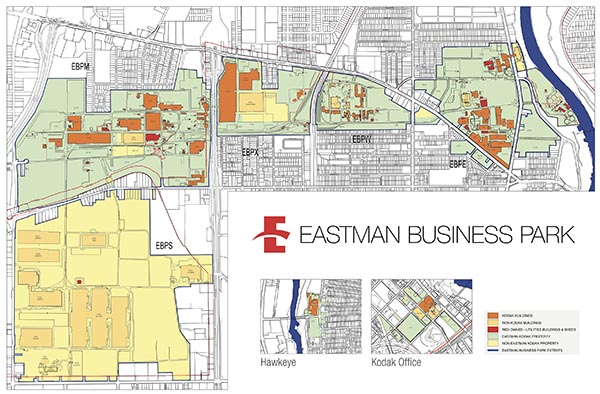
They have also continued to find new ways to leverage the Kodak Park ecosystem. Within its 22 mile perimeter, and over 1,100 acres, supports over 100 businesses including Kodak. Kodak Park has its own power generation facilities, sewer system, railroad, fire department and water treatment facilities, making it an ideal manufacturing environment for Kodak as well as many startups. Some of which become partners with Kodak.
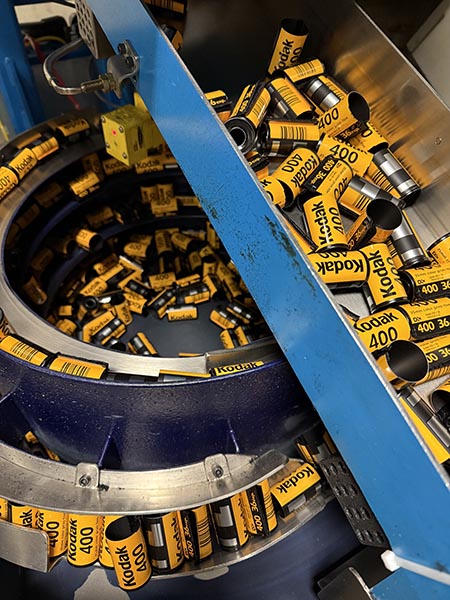
Refocusing and growing film production is a no brainer for them, but it requires rebuilding the lines that were closed down. Many types of photographic film including consumer and professional camera and movie film, dental film, and x-fay films are produced for direct sale. Additionally, Kodak currently OEMs for many other companies now although they hadn’t before. There are a lot of industrial films as well, including film on screens, films on camera and phone lenses, films on glasses, etc. Now their film factory is over a 100% utilized. “I have spools in the end and sensitizers, and we rebuilt those and added 20% capacity. So we are building another spool at a cost of about $10 million that would’ve cost $500,000 when originally made.”
The Markets Are Shifting in Kodak’s Favor
The biggest opportunities seem to be driven by cultural shifts.
- The photographic film market size was valued at US$ 2.69 billion in 2023 and is projected to reach US$3.54 billion by 2031, growing at a CAGR of 4.3% during the forecasted period 2024 to 2031.
- The industrial films market size reached US$43.4 billion in 2023. Projections expect the market to reach US$68.2 billion by 2032, exhibiting a growth rate (CAGR) of 5% during 2024 to 2032.
- The global books market revenue was valued at US$137.12 billion in 2022. It is estimated to reach US$165.22 billion by 2031, growing at a CAGR of 2.2% over the forecast period (2023–2031).
- The global K-12 textbook market was valued at US$124.5 billion in 2023 and is projected reach US$ 666.3 billion by 2032 at a CAGR of 20.5% during the forecast period 2024–2032.
Printing Is an Important Focus
Kodak is dedicated to printing process at its core designed for and with ecologically sustainable processes. Their areas of business include offset plate production, production inkjet printing, and workflow software.
The PROSPER 7000 Turbo Press is a full-color perfecting press, which can run from 200 mpm (650 fpm) up to 410 mpm (1,345 fpm) depending on the quality requirement. It has an imaging width up to 62.1 cm (24.45 in.), with a variable cutoff up to 54-in. It can print on a wide variety of media from 28# newsprint to 100# cover including; uncoated free sheet groundwood and matte, glossy, and silk coated papers 42–270 gsm (3–12 pt). It uses aqueous based pigment cyan, magenta, yellow and black inks which are certified for indirect food contact.
The “upgradable” PROSPER 6000 is a modular press that is offered in three versions: (high coverage commercial), 6000P (perfecting), and 6000S (simplex imprinting) with configurable web paths in either a “U” or “L” configuration. It can run from 650 fpm (200 mpm) to 1,000 fpm (300 mpm) depending on quality requirements supporting the same imaging widths and cutoff.
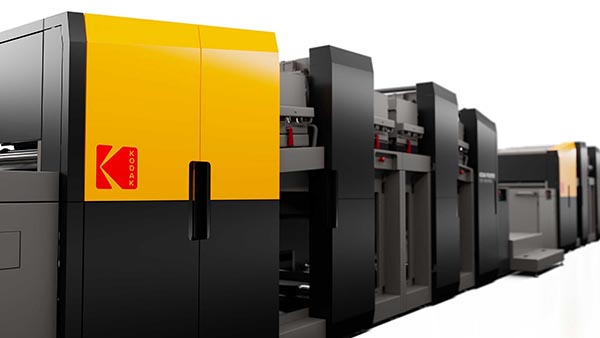
Kodak has recently released their Kodachrome inks for this press which use very narrow particle size distributions with pigment particles that are typically less than 50 nanometers. This process delivers higher quality prints with brighter, purer colors, and a larger color gamut with less ink laydown. Their water-based nano pigment ink grinding uses some of the same technology they developed years ago for photographic films. They have targeted high-speed production inkjet presses like the “upgradable” PROSPER 6000 and PROSPER 7000 Turbo, which are targeted at high-volume runs and offset replacement, to support the market shifts, like the recent growth in printed books. Many people, especially in the younger generations, are now preferring printed books over digital books. In fact, Barnes & Noble is opening 50 new stores in the U.S. in 2024.
The PROSPER ULTRA 520 is targeted at commercial print. Using Ultrastream (their latest printhead technology), the press delivers print quality comparable to 200 lpi offset on uncoated, coated, glossy, and silk papers. It prints full-color 4/4 perfecting output with a scalable web width of up to 21 in. (533 mm) at speeds of 500 fpm (150 mpm). The press was designed to produce high-quality print at a compellingly low cost per page.
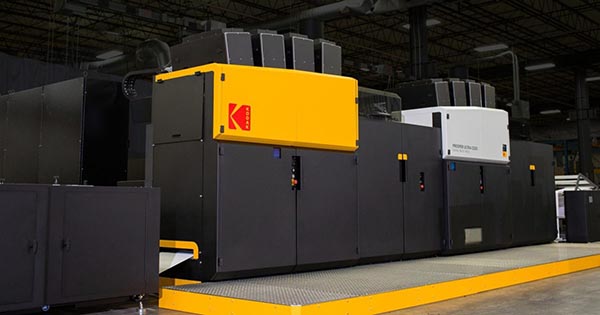
All of the presses are driven by Kodak DFEs and are compatible with their Prinergy workflow solutions and a wide variety of third-party finishing equipment.
Not Done Yet
According to Continenza, “Five years to get to zero. We had some smart fund manager come in and make the comment, ‘It’s a lot of hard work to get to zero.’ You know what? You have to get to zero to get to one. Today, we can service our debt, we cover ourselves, and we’re not losing money. We can now ride our own path. It’s been a long haul. These things take years. We have another four or five years of investing. So that’s where we’re at.”
More to Come…
I would like to address your interests and concerns in future articles as it relates to production inkjet and the manufacturing of Print, Packaging, and Labels, and how, if at all, it drives future workflows including “Industry 4.0.” If you have any interesting examples of hybrid and bespoke manufacturing, I am very anxious to hear about them. Please feel free to contact me at [email protected] with any questions, suggestions, or examples of interesting applications.