

In the classic British sitcom Keeping Up Appearances, Hyacinth Bucket (pronounced “Bouquet”) sought to convey and maintain an upper-class façade, focusing on etiquette and propriety, usually to comic effect.
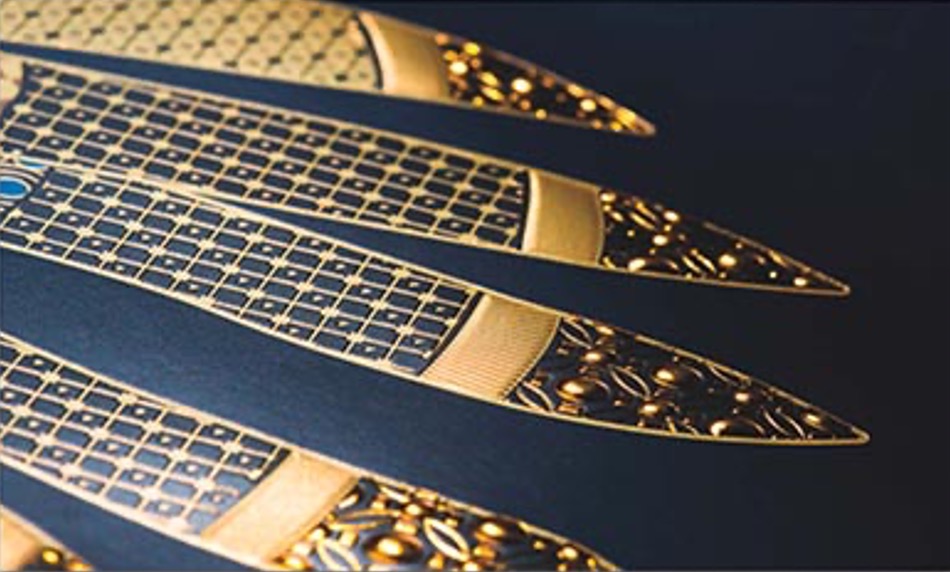
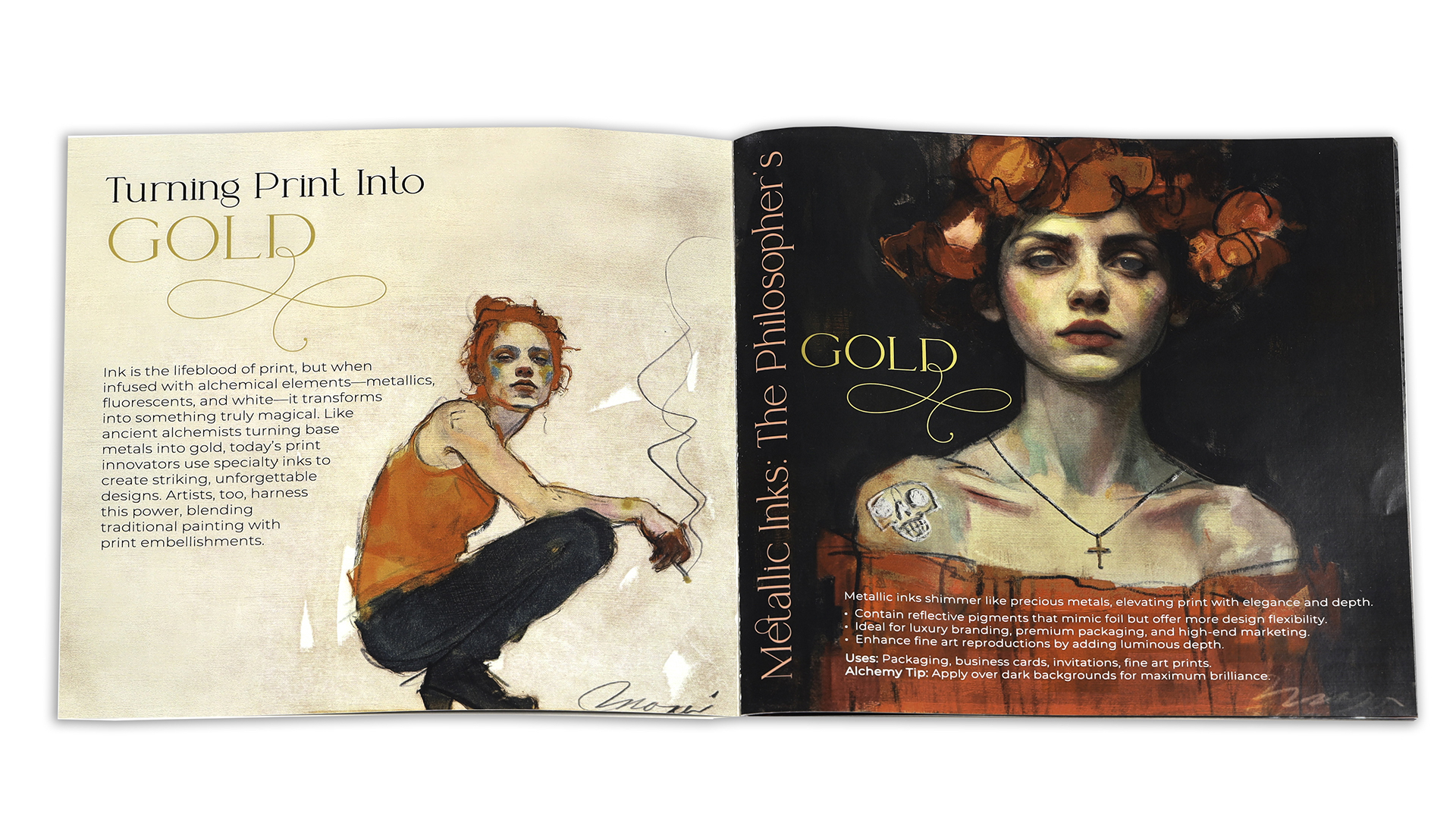
We bring this up because this issue of the WhatTheyThink Quarterly is all about “appearance,” perhaps the most important facet of printed materials, with an emphasis on embellishments, one of the hottest and growing ways of improving the appearance of printed materials.
So, then, this quarter’s “Bucket” list starts with a reprint of a primer on analog and digital embellishments written by Kevin Abergel and Trish Witkowski, to get everyone up to speed.
Our annual Taktiful/WhatTheyThink Embellishment Survey is now in the field (and you are welcome—nay, encouraged—to take it here). What we have found in the previous two studies is that few print businesses that added embellishment production capabilities had a strategic business plan for adding those abilities, while those that did have a business plan reported greater satisfaction with embellishment sales and profits. As a result, the centerpiece of this Quarterly Journal is Kevin Abergel’s highly detailed tutorial on “Crafting a Winning Business Plan for Print Embellishments,” which will also be the topic of a complementary (and complimentary) webinar on March 31.
In our Executive Q&A with issue sponsor Canon USA, we talk with William Lowe, Vice President of Direct Field Service, about how Canon service has a new appearance: a customer-centric approach. We talk about the new service program offerings, the impetus for developing them, and what the response from customers has been.
A term we were recently introduced to by our Senior Consultant Don Carli is “appearance management.” If you google that phrase, virtually all the hits refer to body image, psychological issues related to self-image, and a few fashion-oriented topics—nothing related to the graphic arts. But the context in which we were introduced to the phrase was in the context of digital embellishment, which is related to color management, but goes far beyond it. Carli defines the term thusly:
Appearance management, as architected in the iccMAX standard, works with per-pixel spectral and specular data—encoding how each point in an image interacts with light directionally, not just chromatically. That spectral foundation eliminates metamerism by design, since matches are based on full reflectance curves rather than tristimulus values that can diverge under different illuminants.
Color management, by contrast, operates on colorimetric data standardized through ICC v4 profiles which are inherently susceptible to metameric failure.
So we can think of “appearance management” as “the new color management,” especially as it related to embellishments. Adds Carli:
The per-pixel spectral-specular architecture of iccMAX is also what brings effects like pearlescence, translucency, gloss, roughness, and metallics into scope alongside foils, spot varnishes, and other embellishments—all of which are localized spectral reflectance behaviors.
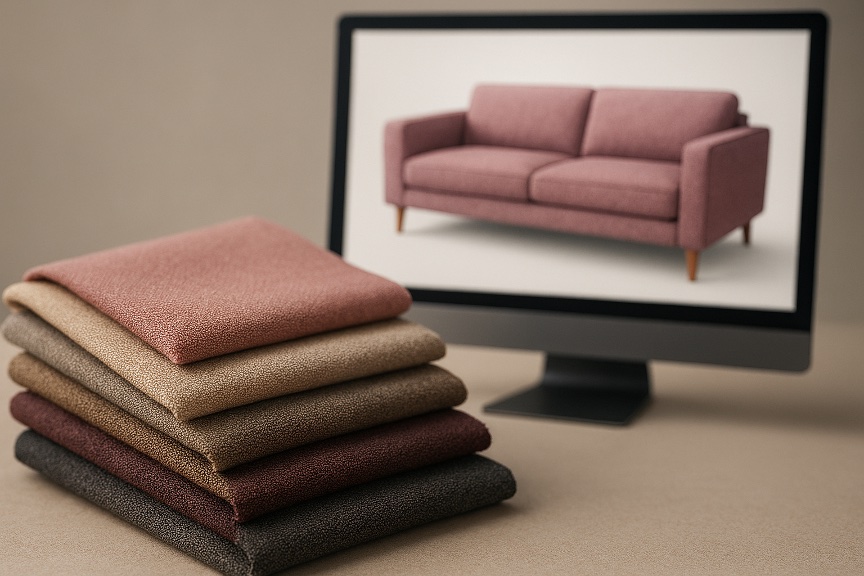
What embellishment advocates have been saying for years is that we need standards for the reproduction of embellishments, and iccMAX is the first ICC standard that can manage the visual complexities of embellishments. And there is a reason why appearance management is such a great concern. As Don Carli explains in great detail in his article in this quarter’s journal, “The $850 Billion Retail Return Problem Nobody Owns…Yet,” e-commerce sites wrestle with merchandise returns—clothing, furniture, etc.—due to inconsistent color or other elements of a product’s appearance.
This is not a problem unique to ecommerce; back in the Golden Age of the printed catalog, returns due to inaccurate depictions of merchandise were also a challenge. For years, late industry analyst Bill Lamparter conducted an annual printed catalog study, in which he compared mail order item catalogs printed in different parts of the country and found often wildly disparate color reproduction of the same items from the same retailer. The issue was further complicated by the advent of ecommerce, as consumers were ordering items from websites viewed on computer monitors (and, eventually, mobile devices) over which retailers and brands had even less control of color management. Carli’s thesis is ultimately that the brands themselves need to take control of appearance management standards to help tackle the returns issue.
So appearance management will be a central concern as embellishments continue to proliferate.
Another potential roadblock to embellishment use and adoption is design, as Paper Specs’ Sabine Lenz explains in “Why Embellishment Technology Struggles to Gain Traction—and What’s Really Getting in the Way,” specifically identifying the communication gap between designer and printer and how it can be overcome.
Lest it sound like we are solely focusing on embellishment problems, we also include the latest installment of Cool Tools with Mary Schilling, in which she details all the exciting tools available that let “designs come to life with shimmer, texture, and light, empowering designers to design with confidence!”
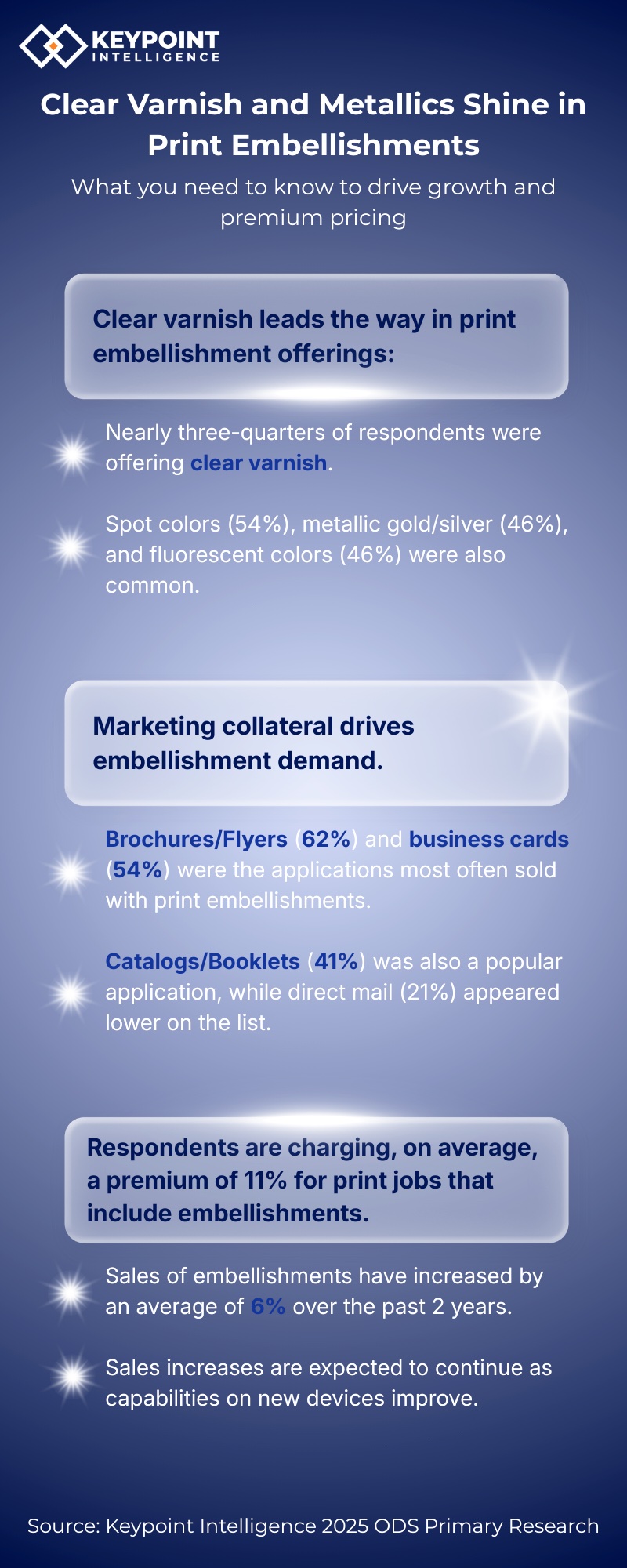
Our Keypoint Intelligence Infographic quantifies the embellishment opportunity for print providers.
A frequent WhatTheyThink contributor—from whom we had not heard in a while—explains what she has been up to in the past few years. In a new installment of The Star-Up Chronicles, “Sorry for Ghosting! When Burnout Leads to a New Business,” Trish Witkowski details the arduous but ultimately rewarding and successful journey in starting up a new business called FreshCut Crafts, turning a kids’ school craft project into a thriving business.
In his quarterly column, swissQprint USA President Erik Norman explains how results?driven teams commit to concrete targets and timelines.
Finally, we wrap up with a special “appearance”-themed edition of our Around the Web miscellany of items that caught our attention.
Without further ado, welcome to the “Keeping Up Appearances” Issue!