

My name is Nick Gawreluk, and I’m not just passionate about the printing industry—I’m obsessed with it. At 33, I took the biggest risk of my life: walking away from a Director-level role at one of the world’s largest printing companies, with a newborn baby in one arm and unwavering belief in the other, to chase a dream that’s as ambitious as it is personal—transforming the global print industry.
Crazy? You betcha. And for good reason. So, what’s the big idea? Profitability in our industry is broken. You read that right. When you look under the hood of most printing companies, job costs are unclear, pricing is a race to the bottom, and profit often happens on a hope and prayer. Business owners around the world operate under these conditions in our 2% net income industry environment. That’s not just a problem—it’s a crisis. But within every crisis lies opportunity: the chance to modernize, bring clarity, and provide a clear path to shift from playing defense to taking control. And so, the software startup Print Profit was born.
The idea came from over a decade of working across the globe for some of the largest printers and equipment manufacturers. No matter the company or country, I kept seeing the same challenge over and over: smart, capable business leaders making critical decisions without a clear picture of profitability and instead relying on outdated and misleading metrics for success. As a result, they were left in the dark, working tirelessly, taking on enormous risk, and hoping profits would follow. But hope, as we all know, is not a strategy. When I realized no dedicated solution existed to solve these challenges for the business side of our industry, there was only one path forward: roll up my sleeves and build it. The mission behind Print Profit is simple—move the industry forward towards a brighter future by modernizing how we understand and achieve profitability.
At the core of the problem lies a methodology dating back to the early 1900s: budgeted hourly rates. We’ve always placed full trust in these calculations to determine job costs, set prices, and drive profit. But the system is flawed—misleading at best, dangerously inaccurate at worst. It’s built on assumptions, arbitrary allocations, and complexity understood by only a select few. The roots of it trace back to the Industrial Revolution and birth of cost accounting, when factories needed a way to track labor and materials on the shop floor. At the time, it was revolutionary. But today, that same model has become a bottleneck for modern, tech-enabled, fast-moving print businesses. What worked for steam engines and assembly lines doesn’t serve us now. If there were ever a rally cry for change in how we run our print businesses, this is it.
Solving a challenge of this magnitude wasn’t going to be quick or easy. I needed time to investigate, reflect, and experiment. That opportunity came while pursuing an MBA in Germany, where I dedicated my Master’s thesis to this very issue. Over the course of a year, I traveled across Europe and the U.S., working hands-on with printers of all sizes to apply and test new methods to better understand costs, optimize pricing, and understand true profitability at a granular level to move the needle. The results were transformative. For the first time, these owners had 20/20 vision into the sources of their profitability—and with that clarity came better decisions, stronger margins, and real financial success.
Years of sleepless nights followed that thesis work, leading to a moment of truth: bring this solution to market, or spend the rest of my life second-guessing what could have been. I chose to leap. Print Profit officially came to life—a then concept and now software platform unlike anything the industry has had available before. One built to eliminate guesswork, reveal true profitability, and give leaders the confidence to make informed, forward-looking business decisions. We're not just building software—we're rewriting the playbook for financial performance in print.
The journey began with a year of consulting engagements where I refined the frameworks, data-driven methodologies, and real-world applications that would become the foundation for the future software. I had the privilege of working with nine figure industry giants, mid-sized commercial innovators, and small apparel decorators across the U.S.—all unified by one need: profit clarity. Then, a bit of fate stepped in. A friend from my undergrad days at Rochester Institute of Technology—where we helped run the country’s only weekly, student-produced 32-page magazine—reached out. I had no idea he had a background in software development and was looking for a side project. Within weeks, we teamed up. Within four months of 80 hour work weeks, the software launched.
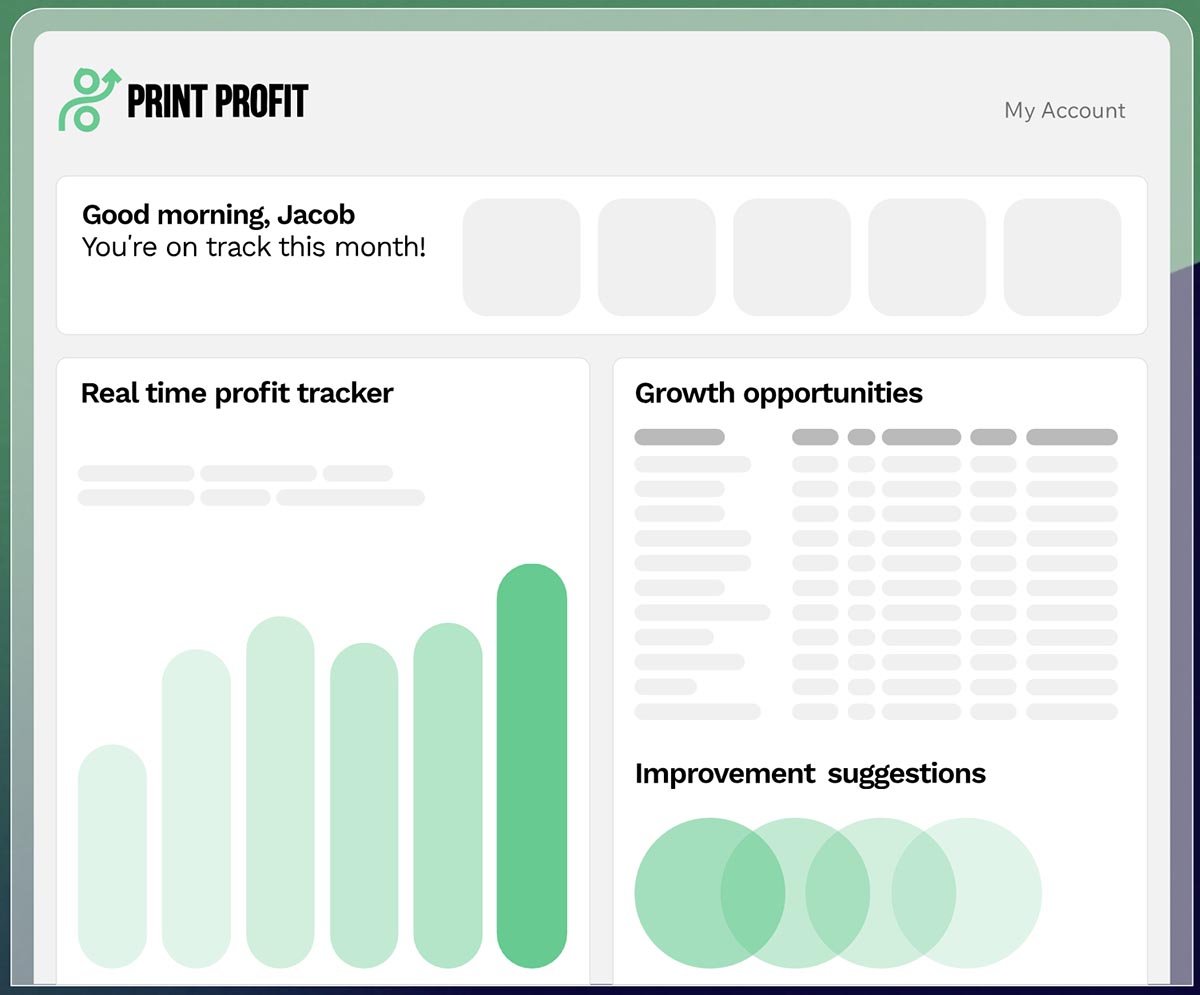
Fast forward to today, we’re embedded in the Twin Cities startup community, run a team of five, and are in nearly half of the United States as the profit engine behind some of the largest and smallest printers in the country. But this is just chapter one. What started as a thesis turned product has become something much bigger—real impact, real traction, and real momentum. From nine-figure commercial operations to local apparel shops, our mission is resonating, and the Print Profit platform is proving that clarity drives confidence—and confidence drives growth.
What comes next is bigger than software. It’s a movement: to challenge outdated norms, empower business owners with transparency, and redefine what success looks like in print. We’ve laid the foundation.
The next phase? That’s where it really gets interesting.
To be continued…