
The success of a printed piece often hinges on its visual appeal. Whether it’s a bold and striking solid tint, a mouthwatering photograph, or a carefully designed logo, the colors printed on a packaging design need to stay true to the chefs—or in this case, the designer’s original recipe. However, translating the designer’s vision from the digital canvas to the physical print is a complex process.
The Flavor of Color
Color is more than a visual element; it’s the secret ingredient that connects with human emotions. When colors are reproduced inaccurately, the “flavor” of the final product can be ruined, leading to an unappealing visual impact, dissatisfied customers, and financial consequences. In the world of packaging, precise color reproduction isn’t just a luxury; it’s an essential element of the brand. Printing a logo or product image in the wrong shade is like oversalting a dish—it spoils the consistency, undermines trust, and can even affect the feeling of freshness on store shelves.
In the packaging industry, where exact color representation and repeatability are non-negotiable, color management becomes the equivalent of a meticulously followed recipe. It involves overseeing an array of variables that affect the final presentation—design software, printing methods, ink chemistry, primers, and post-coating processes. All of these elements work together in harmony to serve up the perfect visual experience.
Crafting the Perfect Recipe
Each printing process works within its own unique “color kitchen,” producing a specific range of colors based on the production variables. This is known as the Print Condition. Within this kitchen, the three main ingredients—Machine, Ink, and Media (MIM)—serve as the foundation for cooking up exact and vibrant colors.
- The Head Chef
The machine is the head chef in the kitchen. Its precision and control create the success of the final dish. Key factors include:
- Speed, pre-treatment, media path control, printhead, wave form, head alignment, head height, stitching, dither pattern, gray levels (overlap), resolution, DPD (drops per dot), and drop size, post coatings, finishing and as well as type of dryers chosen throughout the process (convection, IR, nIR, etc.).
Each of these machine attributes introduces nuances that can elevate or undermine the quality of the printed colors.
- The Seasoning
Ink acts as the seasoning in this recipe, bringing vibrancy, depth, and richness to the final product. The type of ink and its chemistry directly influence the results:
- Ink chemistry (pigment, dye, UV or solvent), type of pigment, volume and pigment size determines the chroma and the colors reflectivity. Ink’s chemistry of surfactants, additives and carrier type decides compatible media, ink wet-out, ink limiting, pre, post coating and finishing compatibility.
- The Plating
Media is the plating of the final print. Critical factors shaping their suitability include:
- Paper grade type (coated, uncoated, poly), white point, surface tension, porosity, weight, media’s manufacturing process, environment, static and temperature.
And many more. To gain perspective, the diagram below shows how each ingredient is delicately intertwined with the next. But keep in mind each of the variables shown below also have deeper layers of complexity not shown.
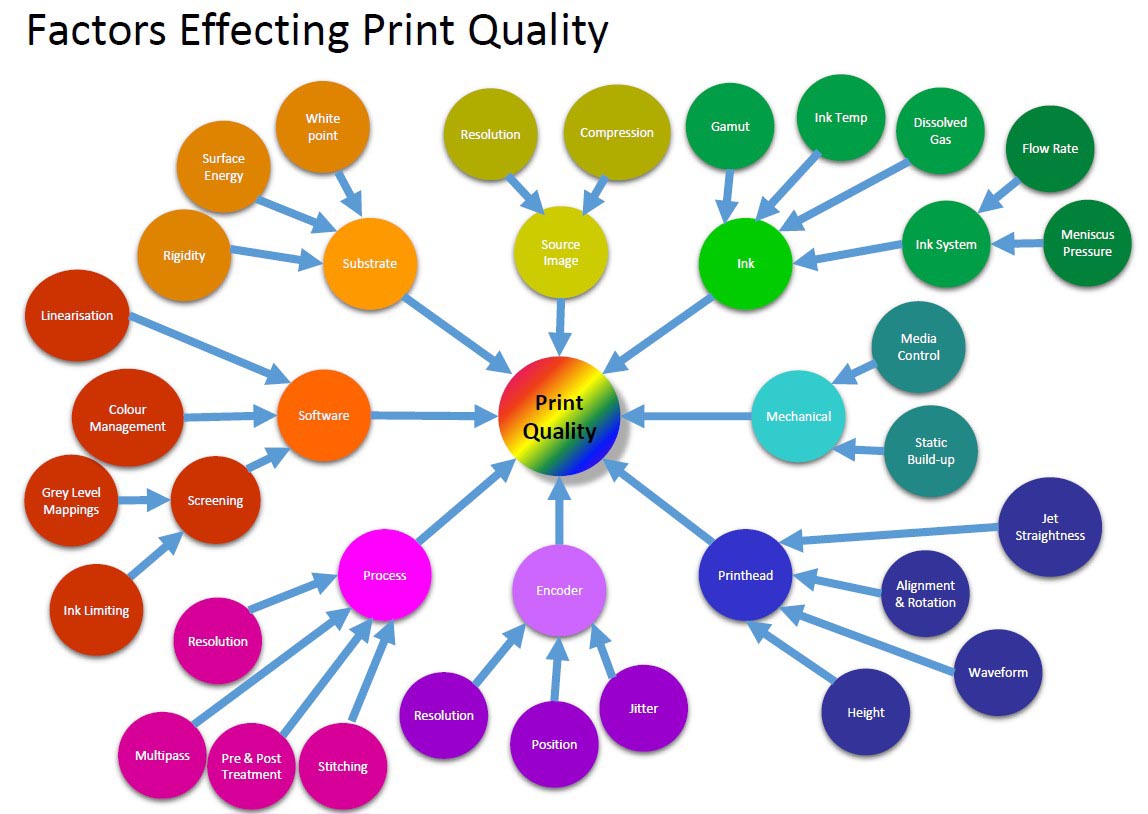
Chart developed by Global Inkjet Systems
When these three core ingredients, Machine, Ink, and Media come together in harmony, the result is a vibrant and flavorful display of colors. However, managing these variables is no small task, as even minor changes in one piece can upset the balance.
Reproducibility in Color Management
Just as no two ovens bake exactly the same, no two printing processes have identical results. Manufacturers claim that their devices can achieve a specific number of Pantone colors within a Delta-E of 2. However, shifting variables in the print environment, this claim is better understood as a range rather than a fixed number. Achieving consistent, reproducible colors requires an understanding of how these variables evolve over time. If any aspect of the process changes, so does the outcome.
The Recipe Isn’t Magic
Color management software is designed to ensure that colors stay consistent, but only if the process itself stays stable. Under stable conditions, this software acts like a cookbook, translating digital designs into a reproducible color space tailored to the specific print condition. But as with any recipe, deviations in the process can lead to unexpected results.
Some variables are easier to control than others, here are a few examples of manageable “ingredients”:
- Ensuring media changes don’t occur. Educate purchasing and engineering on the impact of switching product vendors.
- Storage requirements and conditioning media previous to print.
- Keeping the press room dust free with no vibration and to best temperature and humidity required by the press manufacturer
- Weighing cross web primer to verify consistent coat weight
- Testing media/primed dyne levels
- Checking primer for foaming or viscosity changes and primer tubing is free of any build up.
Surface preparation is critical to success, just as proper prep work sets the stage for a great meal. However, even with these precautions, certain issues such as variability in drop formation across the web can remain difficult to manage over time.
Cool Tools: Innovations in Color Management
For packaging applications, there are tools available to help operators keep consistent color over time. These include: internal and external software, portable color spectrometers, hyperspectral cameras quickly updating color profiles to your current condition, and print flat solutions which addresses print head deviation. While these tools offer robust solutions, they require the press to stop in order to implement updates.
The Future of Color Management: Dynamic, Real-Time Adjustments
As the industry evolves, the future of color management will also involve artificial intelligence (AI) and machine learning. These advanced technologies could continuously monitor color bars across the web while the press is running, creating a dynamic feedback loop that adjusts in real time.
To achieve this, seamless communication between the camera system and print engine/printhead controls will be essential. Currently, high-speed inkjet packaging presses lack the closed-loop functionality needed for on-the-fly color or printhead adjustments. However, this innovation could revolutionize the industry, offering increased levels of accuracy and efficiency.
Stay Colorful, Stay Inspired
At Cool Tools, we’re constantly searching for innovative solutions to help take control of your processes. By exploring the latest advancements in hardware and software, we aim to provide the tools needed to refine every step of the printing process.
Stay tuned for future updates and as always, stay colorful and creative, my friends!