

Background
Some of the earliest entries into the web-to-print marketing category were “constrained design” template-based solutions that offered a print service provider a way to streamline the ordering of personalized business cards. These solutions grew from offering a variety of business cards to offering larger catalogs of products, which could include brochures, mailers, etc. Vistaprint/Cimpress was and still is one of the larger successes in this space. Web-to-packsolutions have been following a similar trajectory, in that they are usually, but not always, a constrained-design solution, or a catalog of customized product offerings.
While packaging is often identified as a singular entity, there are many different types of packaging and many subsets of each of them. Web-to-pack solutions are now available for labels, cartons, flexible packaging, bags, other container types, etc. Most web-to-pack products sold are constrained-design packaging products that came from a library of label or package types. Since the demand for web-to-pack solutions for packaging is increasing, there is also continued development for generic and more specific application templates and solutions.
Can Any PSP Set Up a Web-to-Pack Service?
The prospects of web-to-pack viability vary by market and application, just as they do with web-to-print. If you are already producing packaging and have the necessary equipment for printing and converting, web-to-pack offers some great opportunities for growth. Software solutions include hosted and self-hosted options, as well as outsourced fulfillment services.
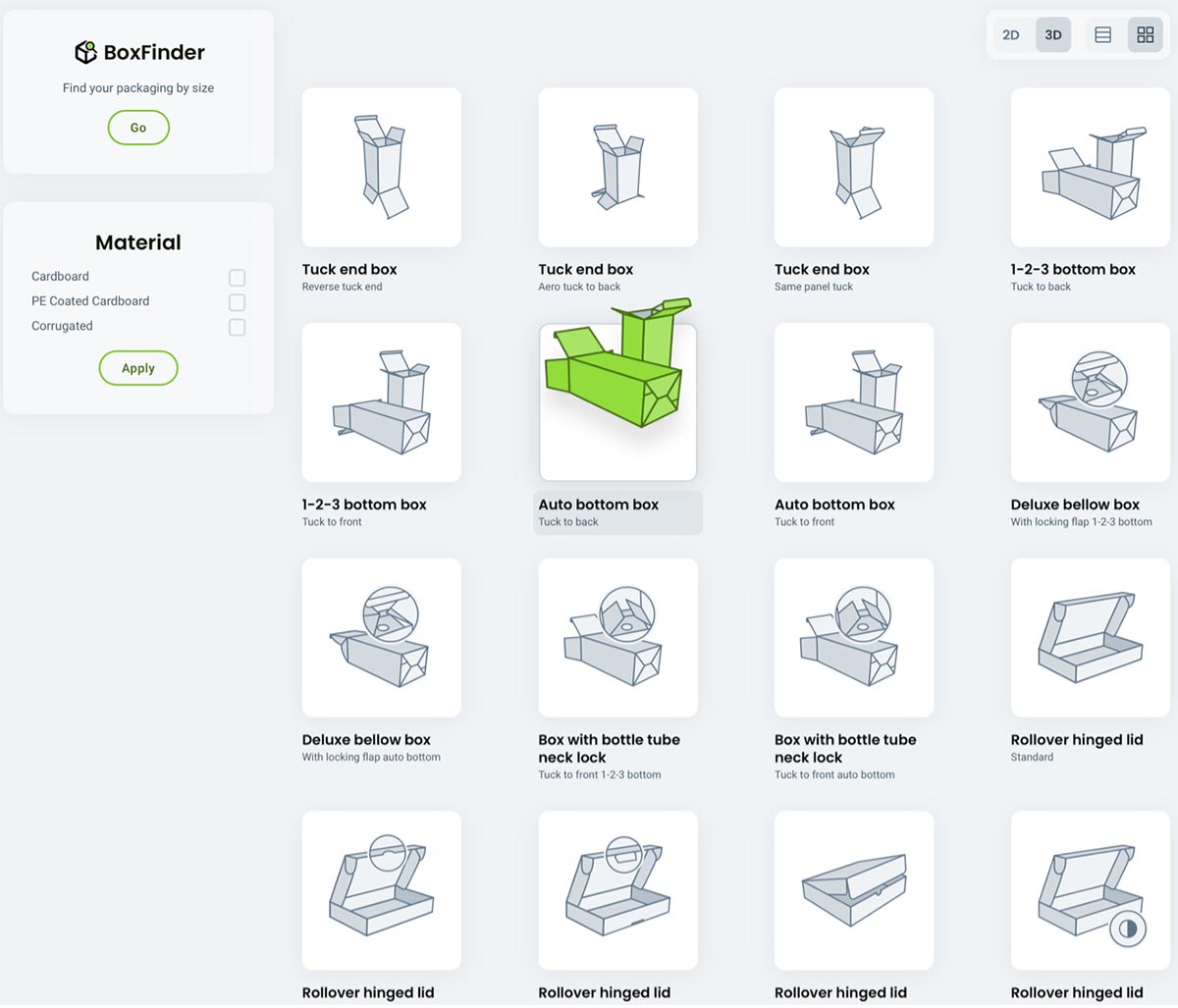
Packly is an on demand web-to-pack converter that developed their own software. If you are not ready to jump in to package converting, you can use them, or other similar companies, as a fulfillment provider with your branding. You fill out the order form, upload your imagery, and can even visualize the finished product with a 3D viewer. Ultimately, the success of these implementations, as it is in web-to-print, is by limiting the variability of the design and production offerings.
© Pakly
Implementing Web-to-Pack
If you are already a packaging converter, web-to-pack or webshops increasingly offer a great growth opportunity for many. Web-to-pack shops, both connected to converters or standalone, are acting as transaction engines for a wide range of digital and flexo printed products. They include solutions for labels, folding carton, corrugated, and flexible packaging and are continuing to expand. Unlike most web-to-print applications, ordering a box or flexible packaging online can be a complex process. After all, a box can come in many shapes and sizes, and flexible packaging varies in size, shape, and material. If you are not a packaging engineer, how do you create the template, die outline, and, ultimately, the graphics to fit?
Almost all web-to-pack software solutions have pattern templates for the layout of the box. Most of the solutions’ process starts with selecting a structural layout pattern for the outside of your box from a templates menu. If you have your own design that you want to use on a product, you can download the layout template and add your artwork or, alternatively, you can add any images by uploading them directly to your selected structural design in the application.
If not already included in your uploaded design, you can add a text layer and choose from different fonts and sizes as well as colors and then place the text anywhere you want. You can even design the interior of the box if you want to provide an opening experience. If you have any questions, many of the solutions offer ways to get in touch with an expert designer. Once you're finished, you can then review the mockup with an interactive 3D visual of the package, where you can open and close the lid with a click and rotate the box to see it from every angle.
Web-to-Pack Software
The available solutions continue to grow, so this is a small sampling of the types of software solutions available. Almost all of these solutions use template libraries for the package development, design and ordering.
Box It Now
 Box It Now is an online custom box creation software tool. They describe their software as a “collaborative web application, primarily used for new packaging development in the consumer product development cycle.” Box It Now currently supports over 150 industry standard box styles, which you can select from and size according to your product needs. It is available to consumer product companies as well as printers and converters through a monthly subscription model. It is also available as an E-commerce widget for easy integration into an existing website. Box It Now exports several file types including; spec sheet for quoting a design, PDF Print Card which shows how your graphics appear on a flat CAD design, DXF for importing into a CAD program, HPGL used to send to a cutting table for sample making, EPS drawing of the box design to import into an alternate design application for exact design processes, and DDES3 drawing that can be imported directly into a CAD or 3D rendering program. It also exports a high-res PDF file that can be sent directly to a professional printer and die-cutter for rapid prototyping.
 This web-to-print software provider also offers web-to-pack functionality. Customers navigate the system to select templates and create designs with a range of options and colors with the use of an editing tool to create their packaging. This includes creation of open source reusable CAD for print packaging providers. When the packaging is finished, the customer can view their work in a 360 degree rotation view. They also offer many configurable controls over the way the application works and has an enterprise API for integration with your existing business and production systems.
Infigo
 Infigo web-to-print software has also added support for web-to-pack enabling your customers to customize and order their custom printed packaging online as well. While making the process easy for the user, they also provide a way for the host to dictate the level of design control the customers have. For simple jobs, the entire process can be completely automated, limiting the number of touchpoints that require human input. Infigo supports a toolkit to build a web-to-pack solution for labels, flexible packaging, folding carton and more.
Design ‘N’ Buy
 Design ’N’ buy offers a web-to-print and web-to-pack solution that can integrate with your website and automate the online experience. They currently have 50+ design templates included in Design’N’ Buy’s web-to-pack packaging design editor making it easy to quickly create artwork for their packages that won’t require significant prepress editing time.
 A relatively new entrant into the packaging design space, Canva has started to work with web-to-pack print software providers, and currently offer label design templates. At their rate of growth, we can expect to see more development from them in this area.
Types of Plans
Almost all of these solutions offer a variety of plans that allow you to scale the software cost to your needs. While some are offered as a full license, most are available as a monthly subscription as well.
Challenges in Web-to-Pack
Packaging design will always play a critical role in engaging the consumer and establishing and reinforcing brand recognition and loyalty. However the amount and, more importantly, the accuracy and consistency of the content is becoming more critical. As design and production workflows continue to expand beyond a single controlled process to more disparate and distributed processes this will still need to be satisfied.
The other challenges are around the new and changing global packaging regulations which can affect package sizing, identification, materials and more. As a converter you could be responsible for this even if your client designed the box.
In Summary
These are just a small sampling of what is available, and what you need to understand in order to take advantage of the huge growth opportunities in web-to-pack. Like many other design applications today, artificial intelligence is rapidly becoming integrated into many, if not most of the web-to-pack solutions, and will probably streamline the process and mitigate some of the restrictions of a limited template library.