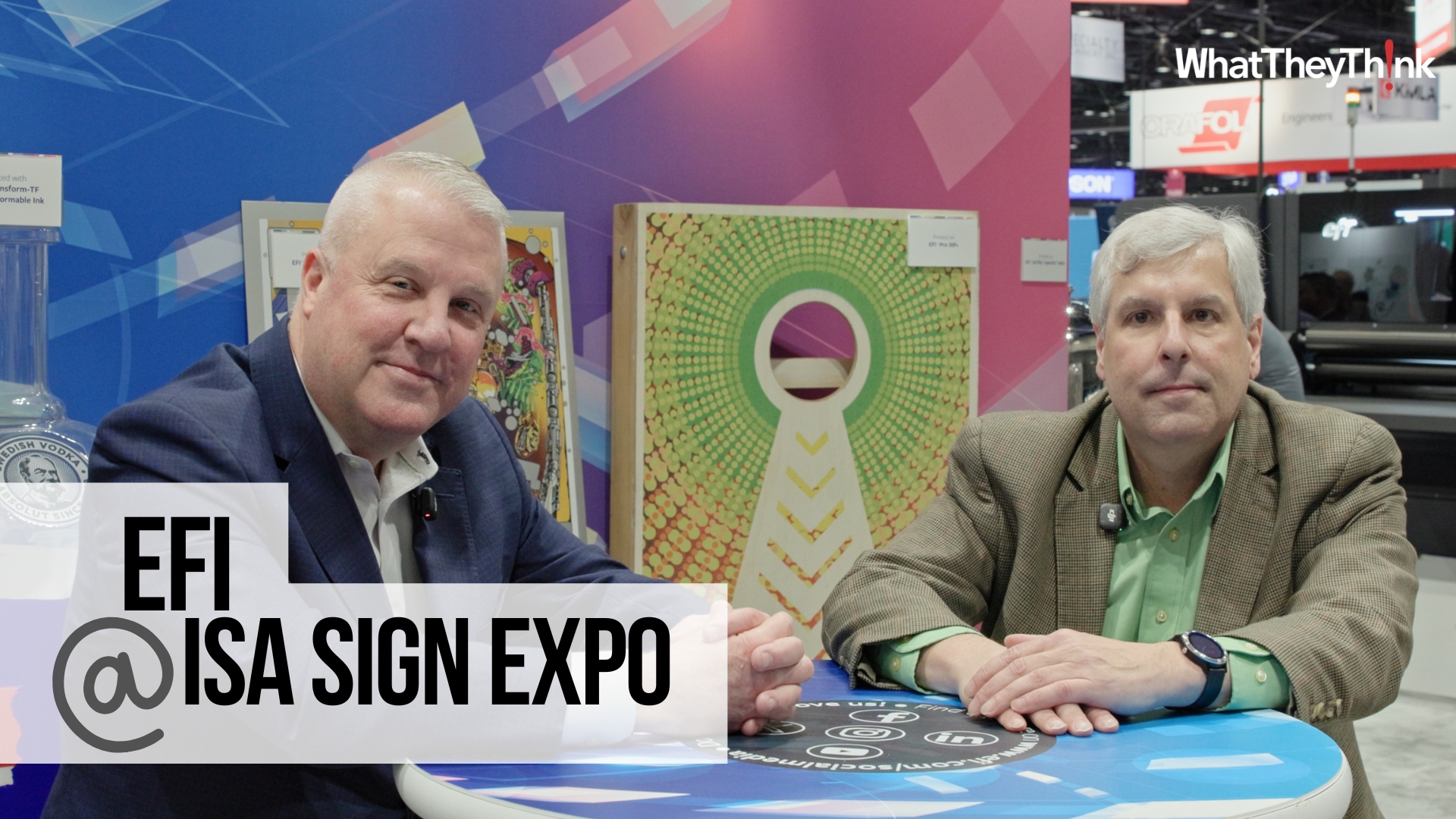
We spoke with Tim Murphy, President of iJetColor by Printware, about the company’s extensive history, its current lineup of inkjet envelope printers, the promise of inkjet, and tips for leadership.
WhatTheyThink: Let’s start with some background on Printware. iJetColor by Printware recently celebrated its 40th anniversary. How has the company evolved and changed over the years?
 Tim Murphy: We’ve always served the print market, and our first products were high-resolution laser printers. Then we morphed into computer-to-plate and laser systems that were using shorter-run CTP polyester plates for very functional printing—things like business cards and checks, business forms, those sorts of things. We saw trends beginning: more complex work, more colorful work, more personalized work. And as the computer-to-plate world began to end and we saw these changes in offset and what customers were looking to do—which was this giant drive to go digital and become more productive—we said, “how is a little company in, say, St. Paul, Minn., going get into inkjet?”
WTT: You began that journey in 2014.
TM: And it was with a product from Memjet, one of the early game-changing, high-quality, high-resolution, single-pass, four-color printheads. We sold over 1,500 of the inkjet envelope presses from 2015 through 2020. They really served a need that had been getting met by xerographic technology previous to that. So customers were looking to go digital and transfer either toner-based work or outsourced work to more profitable inkjet envelope presses like our iJetColor systems.
WTT: You focused on envelope printing equipment.
TM: Put it this way: nobody ever wanted to design an envelope press, right? (laughs) Nobody ever wanted to make a printing press geared exclusively for that other than offset, because envelopes are hard to print. Envelopes have lots of layers, they come in odd shapes with flaps and gum, they’re different sizes, and other materials—all of which makes them hard to feed digitally. But that’s really where inkjet also fits really well. You could personalize them, you could address them, you could introduce variable data, and thus envelopes were a perfect fit for inkjet. That’s why in 2020 we designed and built our own line of inkjet envelope presses launched under the model iJetColor1175.
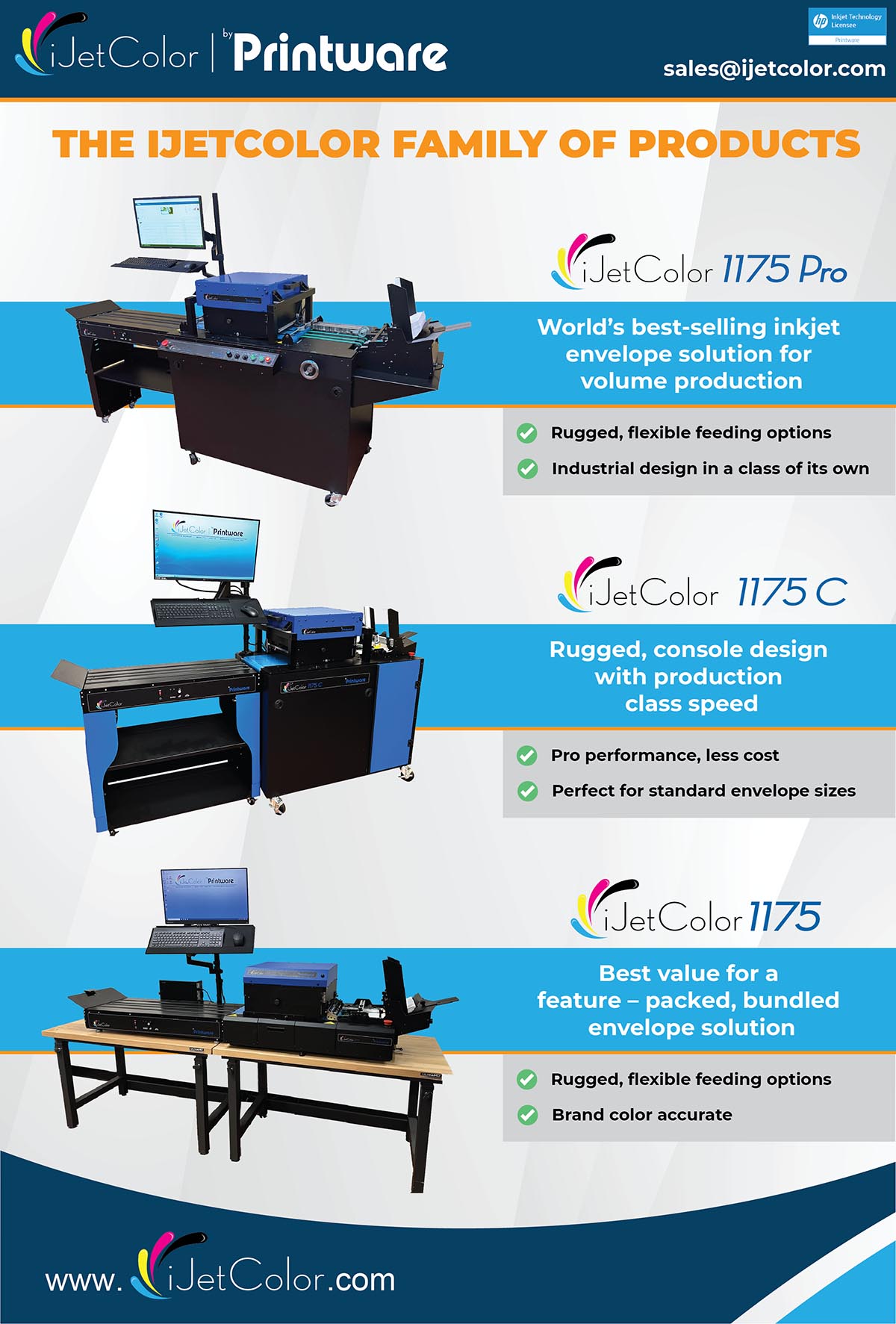
In 2020, we adopted the HP’s FI-1000, which is their page-wide TIJ [thermal inkjet] head. It fit the width—11-3/4 inches—of every envelope in the world, it had a pigment-based ink, it was faster, and it had a black that really looked like an offset black. So we adopted that and added it into our iJetColor 1175. We married that to our own unique feeding systems that are the iJetColor1175Pro, an iJetColor1175C, and a benchtop version iJetColor1175 to provide customers choices for volumes and features from $30K to under $80K and we’ve already sold 750 of those machines to old and new customers. And it’s been a really nice transformation for customers. It’s faster, it’s lower cost to run, and I would argue more color consistent.
At PRINTING United this October in Orlando of 2025, we showed the next generation of HP head, their 108, TIJ 4.0 uniquely configured in our own print bar for four-color that will have higher speeds and even better economics and with great ink options. So we continue to see the transformation of offset and a rapid adoption of inkjet.
We looked at both piezo technology and the next generation of higher-speed technology from companies like HP and Epson. The key is putting together the right performance economics of not only the equipment, but also of the heads in a meaningful way so that you can really apply ink to some meaningful applications. We’re probably never going to be cut-sheet guys, competing with the Indigos or the Canons. We’re going to do the ancillary stuff. As a small company, you have to pick your focus and we feel like we can really add value in feeding small pieces and weird things very reliably and putting the right kind of heads in front of them.
And that really opens up the whole world of packaging. An envelope is really a package to deliver a letter, right? But what other kinds of packages are out there? There are bubble mailers, there are packages that hold pharmaceutical products, auto parts, etc. We’ll be installing a packaging machine in Phoenix in January that’s geared for bags, for example. This customer does a lot of things for veterinary dentists, among other businesses, and even restaurants.
The transformation of packaging from plastic to paper is going to come. It’s already ahead of us in Europe. I think we’re going to continue to see the smarter use of papers, and that’s a really big opportunity for personalizing and tracking batches, for example. And of course, advertising. That’s exactly where inkjet plays a really big role.
WTT: Flashing forward a bit, what have you found to be some of the specific challenges your customers have been facing, especially in the five years or so since the pandemic?
TM: The pandemic was a tipping point, I think, in the print world. Printers really are manufacturers, and they adopt new ideas that help them make more money or get more productive or get them into new businesses. So they’re diversifying, they’re trying to do what they do more productively, and they need to be more profitable. We’ve always seen those as the driving trends. COVID was a particular problem for printers, and some even got shut down. They looked at their workforce and labor thinking about who’s going to be the next pressman or digital operator. It’s like the world changed in one minute and everybody got the lesson, and the lesson was, “I have to change.” Now we’re four or five years later and while the adoption rate of change is trending to prepandemic conversions, it still is fundamentally the same conversations about when is the right time to get more productive and when to add more digital solutions. Customers already know that that will allow them to better use their labor, because they understand the type of labor force that they can get. Finally, we hear from customers about the need to do more complex work really quickly and in shorter runs? So again, inkjet just comes to the forefront of decisions.
WTT: In a recent Product Strategy video that was recorded at PRINTING United, you commented that “customers are looking to do more with inkjet.” What specifically are they looking to produce and what are some of the up-and-coming inkjet print applications that may have been the purview of other print technologies?
TM: I think we’ve been very successful selling inkjet despite with a basic premise: we show customers here is a really cool technology, and then we show them what it can’t do. (laughs). It’s pretty amazing that inkjet is still relatively new in terms of the total print volumes in the printing industry. It’s still less than half of print volumes—and it’s a technology that’s been around for a while. Yet it remains one of the top things people want to invest in. Personally, I think the limiting factor is performance. How good of a quality quality does your customer need? How do these inks perform?
For example, we had an aqueous ink prior to 2020 and now we have a pigment-based ink. All of a sudden, a pigment-based ink means someone can expand into all kinds of mailing applications. Water getting on the surface doesn’t affect it, for example. But our customers are also looking at economics. Look at the big offset volumes. There are shops running 10,000, 50,000 runs. They’re looking at the cost per piece and they’re saying that on smaller systems, those economics aren’t going to work. They need a system that really has the right economics for longer run lengths. So I think what’s changing is that the technology is catching up on capabilities, on performance and quality, and also on greatly improving the economics of inkjet.
WTT: You touched on some of the units in the iJetColor family of products. What are some of the other major entries in that product portfolio?
TM: Our flagship product, the iJetColor 1175 Pro, which uses that HP FI-1000 fixed imager head and a pigment-based ink allowed us to adopt features and configurations to a full product family from entrylevel to replacement of offset presses. With the development of that product, we were trying to solve a very simple problem: how do we make an envelope run better? So we made it a modular system. We looked at every feeding system in the world, and we could never find one that would reliably start an envelope and accurately align it. So in our system, we get it going and then we align it really accurately—in envelope printing, alignment matters. And then we really have to hold it down. So you need a vacuum and you have to create a great surface when you start putting ink on it. So that’s our Pro product, which we launched right after the pandemic. And we found that it was a light industrial product that we didn’t know there was a category for. We didn’t realize how many people were still really desiring to convert volumes from offset presses to envelope printers, and they couldn’t do it on a little benchtop device. Now customers are on the right track to get more of that volume because we just saw the need. Customers say, “I need this.”
Over the years, for most of our customers, we have relationships that are 10, 20, 30 years, and we have a set of customers that literally have bought every machine we’ve made. They really told us what to do next, and we listened. That’s a fun experience when customers tell you what they need. We’re also honored that they trust Printware with sharing their dreams for their next dream machine.
WTT: That leads to one of the topics we write and talk about in these executive Q and As: leadership. It seems leadership has never been more important, especially today. How would you describe your leadership style and what are the important qualities you think that a leader should have, whether it be of a printing company or of a technology company?
TM: At its simplest, leaders fundamentally listen to their customers. And a good leader inside the business would listen to their employees. Making sense out of what you hear is the real trick to this. One of our strengths has been that we have people who have been in the business a long time, and then we have a lot of young people. It’s really fun when you get the intergenerational groups together and you go, “Hey, we should do this,” and different people have different opinions, but when you meld it all together you begin to see trends that are really clear.
What we hear from customers is that what they really want is productivity. They want an improvement in productivity that will help solve a real problem and make it easy to do business with them. We really work hard to be easy to deal with. We try very hard not to nickel and dime anybody. When you buy a machine from us, there aren’t any options. We’re going to give you the machine, we’re going to give you the right service to get started, we’re going to give you the workflow, we’re going to give you the computer—and we’re going give you the table to put it on. Cumulatively, we look more expensive than everybody else, but you get everything you need. And that bundled idea is just how we would want to buy equipment.
Sometimes talking with customers can be surprisingly meaningful. We had a conversation with a new customer who does a lot of funeral work—envelopes and the various inserts. He said, “A customer came to us and said, ‘Our son [who had passed away] was a phenomenal basketball player. We want to add this picture of him on this card.’” Our customer knew that this was not what it was designed for that, but they did their best, they showed it to the family and the family cried—not because it was bad printing, but because of the meaningfulness of being able to personalize something. I was floored by that story and so was our customer, that we can have a technology and it can make such a difference in our customers lives that we probably didn't even intend. Ultimately, it’s about listening to what customers want, making it really easy for them, and understanding what they’re trying to do, that they are trying to help other people communicate a lot smarter and a lot better.
WTT: Are there any emerging but not yet dominant trends that you think customers and perhaps the industry in general is going to have to contend with in the next few years?
TM: Higher-speed printheads, the ability to run a wider range of inks, and the ability to print on a whole wide range of materials. I think it's a cool confluence of technology and materials science. I think the best years for our industry and this technology are ahead.
Going back to that idea about manufacturing—print is primarily transforming one thing into another thing. Some of the most successful products in our industry are taking different kinds of paper and making little things, big things, printed papers, price sheets, menus, etc., etc. Companies also transform, they get more productive, and there’s the constant need to transform things—and to do it fast and efficiently, and yet to make somebody cry about it, to make it emotional, meaningful, and memorable. That’s why it’s been a fun 40 years.
At the end of the day, it’s fun to look around the world and say, “Wow, I wonder how they made that. I wonder what that’s made of. Is that platic? Is that paper?” You begin to know those things, but it’s that transformation of things that make the world a better and a brighter place. I think so. So we certainly keep looking for technologies that can make a difference and help people better communicate no matter the media.