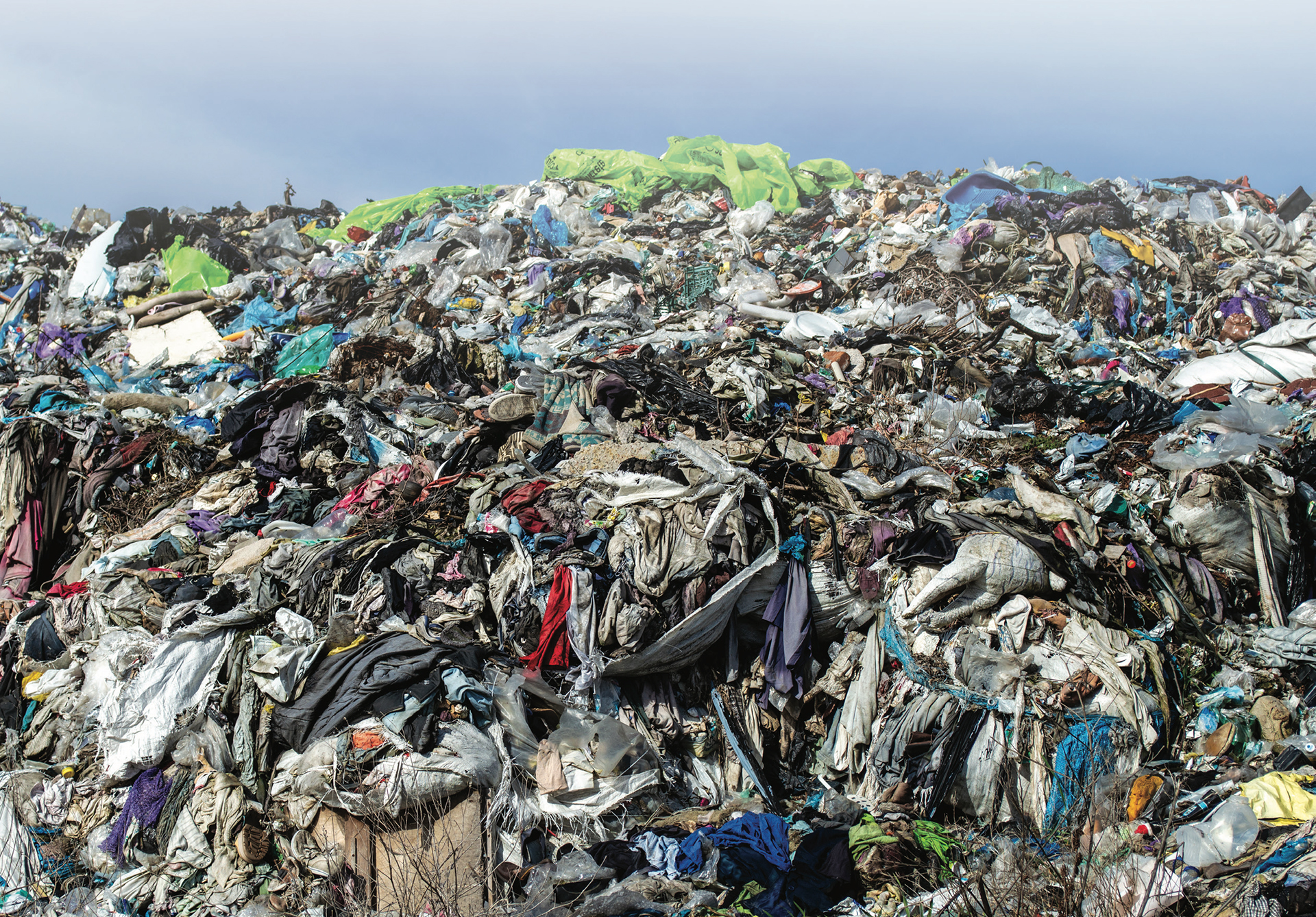
As we have stated many times—as have most other news and analysis sources covering the textiles industry—textile waste is a huge problem. Greenpeace reports that internationally, a staggering 92 million tons of discarded garments find their way into landfills, out of the 100 billion produced every year. They also note that many people will dispose of clothes within a year, often after no more than 10 wearings!
Discarded textiles are also incinerated, which adds to CO2 in the atmosphere.
Yet we’re still manufacturing more and more garments, the majority of which are made of, or at least contain, synthetic materials sourced from oil. And then there’s the dyeing. Not only is textile dyeing the world’s second-largest polluter of water, since the water leftover from the dyeing process is often dumped into ditches, streams, or rivers, but the dyes also make textile-to-textile recycling difficult. How do you remove the dyes without damaging the structure of the fibers?
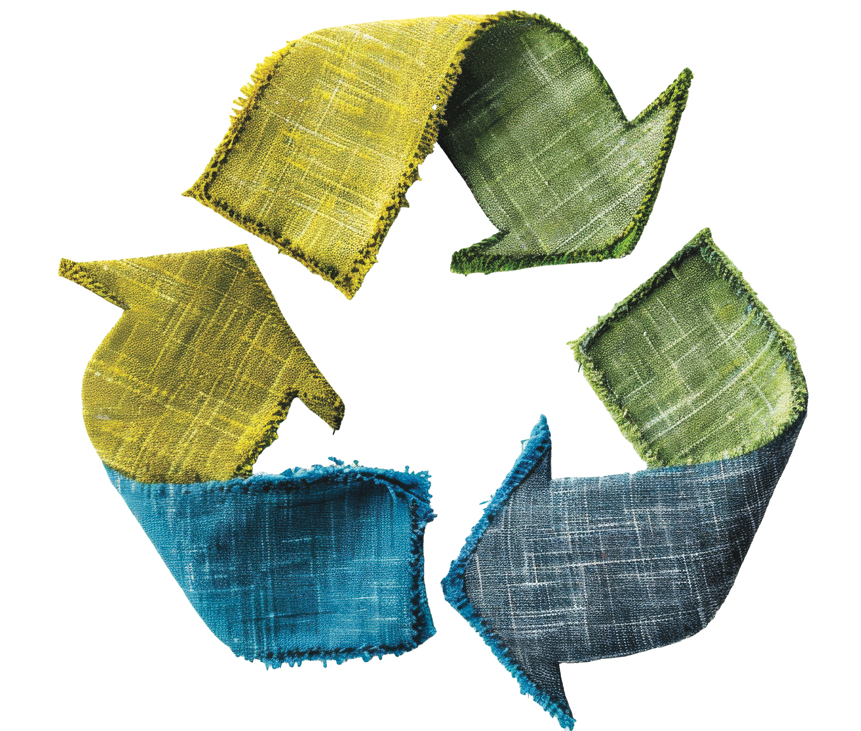
Another huge issue for textile-to-textile recycling is the fact that most fabrics consist of multiple types of fibers, rather than being mono-fiber; for example, poly cotton. How do you separate the fibers from each other, and how do you even determine exactly what fibers are in textiles that are disposed of?
You might wonder why textile-to-textile recycling is getting so much attention of late. Well, one big reason is that the more fiber we can recapture and reuse, the less virgin fiber is required to keep up with the demand for textile-based products, whether those fibers are natural, such as cotton or silk, or synthetic, such as polyester or elastin (Lycra). If we can recapture the fibers at scale and in the process remove (and reuse!) the dyes, that would be a major step in addressing textile waste. So that’s the background. And now the good news—technology is catching up with the need, and there is some good progress being made.
Textile-to-Textile: The Regulatory Impact
As usual, Europe is ahead of the U.S. in terms of its recycling efforts, and even ahead of its own regulations in some cases. Case in point: Circ is building its first (we hope of many!) industrial scale textile-to-textile recycling plant in France. Reju is doing the same in The Netherlands. While these are laudable achievements, it is interesting to note that Teijin launched the first chemical textile recycling process in Japan two decades ago! This according to a recent article in The Sourcing Journal.
The publication cites a report by Systemiq which notes that despite recent advances in textile recycling technology, adoption is still “frustratingly embryonic.” The bottom line is that access to suitable feedstock is a challenge, pretty much around the globe. Why? Because the current system is set up to send textile waste to landfills or incineration, and changing massive systems such as those represented by the global textile industry is not a trivial undertaking. Also, as the Systemiq report points out, “Producing recycled polyester from post-consumer textile waste in Europe costs roughly 2.6 times more than pumping out a virgin version in Asia. Even employing used PET bottles still comes out the better deal, fiscally speaking.” So there’s that. There’s little real incentive to drive change.
So while the efforts of the likes of Circ and Reju should be applauded, regulatory changes and enforcement will also be required to get to scale. Currently, according to the report, the European Union has an annal 30,000 metric ton depolymerization capacity. Systemiq identifies three ways it could get to 340,000 tons, still only 15% of Europe’s projected demand, nonetheless a breakthrough. As noted, access to appropriate feedstock needs to be improved; market demand needs to be bolstered – brands, retailers, and consumers alike need to drive this change; and reducing production costs – bringing them more in line with the cost of using virgin feedstocks.
Circ uses a proprietary hydrothermal process that recovers the original materials from polycotton blends, a unique process that shows a great deal of promise. This process, unlike previous attempts, is able to not only separate the fibers but recover both for reuse in like-new textiles, according to the company.
Reju cites a terrifying statistic from The World Counts, a good source of real-time data on the state of the planet. They state that at the rate we are going, we will need two planets to sustain us by 2030!! And as we have stated many times:
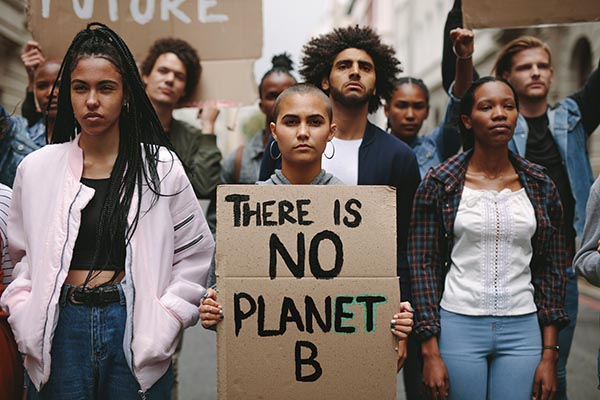
And if past is prolog, most stakeholders are not going to make the required dramatic changes without a push—from consumers refusing to buy their products (not likely) to requiring producers to pick up at least part of the tab. According to The Sourcing Journal article referenced above, “Earlier this year, EU legislators adopted a requirement that all member states establish an EPR [Extended Producer Responsibility] scheme, one that mandates that all domestic and international businesses placing textiles in their national markets shoulder the financial responsibility of collecting, sorting, and recycling their products.” This won’t happen overnight, but it could go a long way toward balancing the financial impacts of virgin versus recycled fibers.
The article concludes with a quote from Clara Luckner, director and fashion lead at Systemiq: “In the absence of policy or other mechanisms, so without targeted policy and industry action to address both affordability and accessibility barriers, depolymerization will remain stuck in pilot purgatory, and the breakthrough to mass adoption will not happen. The linear status quo will continue to deepen Europe’s and the world’s textile waste crisis.” And really, these efforts are primarily taking place in Europe at present, whereas they need to be global efforts.
Fiber-to-Fiber: An Innovative Approach
Another—and likely more sustainable—approach comes out of the University of Nebraska-Lincoln. Yiqi Yang Charles Bessey Professor. Department of Textiles, Merchandising & Fashion Design, and his team have come up with a different way of handling textile waste.
We spoke with Dr. Yang recently and he explained their process. The goal was to reduce microplastic pollution by reducing the usage of virgin materials by recycling them in a closed loop system. He says, “Recycling textiles sounds easy, but it’s not. It’s not like an aluminum can, because most of the textiles that we use are blended fabrics, composite materials. They might be pure cotton, but they might include elastin. It might be poly cotton, etc. So you can collect the stuff, but then what?”
He also points out that it’s not just as simple as recycling the fabric. Apparel, for example, has other components, ranging from buttons and zippers to facing material. Of course, separating out those components with human hands (or robotics?) can be done. But human hands cannot separate polyester from cotton in a blended textile, obviously. And the current processes for mechanical recycling are destructive, requiring adding more than 50% virgin fibers to the recycled fibers to make usable yarns.
In addition to the composition of the fabric, you have to take into consideration of the dyes being used. How do you separate the dyes without damaging the fibers? And can you recycle those dyes for reuse as well? And what about the chemicals used to separate fibers? Most current processes dispose of the chemicals, causing another pollution problem.
His team tackled all of those challenges and had developed a very promising solution. Once collection sites are set up, and the collected items sorted using infrared means such as that used by TOMRA, his process kicks in.
First, they have developed a technology that produces high-quality fibers, reducing the need for virgin fibers to create new fabric. In a textile recycling first, Yang and his team have found a way to remove the dyes without damaging their foundational structure or the fibers. He says, “It not only recycles the fibers successfully, but also recycles the solvents and dyes used in the process”—a closed-loop system that also reduces water waste. Yang is pursuing a patent for the technology. He notes that everything they did in developing this system was done with large-scale production in mind, and ensuring excellent fiber quality as well as competitive cost.
As if that were not enough, he’s also looking at creating new fibers using agricultural waste such as chicken feathers.
Of course, to launch this solution at scale will require significant investments and a change in behavior for both brands and consumers. Yang’s team has done the heavy lifting, making something previously thought impossible, possible. Now we need the rest of the stakeholders to do their part. Yang suggests formation of a consortium of big name brands to share the cost burden of making this process a reality at scale. He asserts that the fibers output from the system, and the dyes, can be used without any major changes in the apparel manufacturing process. The consortium could also be an arm for educating consumers about the value of products made from these recycled products—the value to them, to the brands, and of course, to the planet.
View the full video conversation here.
Looking Ahead
While these developments are encouraging, there is still a great deal of work to do. As consumers, we can buy less and use the products longer, or resell or upscale them at end of life. As brands and retailers, we can aggressively work to adopt these newer technologies to substantially reduce our dependence on virgin fibers and as a side benefit, to reduce the amount of microplastics in the environment.
We’ll be watching as these promising technologies mature, and hopefully scale rapidly so we don’t need two planets by 2030!
List of Resources
Circ: https://circ.earth/
Reju: www.reju.com/
Sourcing Journal: https://sourcingjournal.com/sustainability/sustainability-materials/europe-systemiq-polyester-textile-recycling-tipping-point-1234749274/
Systemiq: www.systemiq.earth/
Teijin: www.teijin.com/
TOMRA: www.tomra.com/waste-metal-recycling/applications/waste-recycling/textiles
The World Counts: www.theworldcounts.com/