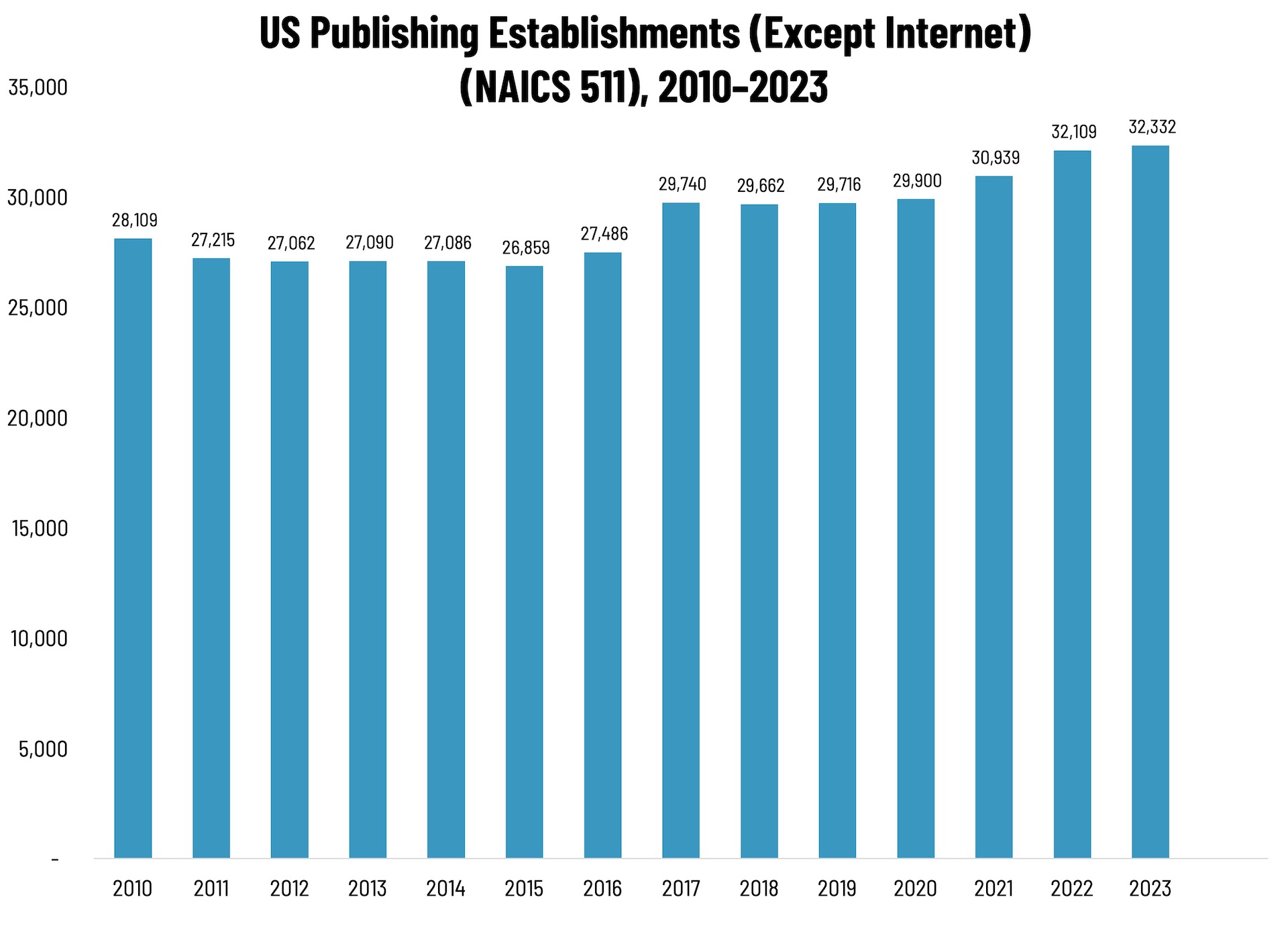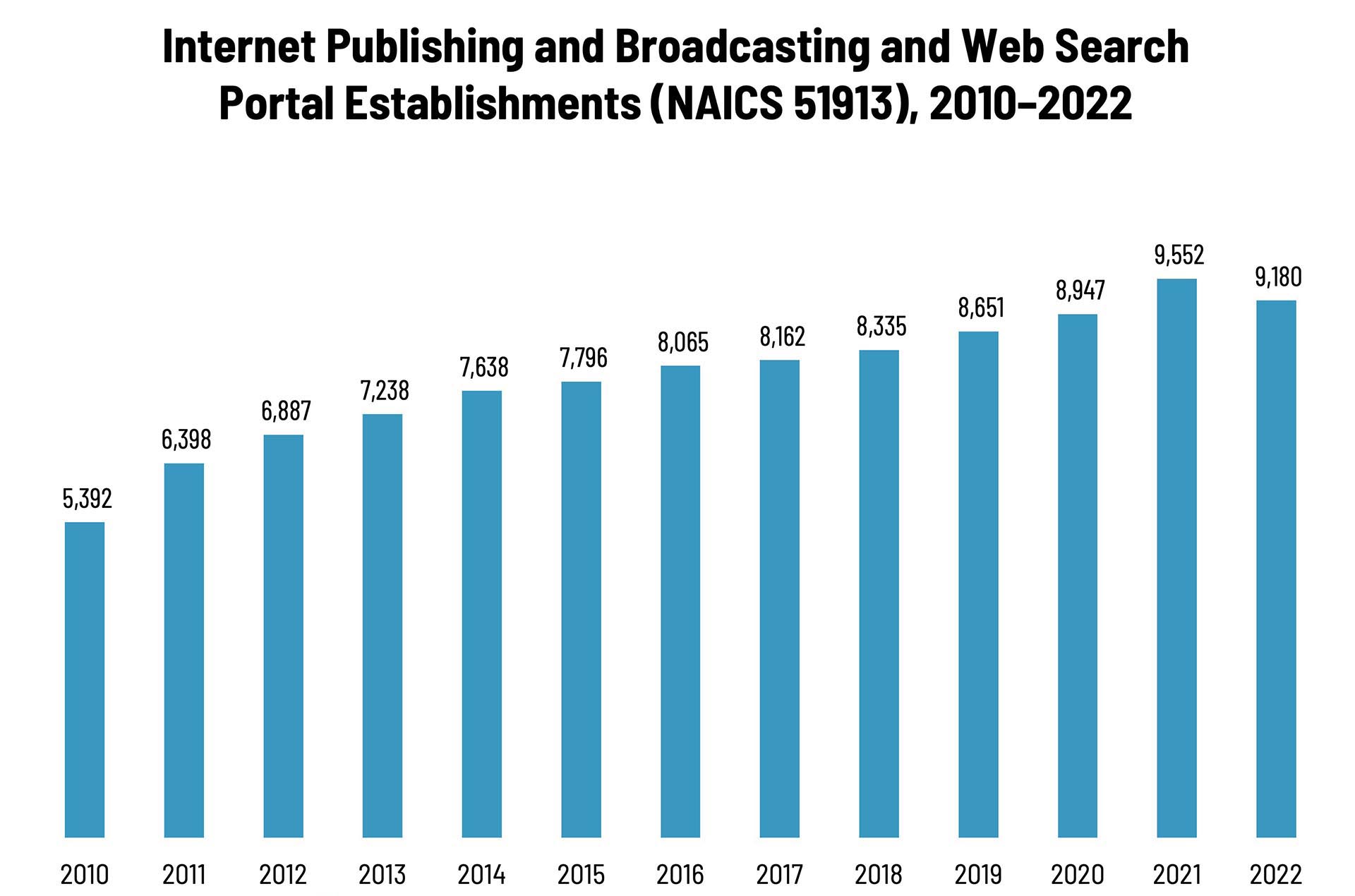
Our Friday data slice’n’dice look at the latest edition of County Business Patterns has been detailing the publishing industries. As 2022 began, there were 9,180 establishments in NAICS 51913 (Internet Publishing and Broadcasting and Web Search Portals). This category saw a net increase of 70% since 2010, but a 4% drop from 2021.
The Bureau of the Census definition for this business classification is:
This industry comprises establishments primarily engaged in (1) publishing and/or broadcasting content on the Internet exclusively or (2) operating Web sites that use a search engine to generate and maintain extensive databases of Internet addresses and content in an easily searchable format (and known as Web search portals). The publishing and broadcasting establishments in this industry do not provide traditional (non-Internet) versions of the content that they publish or broadcast. They provide textual, audio, and/or video content of general or specific interest on the Internet exclusively. Establishments known as Web search portals often provide additional Internet services, such as email, connections to other Web sites, auctions, news, and other limited content, and serve as a home base for Internet users.
The 2010s saw the explosion of social media and podcasting, while not entirely new, also took off in this period, as well as general Internet publishing. The explosion in this category was largely due to reduced costs of entry in the form of publishing, recording, and editing hardware and software, and increased access to WiFi and other broadband Internet. Low overhead costs also mean that huge revenue streams are not required for these kinds of businesses to survive. For many bloggers, “hobbyist” publishers, and podcasters, a sustaining revenue is all that is required.
At the higher end, Internet publishing companies now rival major, traditional newsgathering establishments—Huffington Post, Buzzfeed, Slate, and Salon are sourced as often as “gray lady” publishers like New York Times or even CNN.
Twitter, Facebook, LinkedIn and other social media companies—like TikTok—are also found in this category. These are now major media players that compete for advertiser and marketer dollars—often at expense of print and other traditional media.
And trade publishing across many industries is increasingly of the Internet variety. Indeed, WhatTheyThink fits into this category.
As for the decline from 2021 to 2022, looking at the changes in the individual size categories, there has been some consolidation in this category.
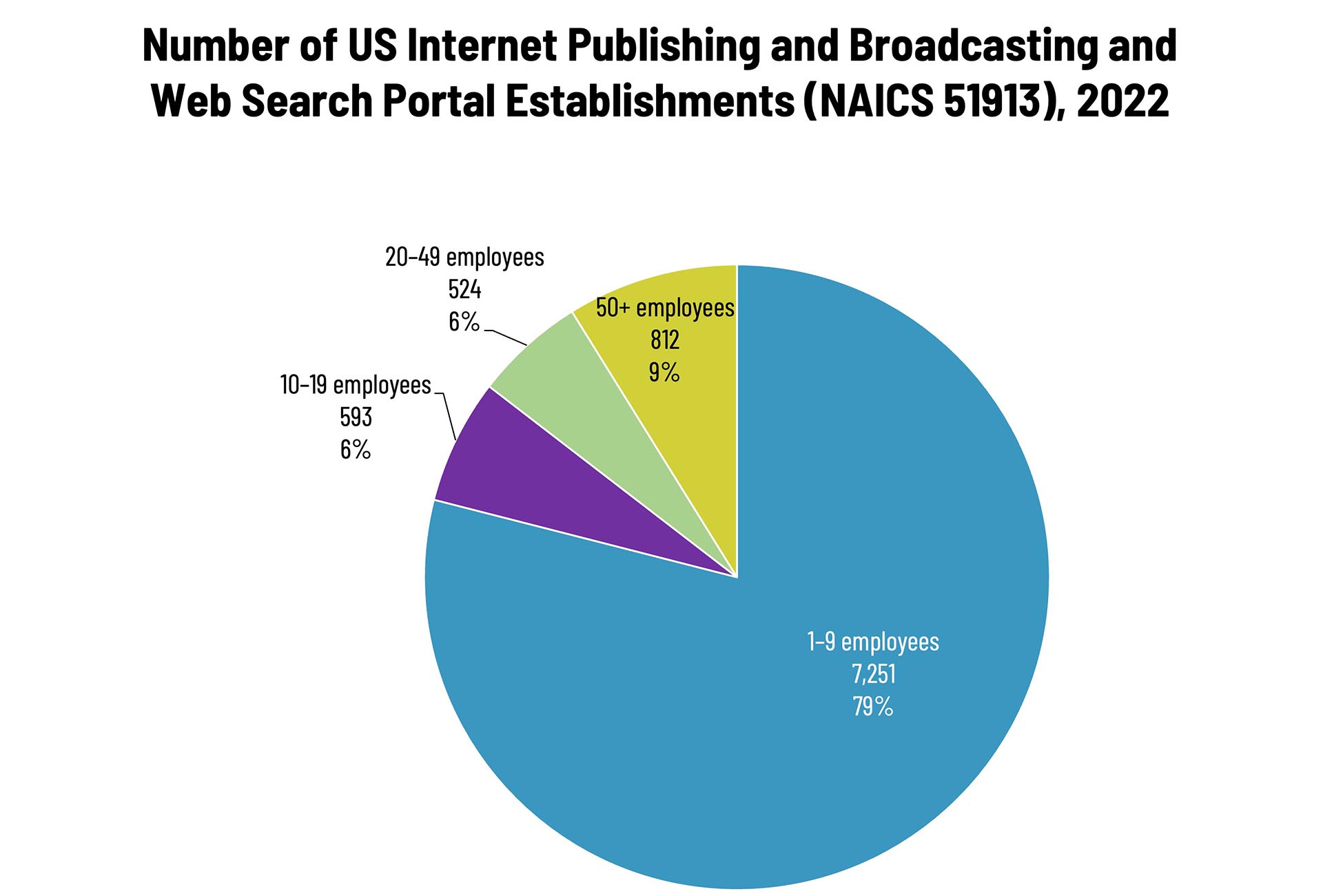
Establishments in this category are concentrated at the lower end of the employee-count spectrum. Small Internet publishers (1 to 9 employees) account for 79% of all establishments, with the other three size classifications account for 6–9% each.
These counts are based on data from the Census Bureau’s County Business Patterns. Every other week, we update these data series with the latest figures. These counts are broken down by printing business classification (based on NAICS, the North American Industrial Classification System).
Next time, we’ll turn our attention to the converting NAICS categories:
- 3222 Converted Paper Product Manufacturing
- 32221 Paperboard Container Manufacturing
- 322211 Corrugated and Solid Fiber Box Manufacturing
- 322212 Folding Paperboard Box Manufacturing
- 322219 Other Paperboard Container Manufacturing
- 32222 Paper Bag and Coated and Treated Paper Manufacturing
- 32223 Stationery Product Manufacturing
- 32229 Other Converted Paper Product Manufacturing
- 322291 Sanitary Paper Product Manufacturing
- 322299 All Other Converted Paper Product Manufacturing
To clarify what is included in the 2022 CBP, establishment counts represent the number of locations with paid employees at any time during the year. If an establishment existed at any point during the year, it would be included in the CBP count of the number of establishments for 2022 CBP.
These data, and the overarching year-to-year trends, like other demographic data, can be used not only for business planning and forecasting, but also sales and marketing resource allocation.
This Macro Moment
W haven’t checked in in a while with the American Institute of Architects (AIA)/Deltek Architecture Billings Index (ABI), which is a leading indicator for new commercial real estate investment and thus potential new signage projects. According to the AIA, in June 2025, demand for design services continues to be relatively sluggish, although there is a glimmer of optimism:
The AIA/Deltek Architecture Billings Index score was 46.8 for the month, indicating that the majority of architecture firms are still experiencing a decline in their billings. However, inquiries into new projects increased for the second consecutive month and grew at the strongest pace since last fall. This means that clients are starting to send out RFPs and initiate conversations with architecture firms about potential projects after a lull since mid-winter. However, these inquiries do not necessarily translate into actual projects, as the value of newly signed design contracts declined for the 16th consecutive month in June. It is unlikely that firm billings will return to positive territory until the value of new design contracts also starts to increase again.
The billings index has been below 50 for the last year and a half except for October 2024 (anything below 50 is poor). Inflation and construction budgets were cited as the big issues. And some regions fared better than others—business conditions were generally soft nationwide, although firms in the South saw a slight increase in billings for the first time since October. Firms in all other regions saw a decline in billings.
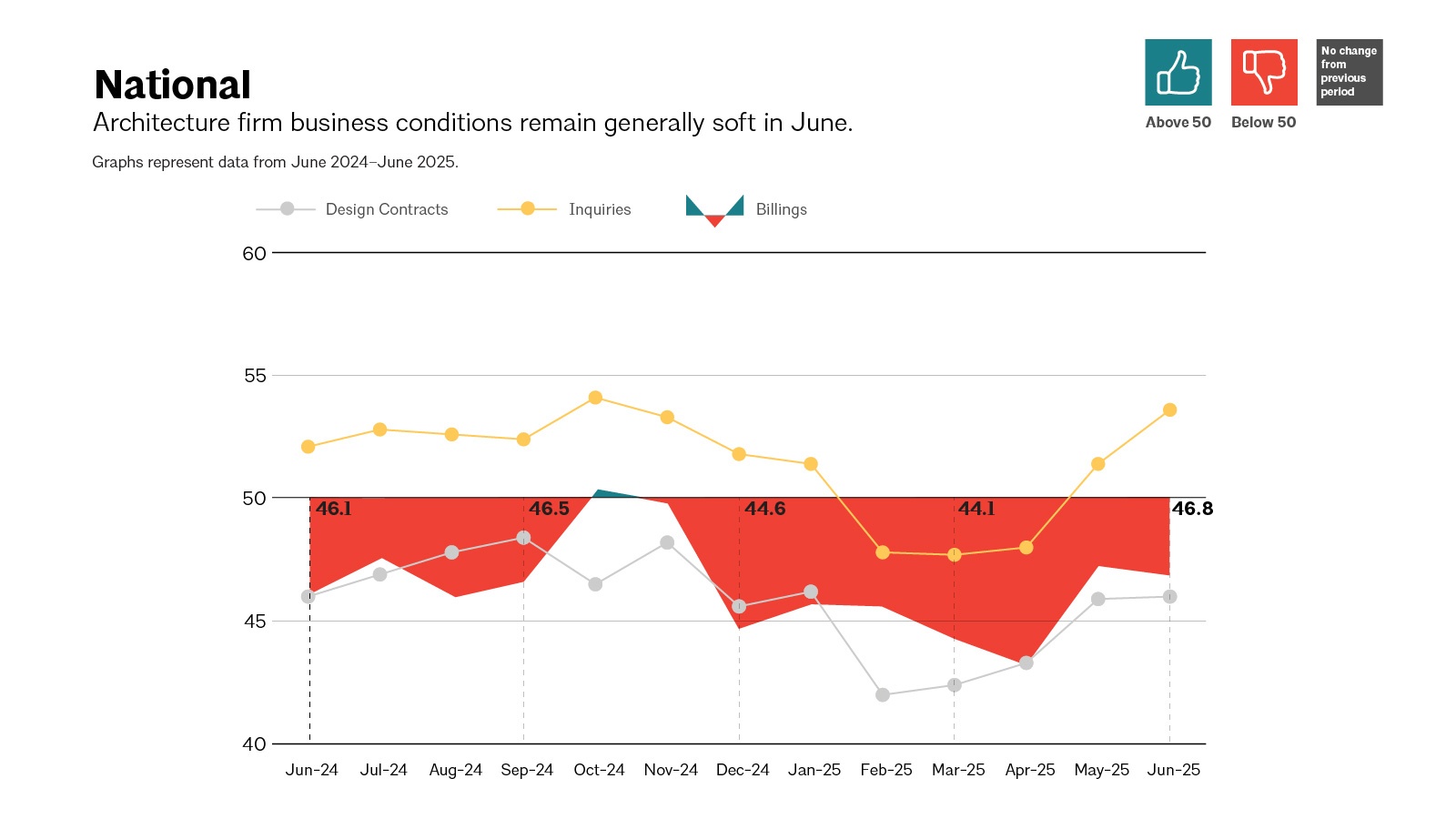
Source: American Institute of Architects
The rule of thumb is that this index leads actual commercial real estate investment by about 9–12 months, so commercial real estate development might also be a bit soft as we head through the latter half of 2025. Sign businesses should keep an eye on construction activity in their area to get a jump on involvement in these projects.