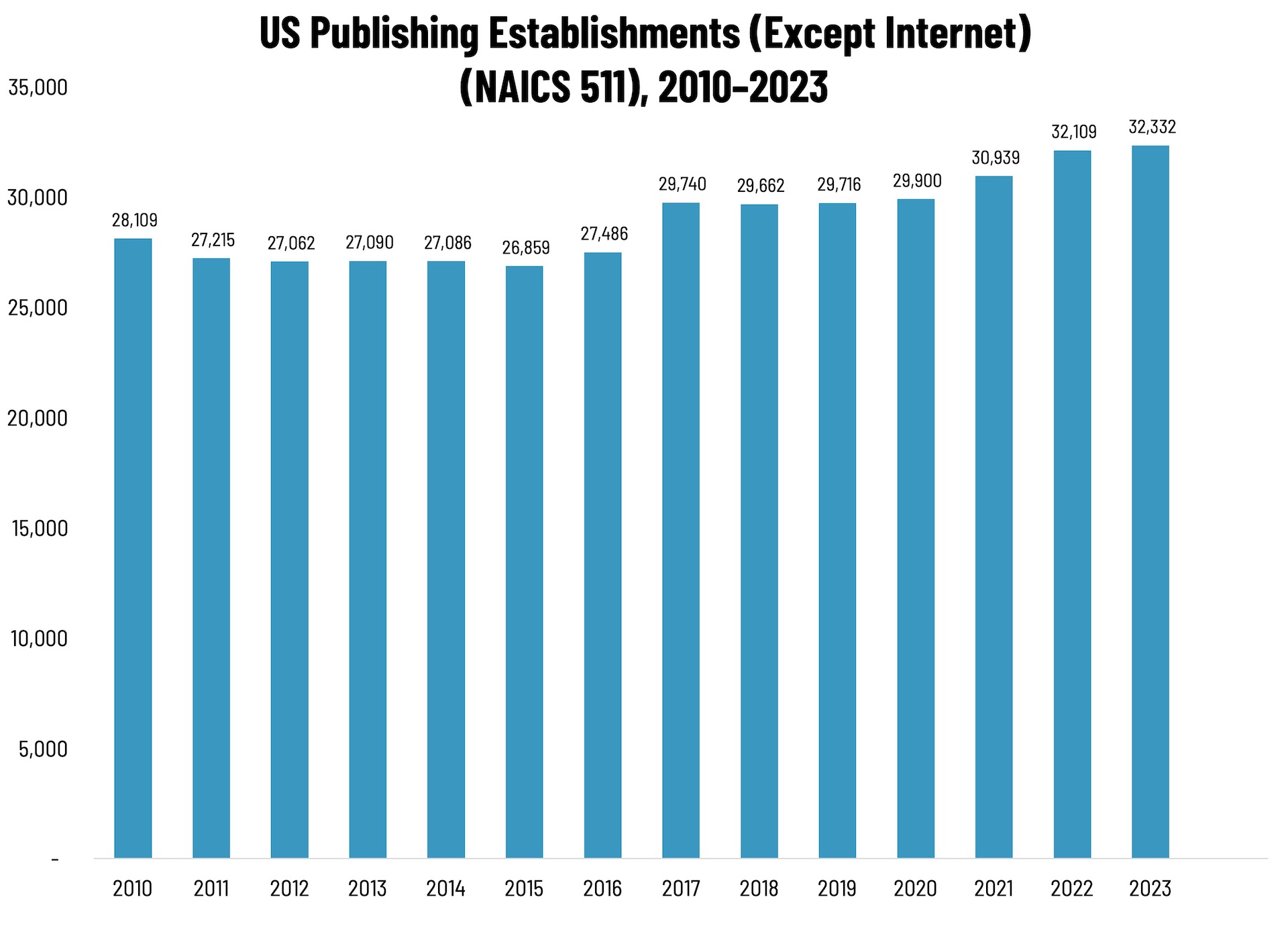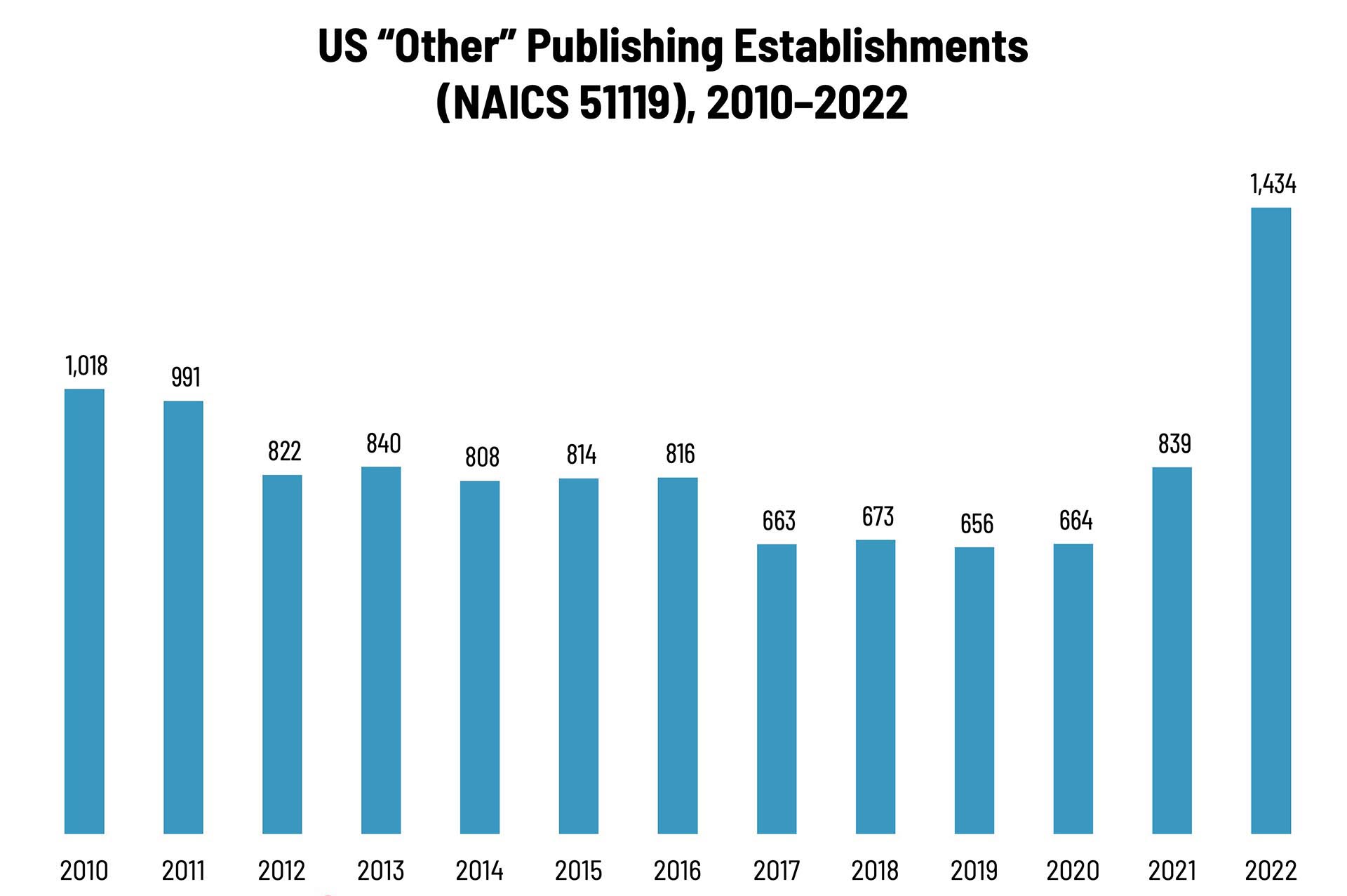
Our Friday data slice’n’dice look at the latest edition of County Business Patterns has been detailing the publishing industries. As 2022 began, there were 1,434 establishments in NAICS 51119 (Other Publishing), a net increase of 41% since 2010—and a 71% increase from the previous year alone. Wha?
This category includes—as the name suggests—a mix of assorted types of publishers. The official description of this NAICS from the Census Bureau identifies it thusly:
This industry comprises establishments known as publishers (except newspaper, magazine, book, directory, mailing list, and music publishers). These establishments may publish works in print or electronic form. (This category includes publishers of art prints, greeting cards, calendars, and others.)
Greeting card publishers are given their own sub-NAICS (511191), which we’ll look at separately in our next slice’n’dice installment.
A lot of the applications produced by businesses in this catchall still remain popular print items, even if the method of their production may have changed, which is why establishments only modestly declined over the past decade, and even increased substantially in the past year. Some general trends that affected these businesses:
- Print postcards have been replaced by posting pictures of trips and events on social media sites.
- Art prints are increasingly produced digitally on inkjet equipment like Epson SureColor units.
- Wall and “page-a-day” calendars are still strong, despite electronic calendars.
- Printed maps are almost entirely replaced by GPS/Google Maps, but there is a market for historical maps as décor items.
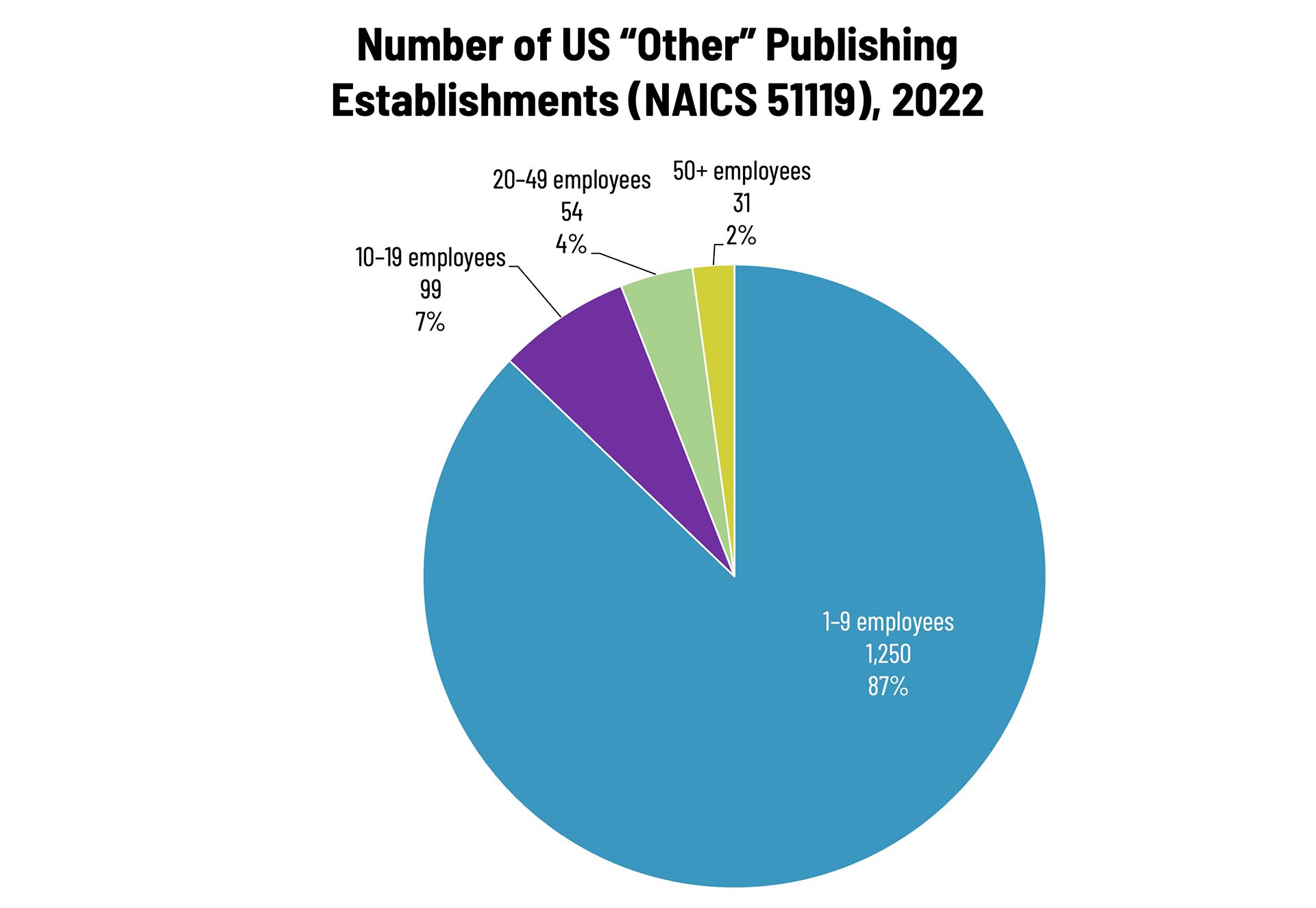
These publishing establishments are concentrated at the lower end of the employee-count spectrum. Small publishers (1 to 9 employees) comprise the bulk of the establishments, accounting for 87% of all establishments, with the other three size classifications each comprising less than 10%.
These counts are based on data from the Census Bureau’s County Business Patterns. Throughout this year, we will be updating these data series with the latest CBP figures. County Business Patterns includes other data, such as number of employees, payroll, etc. These counts are broken down by commercial printing business classification (based on NAICS, the North American Industrial Classification System). Up next:
- 511191 Greeting Card Publishers
- 511199 All Other Publishers
These data, and the overarching year-to-year trends, like other demographic data, can be used not only for business planning and forecasting, but also sales and marketing resource allocation.
This Macro Moment…
One data point we check in with occasionally is the American Institute of Architects (AIA) Architecture Billings Index (ABI), which is a leading indicator for new commercial real estate investment and thus potential new signage projects. According to the AIA, in April 2025, demand for design services continued to decline:
The AIA/Deltek Architecture Billings Index (ABI) score declined to 43.2 for the month. Billings have declined for 28 of the last 31 months, since they first dipped back into negative territory following the post-pandemic boom. Despite generally strong backlogs at firms, inquiries into new work declined for the third consecutive month in April, while the value of new design contracts declined at the majority of firms for the fourteenth consecutive month. Although the U.S. economy is not officially in a recession at this time, many architecture firms are reporting recession-like business conditions.
The billings index was below 50 for all of last year except for October (anything below 50 is poor) and has stayed below 50 for the first four months of 2025 thus far. AIA/Deltek survey respondents’ comments included:
- “Economic uncertainty is leading to project delays and deferrals, as clients have questions about available funding and the ultimate cost of construction in a tariff-fueled materials environment.”—130-person firm in the West, institutional specialization
- “Almost 40% of our contracted projects have officially gone on hold or are unofficially paused.”—20-person firm in the Northeast, mixed specialization
The rule of thumb is that this index leads actual commercial real estate investment by about 9–12 months, so commercial real estate development might also be a bit soft as we head through 2025. Sign businesses should keep an eye on construction activity in their area to get a jump on involvement in these projects.
Our Printing Outlook 2024 report is now available for download! The brand-new report provides detailed analysis of the latest WhatTheyThink Printing Industry Survey, the latest industry economic data and macroeconomic trends, as well as industry and cultural technological trends to look out for in 2024 and beyond. Purchase now!