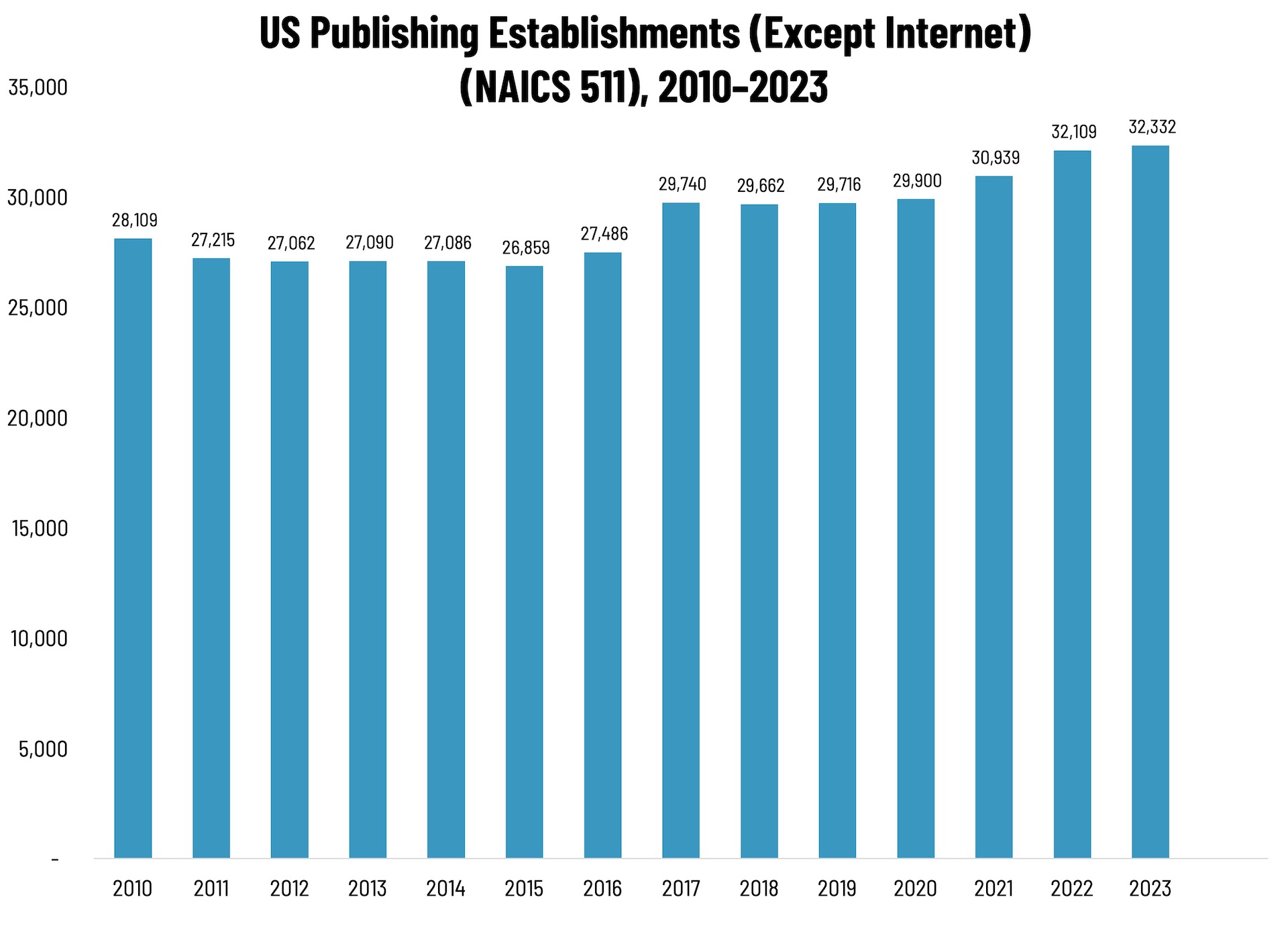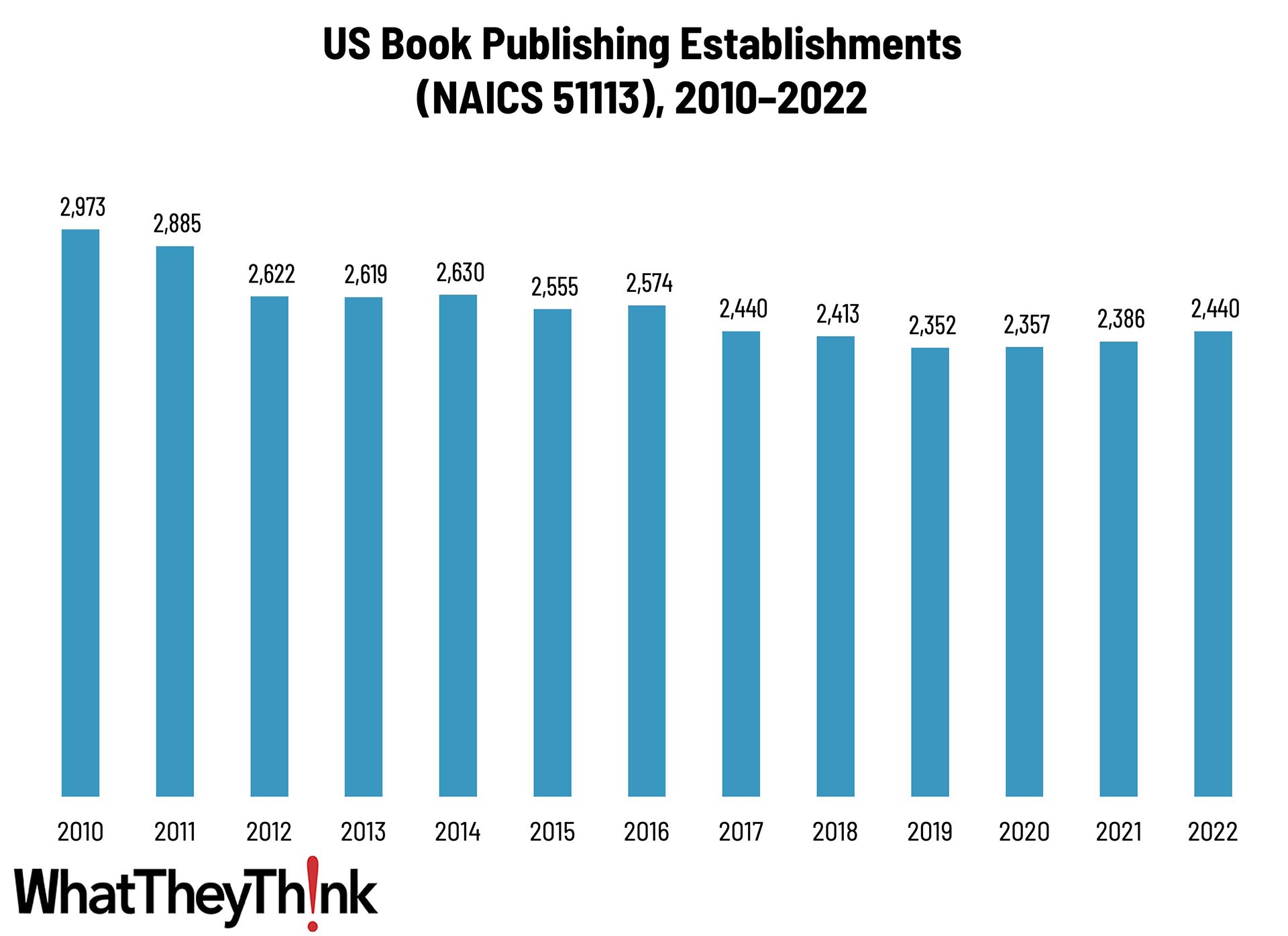
Our Friday data slice’n’dice look at the latest edition of County Business Patterns has been detailing the publishing industries. As 2022 began, there were 2,440 establishments in NAICS 51113 (Book Publishing), a decrease of 20% since 2010, but an increase of 83 establishments since 2020.
The Bureau of the Census definition for this business classification:
This industry comprises establishments known as book publishers. Establishments in this industry carry out design, editing, and marketing activities necessary for producing and distributing books. These establishments may publish books in print, electronic, or audio form.
We’ll look at Non-Employer Statistics* at another time, but it’s worth noting that at least as recently as 2016 there were an estimated 7,977 small or self-publishers in this category. Technology enablers such as electronic publishing, on-demand book production, and e-commerce through companies like Amazon (formerly CreateSpace, now Kindle Direct Publishing) have led to a growing specialty publishing market. When you factor in the ease of creating and publishing ebooks (which are often given away or sold for only a token amount as more of a self/business promotion strategy or tie-in to a speaking gig), some, perhaps many, “book publishers” may not classify themselves as such.
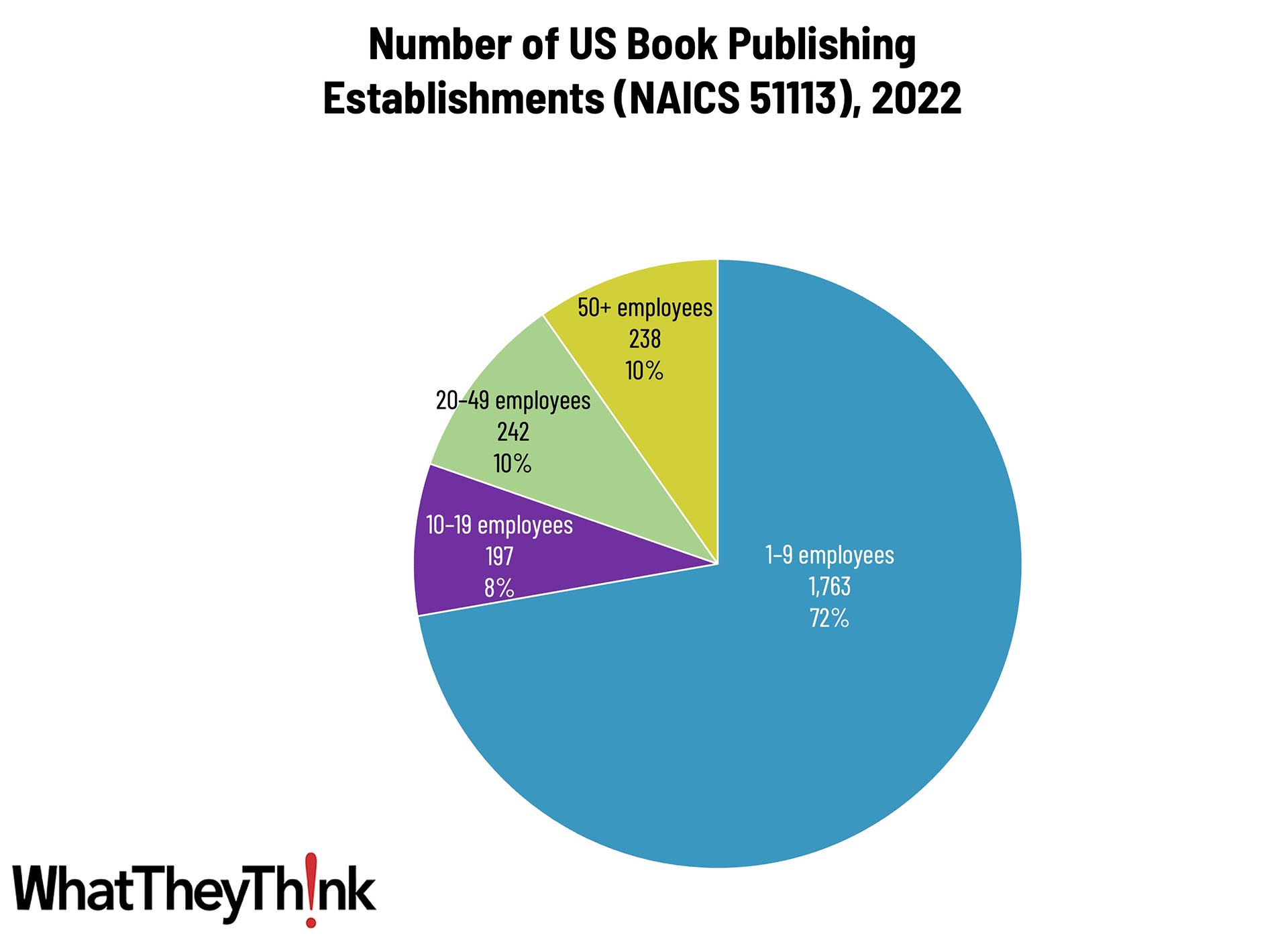
Book publishing establishments are concentrated at the lower end of the employee-count spectrum. Small publishers (1 to 9 employees) comprise the bulk of the establishments, accounting for 72% of all establishments, with the other three size classifications just about equal.
These counts are based on data from the Census Bureau’s County Business Patterns. Throughout this year, we will be updating these data series with the latest CBP figures. County Business Patterns includes other data, such as number of employees, payroll, etc. These counts are broken down by commercial printing business classification (based on NAICS, the North American Industrial Classification System). Up next:
- 51114 Directory and Mailing List Publishers
- 51119 Other Publishers
- 511191 Greeting Card Publishers
- 511199 All Other Publishers
These data, and the overarching year-to-year trends, like other demographic data, can be used not only for business planning and forecasting, but also sales and marketing resource allocation.
This Macro Moment…
Last week, the Bureau of Labor Statistics released the inflation figures for March:
The Consumer Price Index for All Urban Consumers (CPI-U) decreased 0.1 percent on a seasonally adjusted basis in March, after rising 0.2 percent in February, the U.S. Bureau of Labor Statistics reported today. Over the last 12 months, the all items index increased 2.4 percent before seasonal adjustment.
In terms of energy, there was a 6.3% drop in the index for gasoline (which, if you’ve been to the pump recently, you’ve seen), which offset more modest increases in electricity and natural gas. As for food, that index rose 0.4% in March—with the food at home index increasing 0.5% and the food away from home index rising 0.4%. Note that this was before the “tariffopolooza” kicked off, so fingers crossed that inflation stays fairly tame.
* “Non-Employer Statistics” is where the Census Bureau tracks freelancers, sole proprietorships, and other small businesses or individuals. For our purposes, these include graphic designers, small agencies, and small or self-publishers.