 WhatTheyThink’s annual Print Outlook report is now available! Based on our Fall 2024 survey of print business owners and managers, as well as industry and general macroeconomic data, the report provides the latest industry trends, the latest cultural and technological factors that are driving those industry trends, and the overall macroeconomic landscape.
Introduction
One of our Print Business Outlook Survey respondents this year wrote:
“Since this year [2024] has been a monster for growth, we look for more sustainable growth next year.”
Another wrote:
“The top line is up but wages, benefits, utilities, and other overhead items continue to increase significantly and creates downward pressure on the bottom line.”
And yet another added:
All indicators show PAPER IS NOT GOING AWAY!!!
So one of the themes of this year’s Printing Outlook report is that while business has been good, high prices, employment costs, and overall inflation have made it harder to boost profits, even if revenues and jobs are up.
Business Conditions
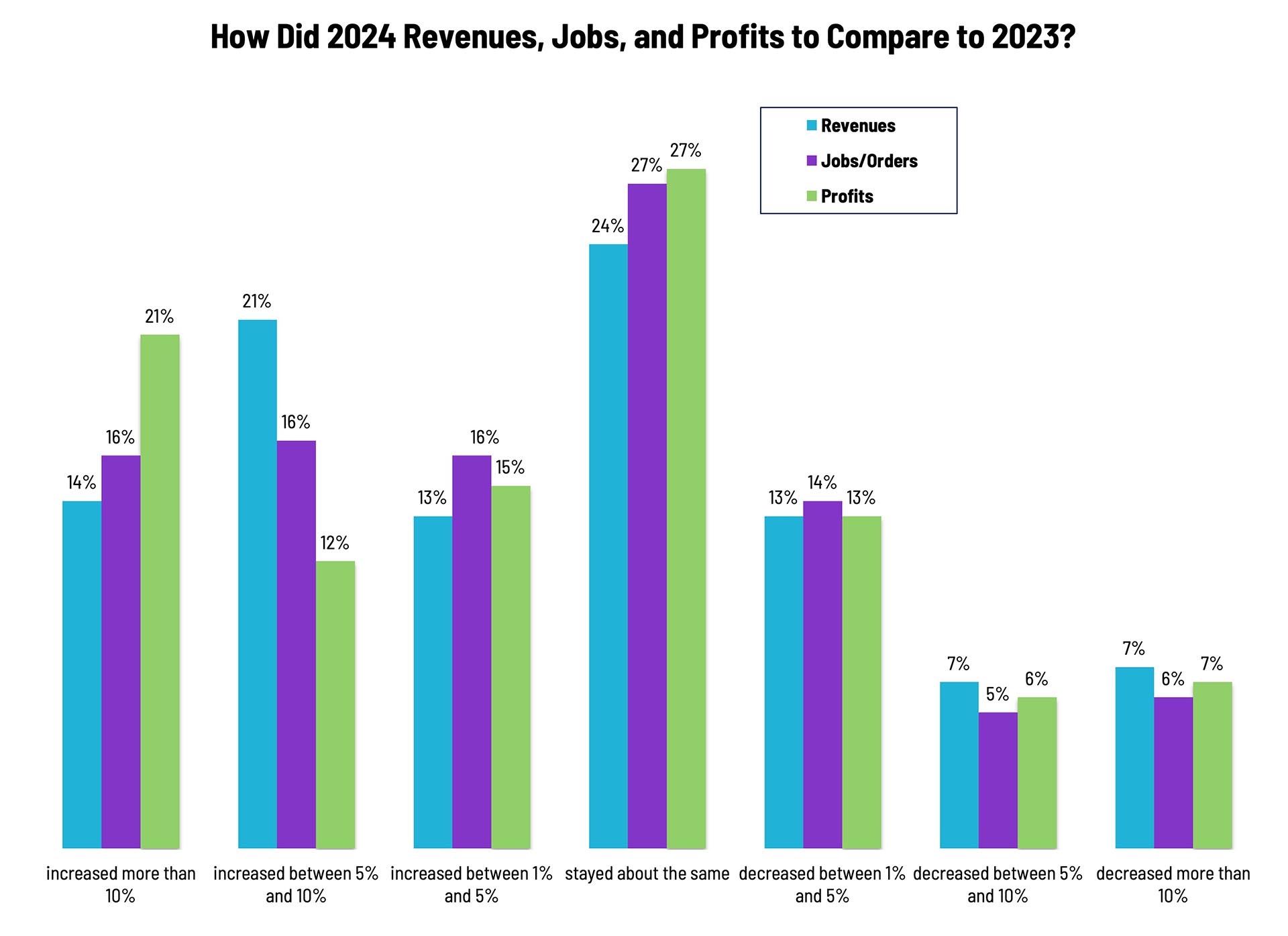
In terms of revenues, 14% of print businesses surveyed said that revenues for 2024 had increased more than 10% compared to 2023, and 21% said that revenues had increased between 5% and 10%. All told, just under one-half (58%) of print businesses surveyed reported an increase in revenues in 2024 compared to 2023—down from 57% who said this last year. We calculated an average change in revenues of +2.0% from 2023 to 2024 (compared to +3.2% from 2022 to 2023). We also adjusted the average change in revenues for inflation, backing -2.9% out of the average change in revenues. So, adjusted for inflation, revenues only grew -0.9% from 2023 to 2024.
In terms of jobs/orders, 48% of print businesses surveyed said that jobs for 2024 had increased compared to 2023. We calculated an average change in jobs of +2.1%, down from the +3.7% from 2022 to 2023. As for profits, 48% also reported that profits had increased compared to 2023. The average change in profits was +2.1% (down from the +2.7% they had reported from 2022 to 2023) or, adjusted for inflation, -0.8%.
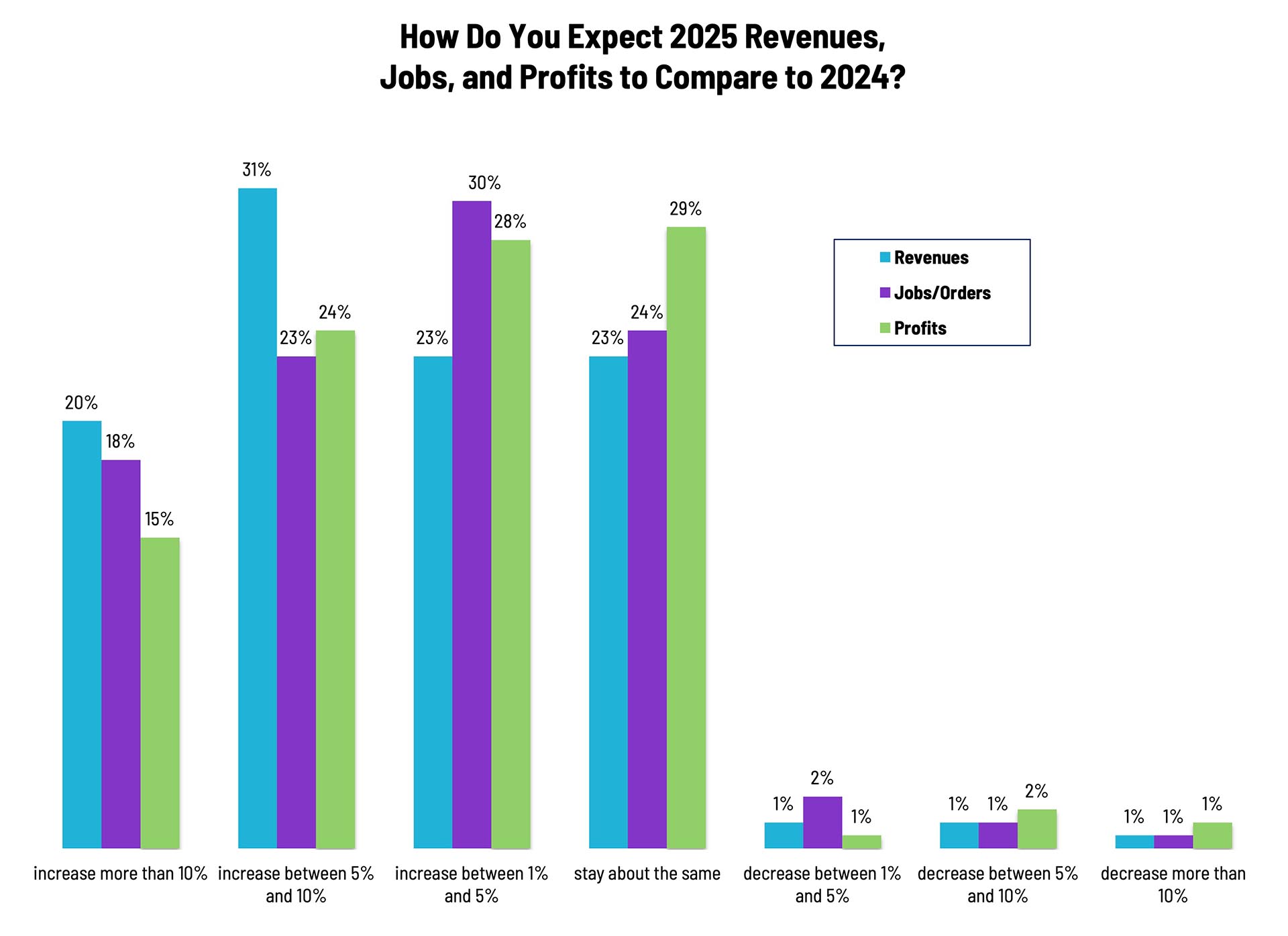
The general expectation is that 2025 will be a little better than 2024, although optimism for 2025 was muted compared to optimism for 2024. Also note that our survey was in the field before the incoming Administration announced its prospective tariffs, which could affect how business ultimately turns out in 2025.
Business Challenges
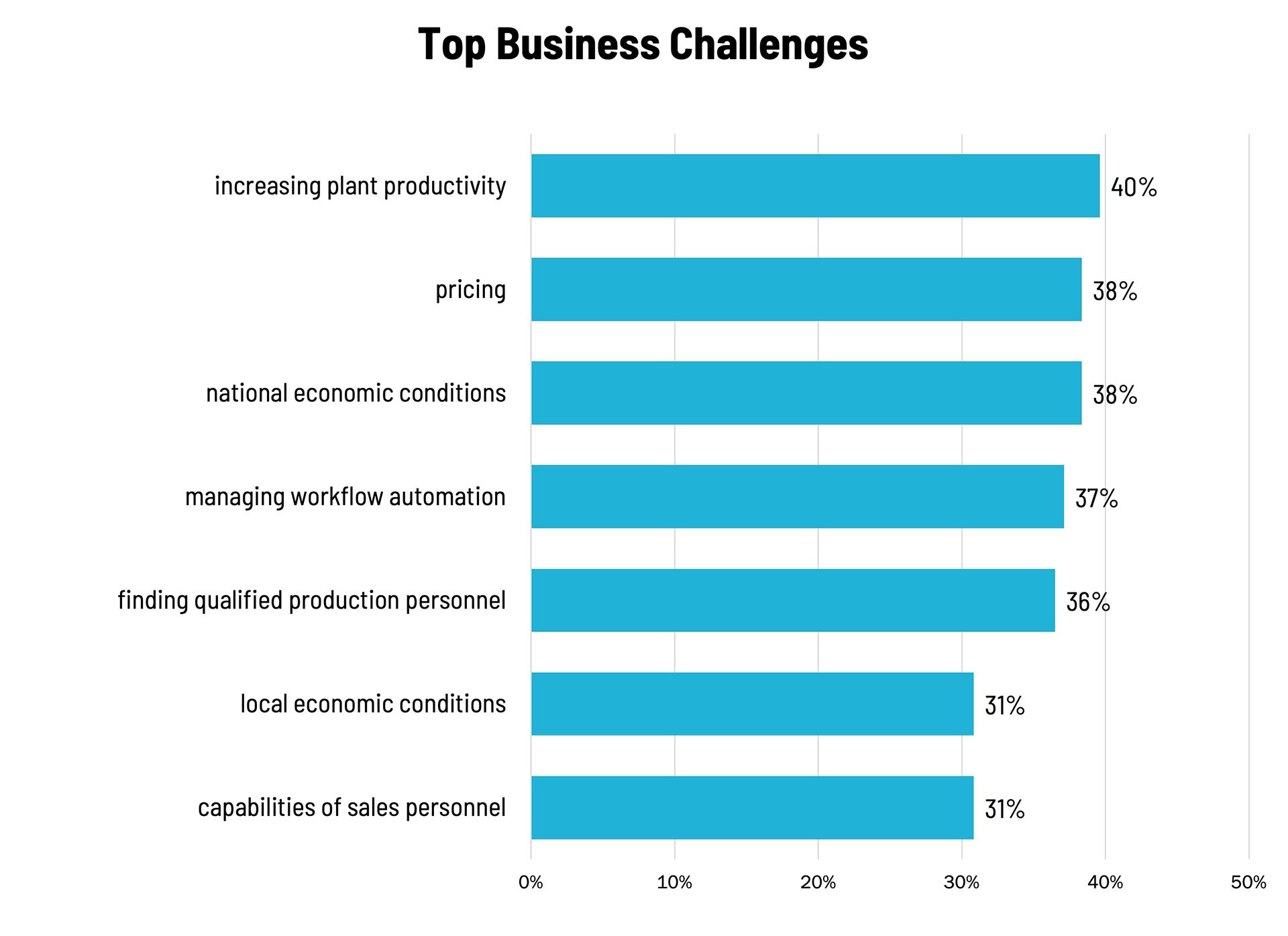
The top challenge this year was “increasing plant productivity,” down slightly from last year’s all-time high of 44%. Number two was “pricing,” selected by 38% of respondents, up from 34% last year but still below 2021’s all-time high of 41%. Tied at number two is “national economic conditions,” selected by 39%. We can interpret “national economic conditions,” down from 41% last year. Number three was “managing workflow automation” at 37%—an all-time high for this challenge and up from 32% last year. It had historically come in in the mid- to low 20%s, but has now finally become an issue that plants must address.
Business Opportunities
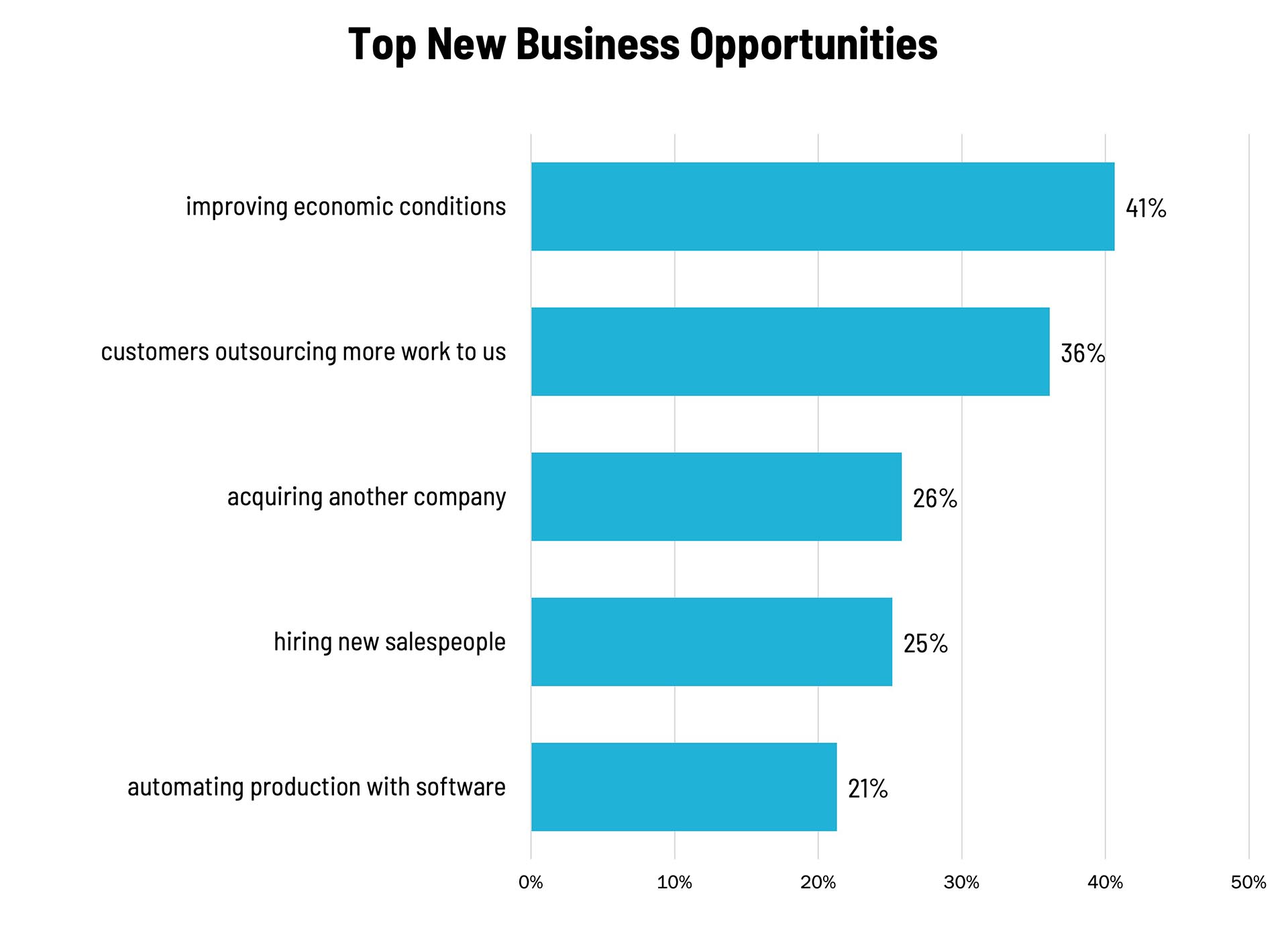
The number one opportunity was “improving economic conditions” at 41%, way up from 29% last year——although, if you look at virtually every economic indicator from last year, it would be hard to see how the economy could have gotten any better. Number two is the former perennial number one, “customers outsourcing more work to us” at 36%, up from 28%, and number three is a new entrant in our top five (or even top 10) list: “acquiring another company” at 26%, up from 18% last year. Companies are looking to diversify their offerings and one way of doing that is acquiring a company that has the capabilities they’d like to add, which can be a better strategy than buying new equipment, especially if the new capabilities also come with a pre-existing customer base.
Planned Investments
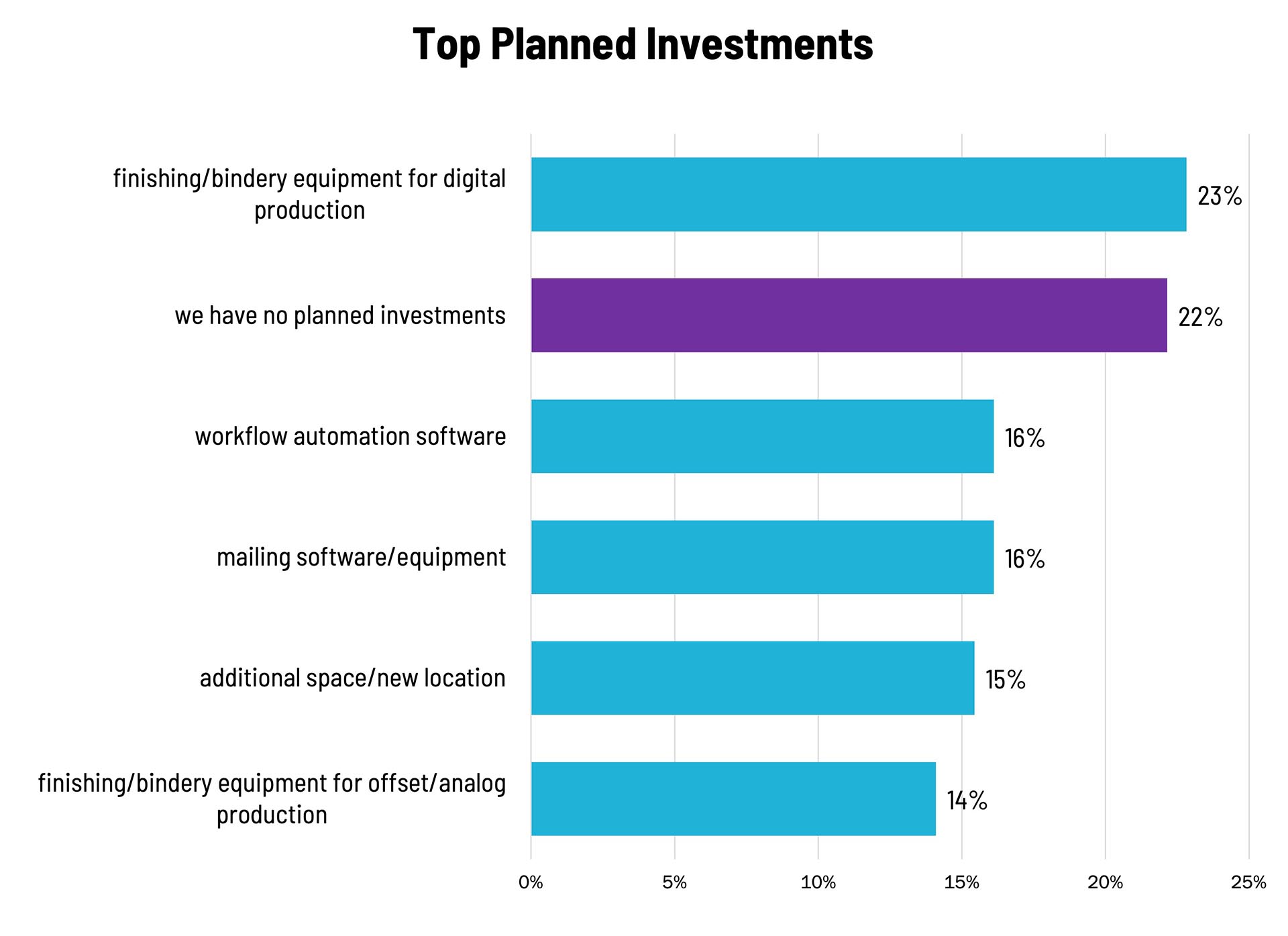
In terms of planned investments, “we have no planned investments” falls out of the top spot and was selected by 22% of respondents, down two percentage points. In the top pot, though, is the traditional top investment category, “finishing/bindery equipment for digital production” at 23%, up one point. “Workflow automation software” is at 16%, only down one point from last year. Looks like shops really are challenged by workflow automation.
New Capabilities
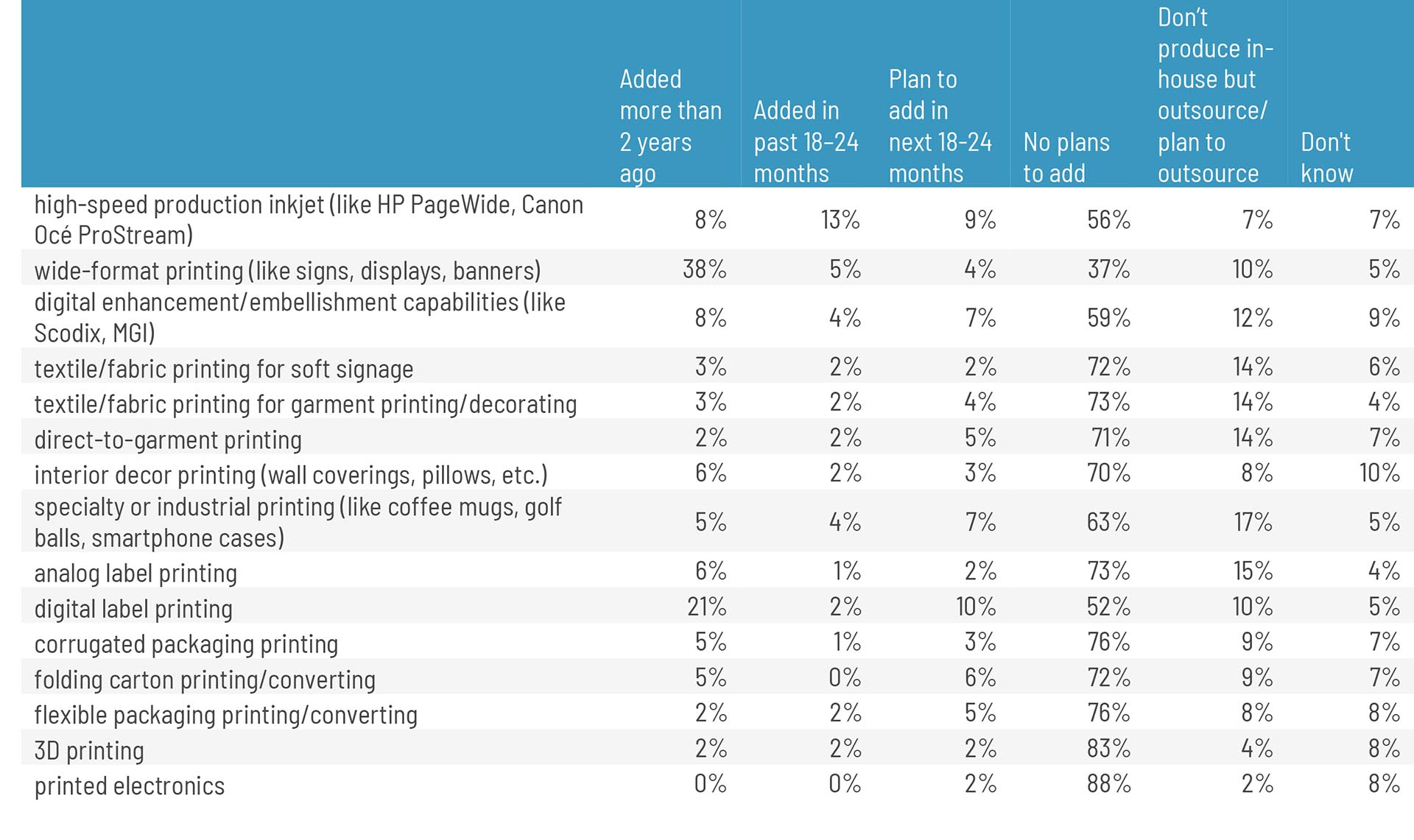
In terms of what print business plan to add in the next 18–24 months, digital label printing tops the list, as well as some manner of high-speed production inkjet. There is some interest in specialty/industrial printing, some digital enhancement/embellishment, and some folding carton. Textile printing—especially décor—has been touted as hot growth areas, but they have not turned up in our survey data, or at least not yet, nor has corrugated. Still, we’ll keep an eye on these new application areas.
Hiring Plans
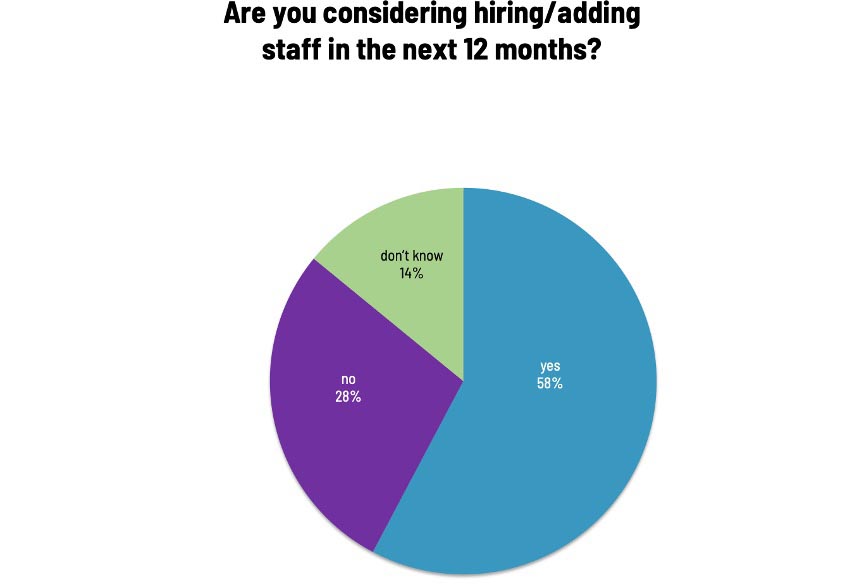
Just under six out of 10 survey respondents (58%) have plans to hire staff in 2025, down from 63% last year and down from an all-time high of 71% in 2021’s survey. Unlike last year, where production staff were the most in-demand, this year’s top potential hires are a mix of sales and production staff.
Digital Embellishments
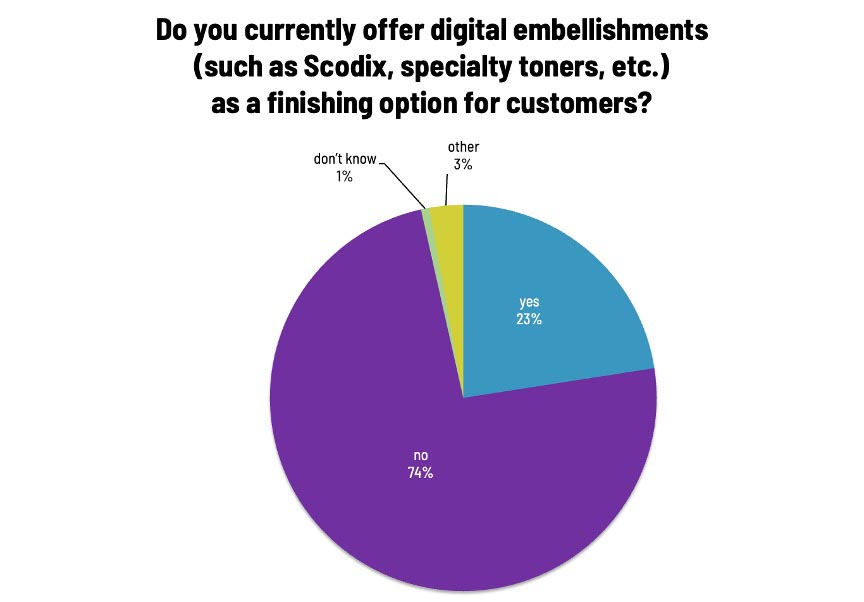
Less than one-fourth (23%) of survey respondents offer digital embellishment to their customers. Three-fourths (74%) said they don’t, and 3% said “other” (the write-in responses said that they outsourced embellishments when needed).
For those who do not offer embellishments, the top barrier to offering them is lack of demand from customers. For those who do offer them, the top reason (cited by 31%) was to “generate more profit,” while 27% said they “don’t know” why specifically they added embellishments. Of those who use embellishments, how often do they use them? Twenty-seven percent say “sometimes,” and 25% say rarely. Fifteen percent say “never” but one-fifth (21%) don’t know. Only 6% said “always.”
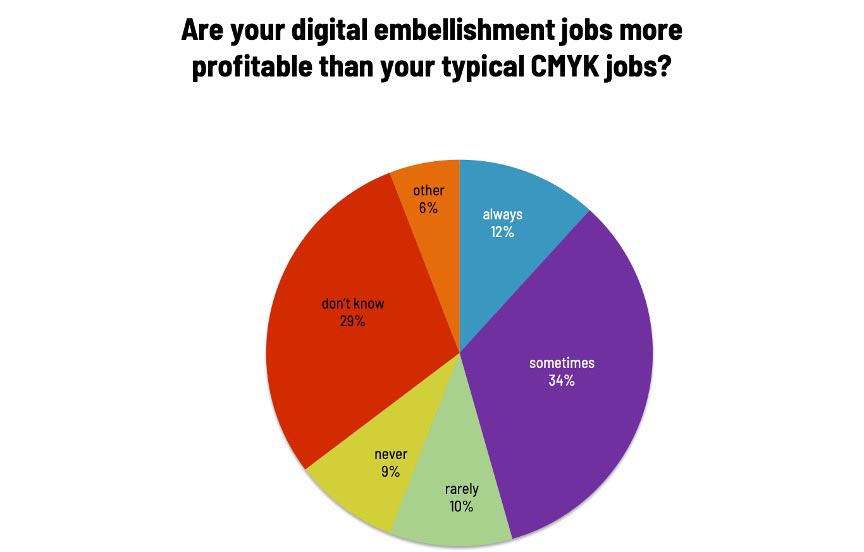
Nearly half (46%) of those who have added digital embellishments say they are more profitable than standard CMYK jobs—12% said those jobs were always profitable, while 34% said they sometimes were. Ten percent said they were rarely profitable, and only 9% said they never were. A full 29% said they did not know.
At the End of the Day
Ultimately, 2024 had been a generally good year—maybe not as spectacular as 2022, which saw a rebound in print demand from the depths of the pandemic, and 2023 was likely a course correction year, with 2024 giving us a sense of the “new normal.”
So, at the halfway mark, heck of a decade, the 2020s, so far, right? We are not expecting things to change appreciably in 2025 from 2024, but we have entered the year with a great amount of uncertainty, economic and otherwise. Fingers crossed it all works out. At the end of the day, though, let’s just keep on printin’.
The full version of the Perint Outlook 2025 report can be purchased from the WhatTheyThink estore.