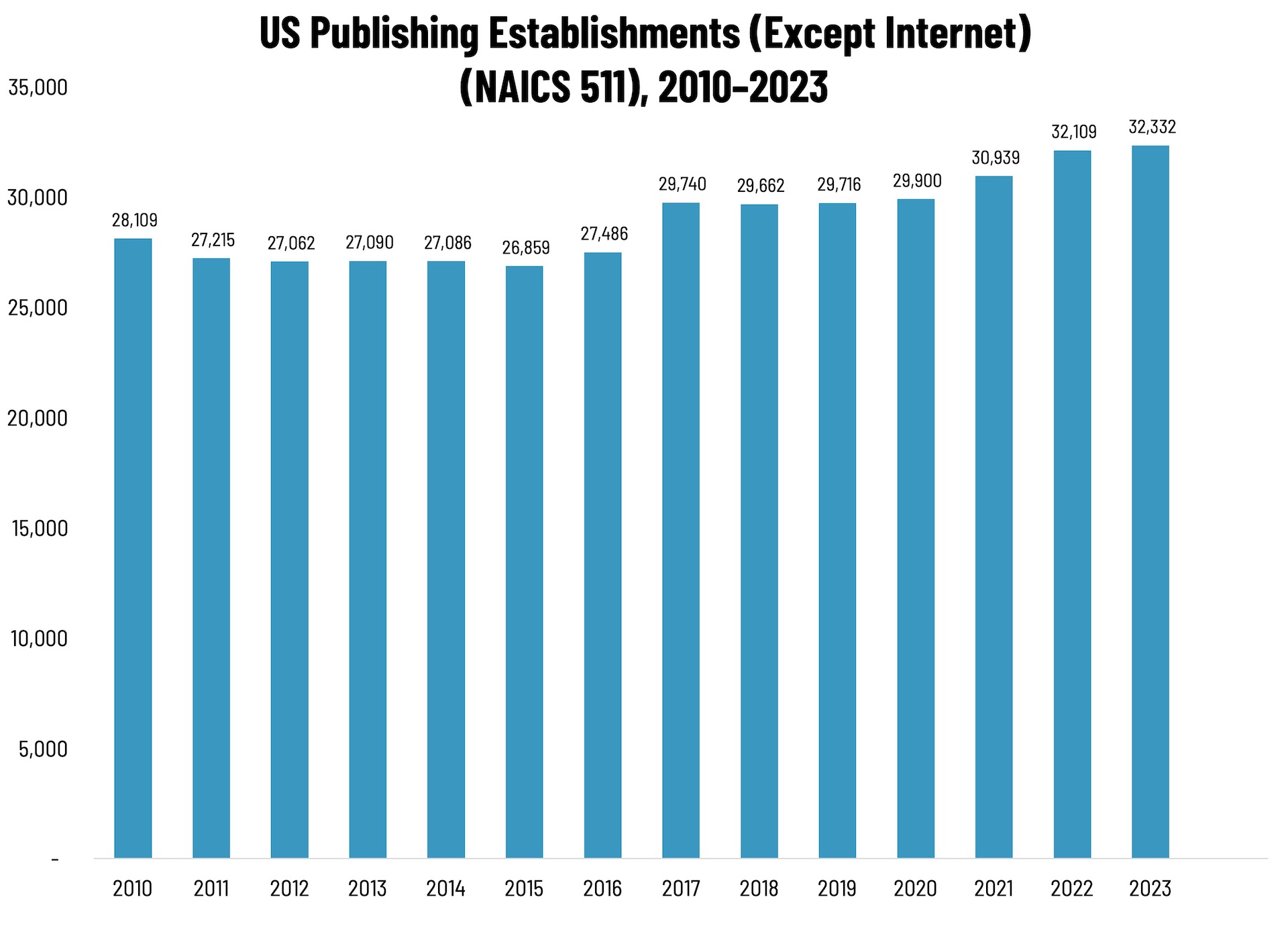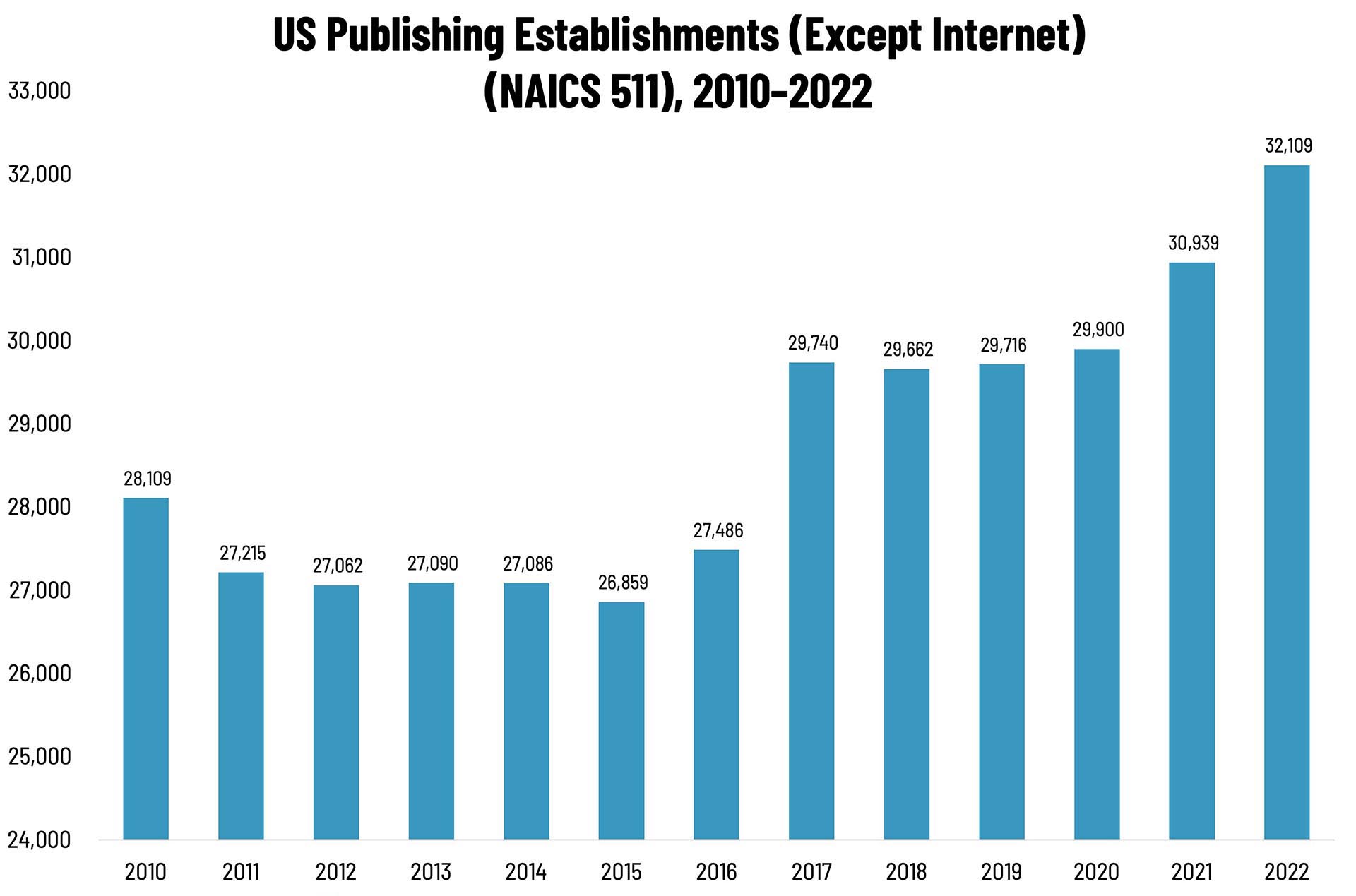
Our Friday data slice’n’dice look at the latest edition of County Business Patterns now turns to the publishing industries. As 2022 began, there were 32,109 establishments in NAICS 511 (Publishing Industries [except Internet]). This represents an increase of—wow—14% since 2010 and increase of 4% since 2021.
The U.S. Census Bureau officially designates NAICS 511 as:
Industries in the Publishing Industries (except Internet) subsector group establishments engaged in the publishing of newspapers, magazines, other periodicals, and books, as well as directory and mailing list and software publishing. In general, these establishments, which are known as publishers, issue copies of works for which they usually possess copyright. Works may be in one or more formats including traditional print form, CD-ROM, or proprietary electronic networks. Publishers may publish works originally created by others for which they have obtained the rights and/or works that they have created in-house. Software publishing is included here because the activity, creation of a copyrighted product and bringing it to market, is equivalent to the creation process for other types of intellectual products.
“CD-ROM”…
We’ll have more to say when we dive into the specific publishing NAICS categories, as “Publishing” here refers to everything from books, magazines, and newspapers to greeting cards, to mailing lists and directories, and the catchall “other publishing” which can include maps and other specialty publishing products. Generally, though, the growth in establishments over the 2010s is due to two basic factors: economic growth following the Great Recession and lowered barriers to entry for small or self-publishers thanks to digital printing (enabling short-run on-demand publishing) and the Internet/ecommerce, easing distribution, which was always a challenge in the pre-Internet days). Spoiler alert: book publishers and “other publishers” were the two sub-categories that drove up the average number of establishments between 2021 and 2022.
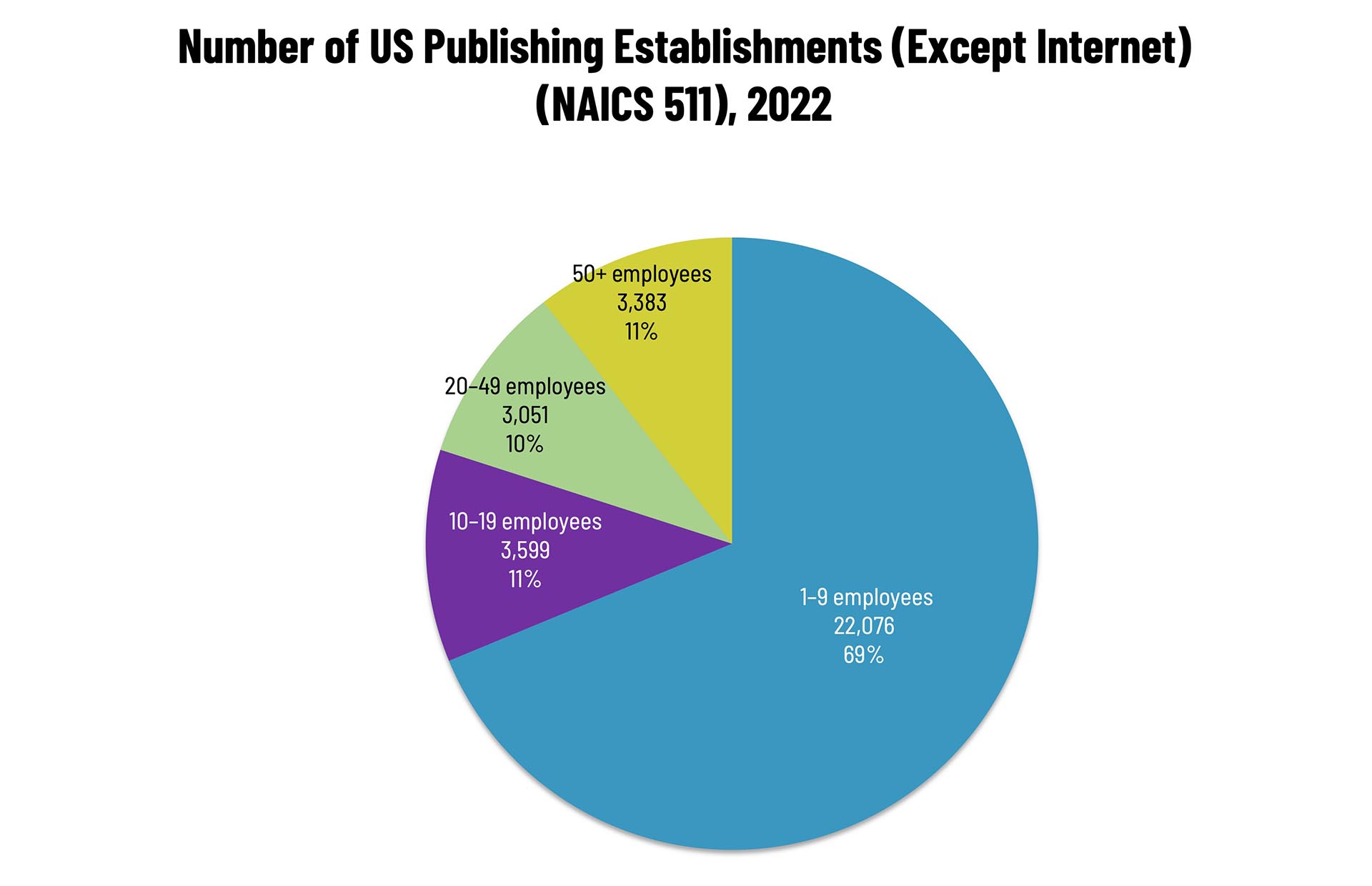
As we saw in the printing categories, publishing establishments are concentrated at the lower end of the employee-count spectrum. Small publishers (1 to 9 employees) comprise the bulk of the establishments, accounting for 69% of all establishments, with the other three employee size categories equally sized at 10–11% each.
These counts are based on data from the Census Bureau’s County Business Patterns. Throughout this year, we will be updating these data series with the latest CBP figures. County Business Patterns includes other data, such as number of employees, payroll, etc. These counts are broken down by commercial printing business classification (based on NAICS, the North American Industrial Classification System). Up next:
- 51111 Newspaper Publishers
- 51112 Periodical Publishers
- 51113 Book Publishers
- 51114 Directory and Mailing List Publishers
- 51119 Other Publishers
- 511191 Greeting Card Publishers
- 511199 All Other Publishers
These data, and the overarching year-to-year trends, like other demographic data, can be used not only for business planning and forecasting, but also sales and marketing resource allocation.
This Macro Moment
Here’s something bound to send a frisson of terror down one’s spine. The Atlanta Fed’s GDPNow estimate of Q1 GDP growth went negative this week:
The GDPNow model estimate for real GDP growth (seasonally adjusted annual rate) in the first quarter of 2025 is -2.4 percent on March 6, up from -2.8 percent on March 3.
ZOMG! Recession!
But there is a danger in jumping the gun and looking at these kinds of numbers before all the data are in. Calculated Risk clarifies:
GDPNow is an excellent tracking model, however, the January surge in imports - especially for gold - caused the model to move negative. As the Atlanta Fed noted: "the contribution of net exports to first-quarter real GDP growth fell from -0.41 percentage points to -3.70 percentage points".
Usually there would be an offsetting increase in inventories, but that is a lagging indicator. This is a short-term distortion and will balance out over the next month or so. I don't expect negative GDP in Q1.
Whew!