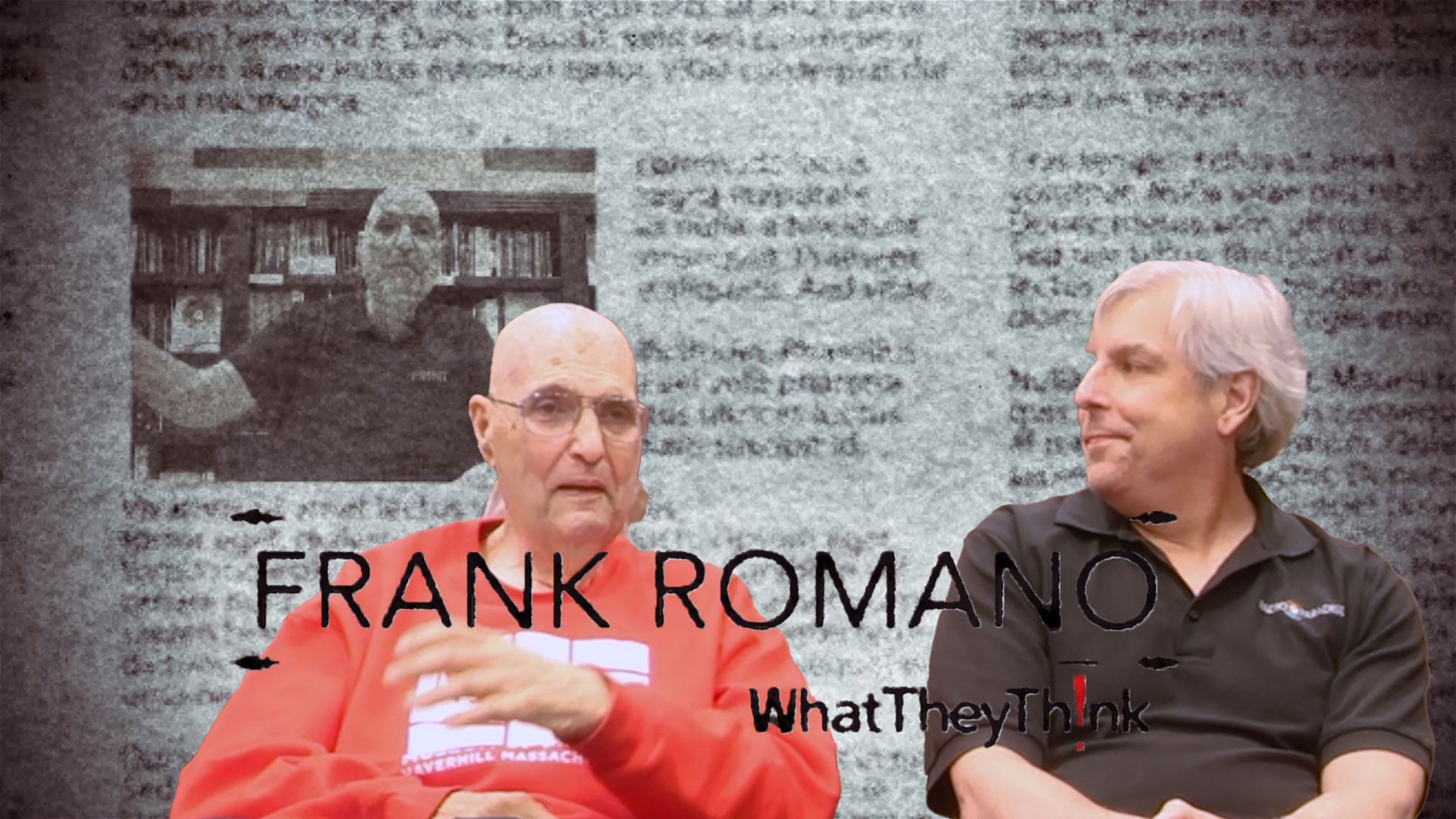
On April 4, 2002, Presstek announced the appointment of Edward J. Marino as President and Chief Executive Officer. Mr. Marino is an experienced executive with more than 10 years of senior management responsibilities in the printing, publishing and digital imaging industries and had served on Presstek's board of directors for two years.
Since his appointment, Marino has moved quickly to shift the focus at Presstek from a primarily technology-oriented company to a market-oriented company. WhatTheyThink.com had the opportunity speak with Mr. Marino and gain insight into his perspective on the industry and his plans for Presstek's future.
Presstek, Inc. is a leading developer of digital laser imaging and chemistry-free plate technologies for the printing and graphic arts industries. Marketed to world-leading press manufacturers and directly to end users, Presstek's patented DI(R), CTP and plate products eliminate photographic darkrooms, film and toxic processing chemicals - reduce printing turnaround time and lower production costs. The company's Lasertel subsidiary supplies it with valuable resources necessary for its next generation laser imaging devices.
Part Two
WTT: Presstek’s PEARL, Anthem and DI technologies have been in the field for some time and most of our readers should be fairly familiar with them. Can you share your thoughts relative to the benefits of these technologies and the market forces in play that will drive increased success in the marketplace for Presstek?
Ed Marino: Of tremendous advantage to Presstek and its customers is the company’s development of a set of chemistry-free products in a world that has traditionally involved significant chemistry. As someone recently pointed out to me, it is virtually cultural in the company. And while "chemistry-free" may be perceived as more of a feature than benefit, the fact is that there is a clear, tangible benefit to the user. The technology delivers more consistent performance with a simpler process, and we believe very strongly that while the environmental component has not received as much attention to date as it probably should have, it certainly will in the future. We sincerely believe that the chemistry-free process – and its inherent performance improvement and environmental safety -- is an element of the Presstek story about which we need to do a better job of educating the industry. Once a printing operation migrates to "chemistry-free," it seldom goes back. This is a sustainable business.
The message I like to send is that the environmental impact is in and of itself a good reason for people to migrate to our technology, but there is an economic imperative as well. By taking the environmentally safe approach, you also simplify the process because you are not dealing with the chemistry and the balance of chemistry. We have eliminated that step – along with 20 to 25% of the cost of producing a plate. You really don’t want to wait until the plate is on the press to figure out that the chemistry wasn’t right!
WTT: From a technology perspective, what are the next steps for Presstek?
Ed Marino: We continue very aggressively along two fronts - The first is our consumables development, and we have two new technology platforms we are pursuing. One is the Anthem technology – our plates for wet off-press imaging -- there will be successor products from Presstek in the market soon. And the other is Applause, a technology that we previewed at IPEX. Applause is a non-ablative laser imaging technology, meaning it does not require a cleaning process. While the technology is not commercialized yet, we have publicly demonstrated it, are continuing to develop it, and intend to commercialize it next year. There will be a number of products that spin off that platform.
The second front is laser imaging. We’re doing good technological development on not just the laser itself, but also on associated components. A number of components either comprise the laser imaging system or like the the drum and media are intimately associated with the imaging process. We are constantly looking at the interactions among these components to determine what changes can be made to optimize performance. This is the primary focus of our research.
We like to think that the developments we are bringing to the market with this research focus are a way to revolutionize the offset press. If we can successfully bring together the worlds of imaging, media and related components, it will be possible for us to greatly simplify offset press operation so that cleaning and water would not be necessary. We see a world where the architecture of the press can be dramatically improved and simplified using digital technology. We are working – through our own research and in conjunction with our partners -- to improve image quality and consistency throughout the entire digital workflow.
Once you go digital in a press, it is possible to provide feedback mechanisms that enable a smart engine to analyze the process and make adjustments based on the data. Knowing what the file looks like coming in, and how it is likely to image, you can automatically make changes based on the nature of the file. This is, in effect, using the latest in information technology to improve the imaging process without the tinkering that is required today.
Taking this a step further, it means that you can also change the requirements for the press operator. The operator may need to become a person who understands as much about IT as about the ink and water balance. Think about the transition we went through when we moved from stripping tables to automated prepress systems. Did the stripper, by default, become the prepress operator? Not always. This new world we are entering will place new requirements on our production staff, just as the prepress migration did. Press operators and shop owners alike should be thinking about this as they plan for the future.
WTT: As you speak to customers, what do you find are the key reasons they acquire your technology, whether embodied in a press or at the platesetter level? And what are some of the reasons they don’t buy?
Ed Marino: Allow me to share this excerpt from a letter we received from a new customer: "The Presstek Dimension and Anthem gave us a better quality of work at a better price than the competition. We liked it not needing any chemicals, too." This was a user who was familiar with using chemical processes. She could clearly see that the process was simplified. It reduced the amount of equipment that was needed, and resulted in a savings in floor space. People intuitively see the benefit. This is the reason they buy -- the total cost of ownership is better.
And once the technology is in place, people discover that it also provides them with an opportunity to produce work that would not have been practical using traditional processes. Let’s just talk about the DI presses for a moment. A lot of the early DI presses went into nontraditional press environments. These were people who were not dyed-in-the-wool press operators. The DI was a very natural path for them. And they found that they could effectively produce those 350- to 1,000-unit quick turnaround jobs that were not reasonable to produce using traditional offset. With the DI press, you can do that work all day long.
Why don’t more people buy? Sometimes the technology doesn’t fit with their core application set. Most often, though, it is because they don’t know about us yet. This is the biggest challenge we face today, and it is channel related. We need to make sure we are in front of the customer at the right time with the right message. That is why we are shifting resources and becoming a market-focused company that can more effectively support our channels. My vision is that the dealer’s sales person should never walk away without a deal. If the DI press is not the answer, then our computer-to-plate offerings may be. We need to provide our channels with the knowledge and the tools to enable them to effectively present the message, and ultimately to close the deal.
WTT: These presses seem relatively easy to use. What is your advice to customers about the type of operator they should assign to your presses, and what type of site preparation is required?
Ed Marino: As we discussed earlier, we provide a simplified process with a significant amount of automation. You need to understand the offset process, but because of the extensive graphical user interface and its intuitive operation, the skill levels required are not as extensive as those required by the traditional offset process. Our solutions run in a quasi office environment and you certainly don’t have to install cement pads to install the press, so the installation process is much simpler as well.
WTT: How does training get accomplished for your platesetters and presses?
Ed Marino: Training is provided either by our service force or by the dealer, and it takes about two weeks to get up and running, producing sellable jobs.
WTT: You have quite an impressive stable of vendor partnerships. Later in the discussion, we’ll talk about some of them individually. Overall, though, where do you see your alliance strategy heading, and what are your plans relative to Presstek – versus OEM – branding?
Ed Marino: We clearly see Presstek as more of a Switzerland to the market. Today, we have Presstek branded product, but over time we see our brand being more aligned with our partners, and not as a discrete Presstek brand. One way to think about this is exemplified by Dolby. Everyone knows the name, but Dolby doesn’t make products. Rather, they are imbedded in other people’s products. We see ourselves as an enabling technology company. We obviously want strength behind the brand, but we want to do that through our partnerships and alliances.
WTT: Heidelberg has been a key partner for Presstek and has experienced success in the marketplace with its Presstek-enabled Quickmaster DI. How do you see your relationship with Heidelberg continuing to evolve over time?
Ed Marino: Heidelberg is a great company, the leading press manufacturer in the world. We have been very fortunate to be aligned with them and we will continue to strengthen that relationship over time.
WTT: In October of 2001, Presstek announced a strategic partnership with Koenig & Bauer AG (KBA) where KBA will sell an additional Presstek-enabled direct-to-press solution, the 46 Karat, as well as the PEARLdry plates for the 46 Karat. This added the smaller format DI press manufactured by Ryobi to KBA’s product portfolio, joining the 74 Karat press developed by KBA. How is that relationship going, and where do you see it heading in the future?
Ed Marino: This is a company that has made a substantial commitment to digital print with the 46 and 74 Karat products. We are continuing to work very closely with KBA to help them strengthen their position in this area of digital direct imaging, and we consider them a strong ally.
WTT: Speaking of Ryobi, their branded version of the press is primarily sold through the dealer channel. How is that going for you, and do you expect to see any changes there?
Ed Marino: Like most companies that sell through indirect channels, we have to pay special attention to gaining mind share and assuring that we capitalize on every opportunity to be presented. We intend to close that gap through Presstek resources.
WTT: The announcement that Xerox would be selling the Presstek-enabled Ryobi press as part of its DocuColor series may have surprised some industry-watchers. How is that going, and what types of future announcements might we see from Presstek and Xerox?
Ed Marino: Xerox has done some amazing things in helping to advance the digital wave in the printing industry and we are all benefiting from that. Having said that, the notion of Xerox getting into the offset business may have been a surprise for some people, but this is not as big a leap as you might think if Xerox intends to reach its stated goal of providing a complete digital solution for the printing industry. It is fair to say that both Xerox and Presstek had higher volume expectations, but Xerox has been enthusiastic about this product set from the beginning, they are marketing the products, and we think they understand how to position them.
You can really think about the central impression cylinder technology like the Ryobi press as falling between electrophotography and offset. It’s offset with a digital look and feel.
WTT: Just this week, you added MAN Roland to your partner portfolio. Can you comment on any other existing or future partners?
Ed Marino: The MAN Roland marketing alliance is interesting. It turns out that the geometry of our plates fits uniquely with their Roland 300 and Roland 500 presses. What I mean by that is that one plate fits both presses. Also, MAN Roland was very receptive to the concept of bundling our CTP solutions with their presses. We are excited about this new partnership and looking forward to working with them. As far as future partners, I really can’t comment, other than to say that our reliance on partnerships will continue to grow.
WTT: If our readers haven’t seen your technology, what’s the best way for them to educate themselves?
Ed Marino: This gets back to the channel question we were talking about earlier. A good starting point for that education is Presstek’s web site (www.presstek.com), but with our new marketing and commercialization focus, people are also going to see us presented in the marketplace much more frequently. And there are dealers everywhere that handle Presstek-enabled products.
WTT: Ed, thanks for sharing your thoughts with our readers at WhatTheyThink.com. Before we close, are there any additional words of wisdom you would like to share with our readers?
Ed Marino: If I could get any single point across, it would be that there is absolutely no stopping the digital wave; we are all riding it to one degree or another. The benefits of this digital wave should be pushed to the customer not so much through pushing the Presstek brand, but more by educating the market on the benefits of digital in terms of turnaround time, price/performance, product quality and ease of operation. The more the digital infrastructure builds within the industry, the more important enabling technologies will be. We see an acceleration of this over time, and we think we are still at the beginning of this wave.
Digital processes provide more flexibility, and that translates into better price/performance. From a customer’s perspective, the ability to keep your ad window open a little longer, or to better time production of your marketing materials to take advantage of the latest information are things that are meaningful. This wave has rippled through the prepress area, and it’s now ready to hit the pressroom. Presstek is well-positioned to ride that wave.
Continue reading your article
with a WhatTheyThink membership.