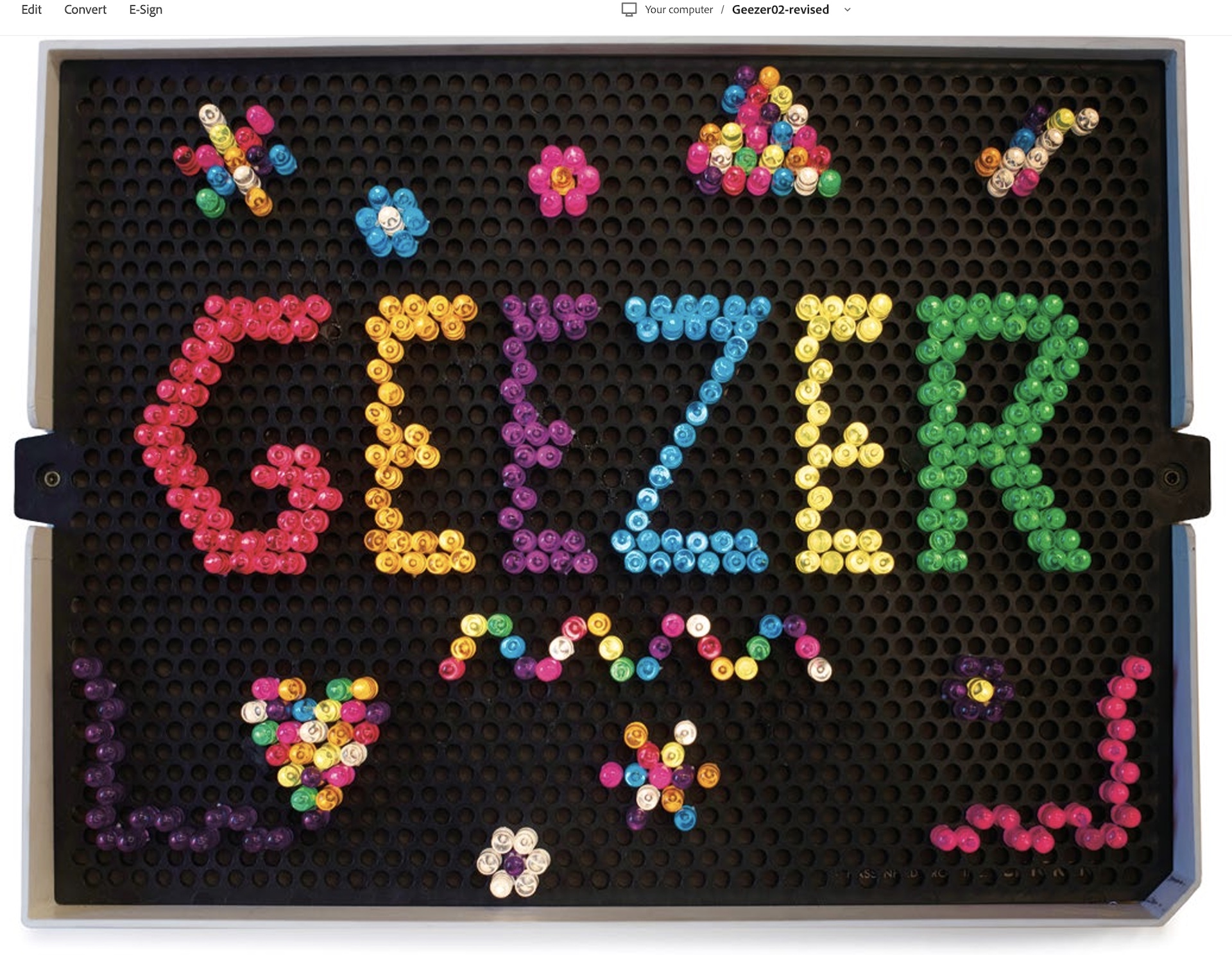
Do you want to know the definition of insanity? It’s starting a print-only, subscription-based magazine with your own money. Then launching it with the best writers and the highest quality content in a four-color tabloid format. Then you name it Geezer.
Geezer was the brainchild of Laura LeBleu, creative/editorial director, and Paul von Zielbauer, Pulitzer-nominated former New York Times journalist, who recognized an unmet need in the market—high-quality lifestyle content, in magazine-sized bites, for the over 50 population who, like Laura, burned their AARP mailers when they first arrived.
“We were seeing a void in people having conversations around aging that felt relevant to Gen X,” says LeBleu. “AARP has its place in this world, but the first time I received one of their mailers, I set it on fire. I said, ‘This is for my mom. I’m a different generation. I don’t want your soft cooler with AARP on it.’”
Starch-Collared Hippies
Indeed, Geezers aren’t your average 50+ readers. They might look like the guy (or gal) in the office next door, but inside, they are more like the children of hippies who graduated from college and got starched-collar jobs, bought split-level ranches, and, once they realized what they’d become, squeaked out defiance by cordoning off a raised bed garden and buying a flock of backyard chickens.
Geezer knows this audience. They’re the ones who once huddled together in their weirdo high school friends’ basements, gorging on cheap home-made popcorn in the dark, and watching “Deathrace 2000.” Some straightened up and got office jobs. Others became artists and musicians and spent the next 30 years destroying their bodies with Pop Tarts and substances before trying to reverse the damage with kale.
Fast-forward 40 years and many now grown-up geezers have donned the mantle of full financially secure, health-conscious adulthood. Others are facing retirement with no financial plan and failing livers. Some have their parents’ long-term care mapped out. Others are facing caring for them—or ailing spouses—at home.
Because Life Is Messy
Whatever type of geezer you are, Geezer tackles the issues of aging without compromise, either in substance or humor. The magazine’s Facebook page describes it well: “We explore how people are aging with energy, creativity, and imperfection—because midlife is messy in ways no one warned us about.”
Geezer knows that the topic of aging is a serious buzzkill. But it also knows that when something is intellectually stimulating and funny, people are more likely to read it anyway. Hence, Geezer is written like the lovechild of The Atlantic and Mad.
To create content that is cheeky, funny, and yet addresses aging’s most serious issues, LeBleu and von Zielbauer worked with the best writers they could find—in lifestyle, in science, in finance, and self-care. In the first issue, article titles include “Damage Control: We’re Aging Less Like Fine Wine and More Like a Six-Pack of Schlitz” and “How to Un-F$@! Your Finances.” The titles (and articles) are funny, but the content is intended to resonate.
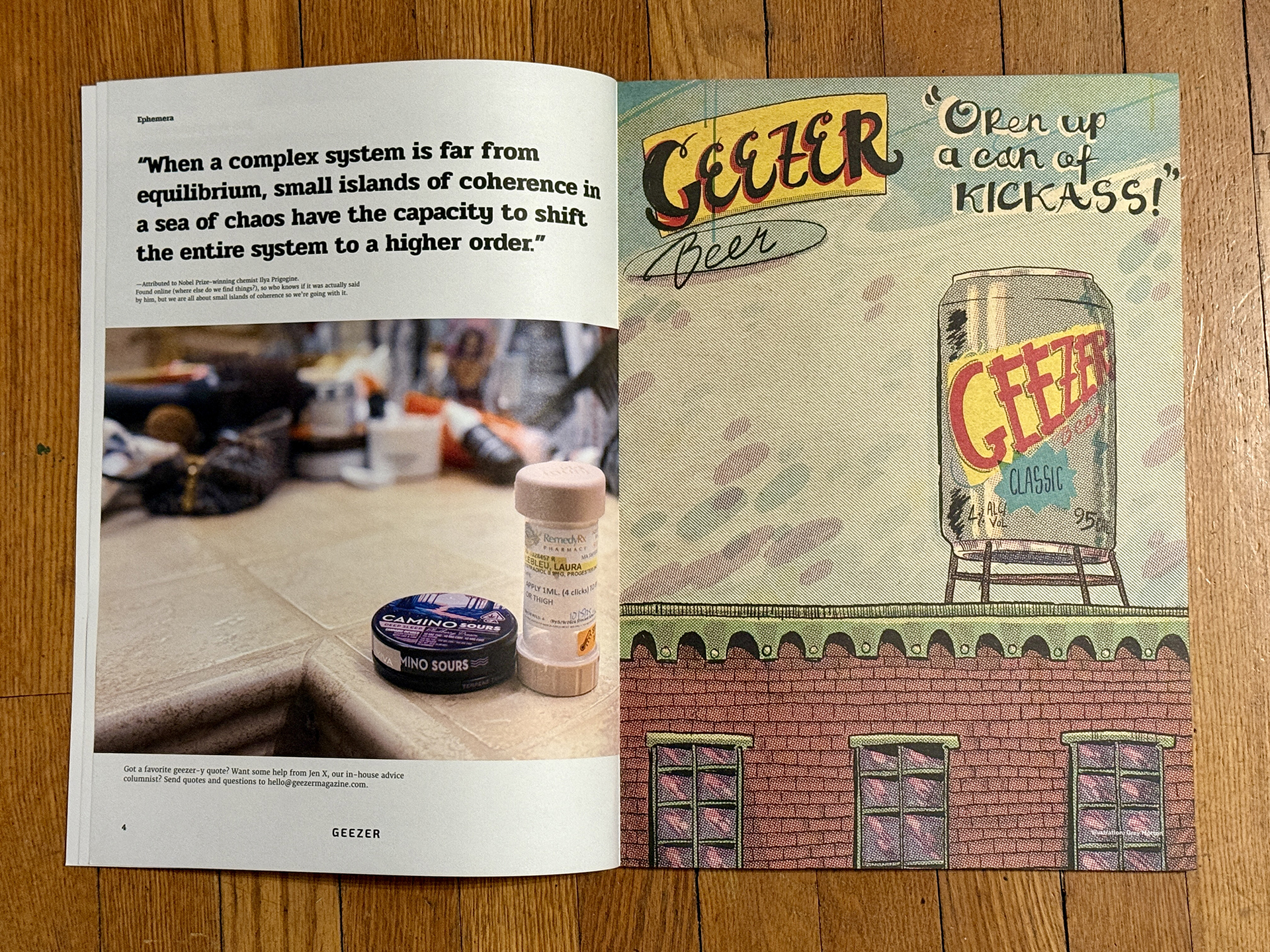
Geezer also beautiful to sit with. It offers outstanding graphics, over-sized 11 x 15-in. pages, and an artistic layout that makes you want to linger with it over a good cup of java. “You don’t do that with digital media,” observes LeBleu.
Entirely Subscriber-Based
Geezer is subscriber-based. Not that the team wouldn’t accept the right advertising if it came along, but they wanted to get the magazine into people’s hands first. “We found that, once people see it, feel it, and experience it, they love it,” says LeBleu. “We’re confident that people who are interested in the Gen X audience, at an intimate level, will find us.”
Printing was done by Mittera, a mail, print, and marketing services company in Beaver Dam, Wis. LeBleu claims that she chose the tabloid size because “bigger is better,” but it’s also possible that, in addition to having a lot to say, the pair knew that tabloids are easier on the eyes.
This is a hefty book at 96 tabloid pages. First print run was 5,000 copies at a total cost of $80,000. (Printing alone cost half of that.) The inaugural run was born of love…and stock options. “I decided that if I’m ever going to create something that feels like my vision and creativity, after 25 years of writing for other people, it’s time to do it,” says LeBleu. “I was lucky enough to have some stock options, so I cashed them in, and along with Paul, decided to go for it.”
Stocked from Coast to Coast
Geezer will publish three times per year for $120 subscription. It needs a total of 2,000 subscribers to be self-sustaining. As of this writing, the team was well on their way. “We are also stocked from coast-to-coast,” says LeBleu. “Primarily in independent retailers like the Bold Magazine Shop in Portland, Maine, Casa Magazines in New York City, and Clock Tower Records in my hometown of Nevada City, Calif.”
It’s a pricey adventure, but for LeBleu and Paul von Zielbauer, a necessary one. Our culture has been awash in digital content for a long time, and the pendulum, the pair believes, is swinging back to print. “We’re drowning in digital content,” says von Zielbauer. “As a society, the acceleration is driving us mad. The launch of Geezer is, I believe, a really touch-grass moment for people. It helps ground people and bring us back to our humanity.”
Indeed, Geezer is very human. The paper is matte, the photos sometimes grainy. Like it should be sold in a marijuana dispensary rather than a street-corner magazine shop. It doesn’t look like any other magazine, and that’s the point.
“We don’t want Geezer to look or feel like anything else that’s out there,” LeBleu concludes. “We want Geezer to be that creature in the woods that you look at and say, ‘What is that?’ Then you bring it home, open it, and read it, and say, ‘Wow!’”
Indeed, Geezer does just that. You might be able to wrestle it from the mailbox and bring inside. But, like the creature in the woods, once it’s there, it’s going to do its own thing.