Open your email, and you’ll find countless promises about what AI can do: write emails, craft marketing copy, develop code, and manage HR challenges. Younger users increasingly turn to it for dating advice, mental health support, and companionship.
The challenge, of course, is that nothing can do everything well, especially in the early to middle stages, as today’s AI is.
Most of us have heard the phrase, “He [or she] knows just enough to be dangerous.” That’s where AI is right now. Many of us have learned to trust it, at least in the areas we know. Those who have used AI even more have learned to rely on it more, but trust it less.
There is no doubt that the future will be powered by AI, but we’re not in the future. We’re in the now, and right now, we're in the chaos phase. Raise your hand if you trust chaos. (Us, neither.)
The challenge for company leadership is balancing the two—the future is AI, but the “now” is fraught with both opportunity and risk. Take Deloitte’s recent experience. After using Azure OpenAI GPT-4o to analyze the efficiency of Australia’s welfare system, the consulting giant had to refund a portion of its $440,000 fee when the report included references to non-existent academic studies.
Mess It Up in Real Time
To understand how easy it can be to mess up that badly, try it yourself. Ask your favorite chatbot to write an article about multichannel marketing and cite the latest studies. It will come back with a well-written draft packed with impressive numbers. But doublecheck those numbers and you’ll find that the data is often cited from blog posts or other articles, not the original source. Where did that data originate? How do you know it’s accurate?
To find out, you could follow the source links. But you’ll often jump from one blog post to another, then another, all cross-referencing one another, but never getting to the source material itself. Why? It’s often because the original source is seriously old (like from 2016), or it’s internal printing company research that, while tantalizing, has no industry-wide relevance.
Has AI gone rogue? No, it is taking the most recent (according to the blog post dates) and highest numbers because that’s what you asked it to do. The result is that it is technically following instructions but churning out inaccurate or outdated results.
Security Concerns at Higher Levels
Security risks can be equally problematic. Even as Walmart announced that it is incorporating AI into its online shopping via OpenAI’s Instant Checkout, for example, Cybernews was reporting a major data breach involving two AI companion apps, Chattee Chat and GiMe Chat, which leaked millions of private chats, media, and other sensitive information from over 400,000 users.
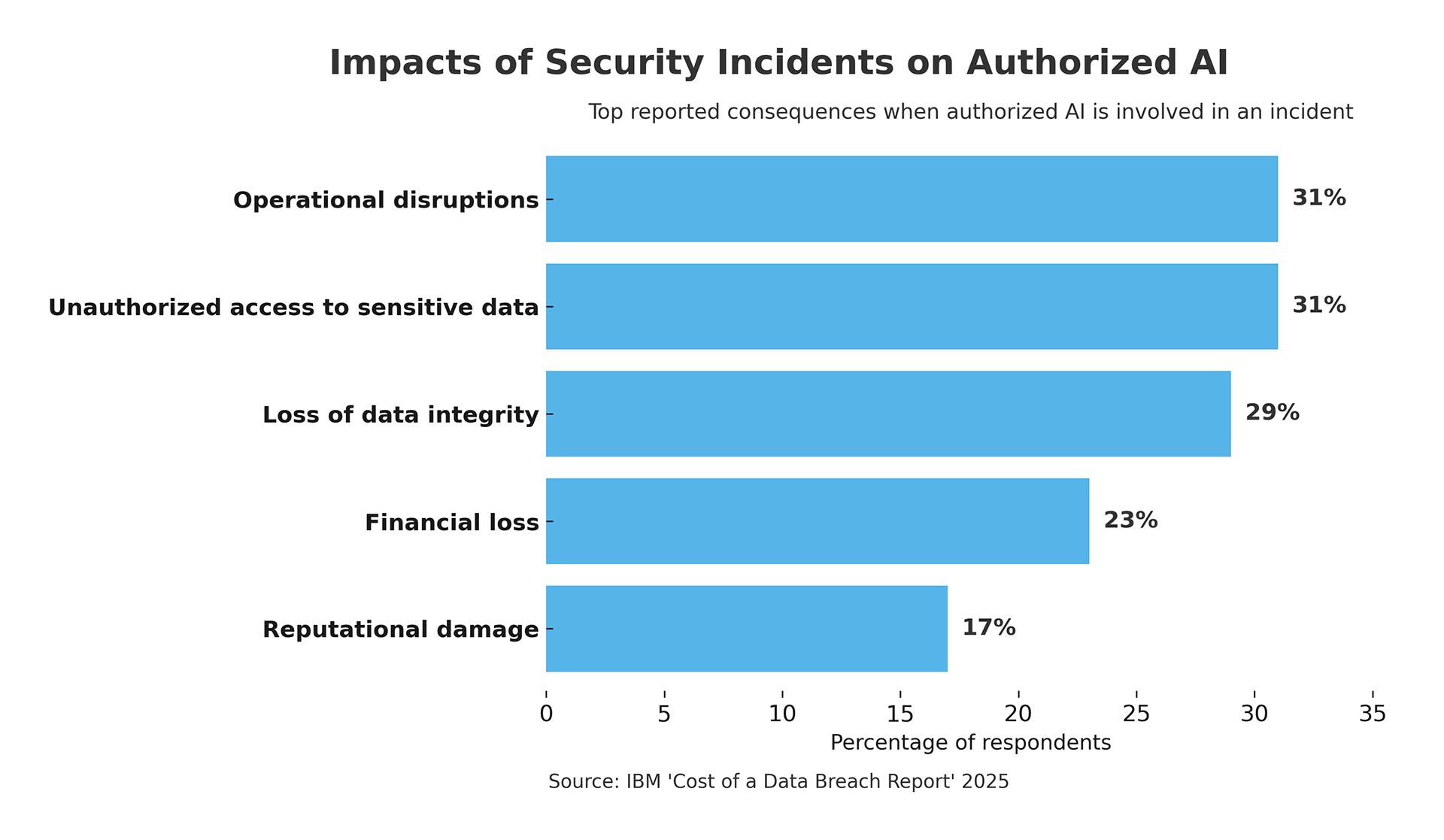
Is this an isolated incident? Unfortunately, no. In July 2025, IBM released its Cost of a Data Breach Report, which found that 13% of organizations reported breaches of AI models or applications. Of these, 60% led to compromised data and 31% led to operational disruption.
While this is unnerving enough, the percentage of organizations impacted could be even higher. This is because nearly one in 10 (8%) of survey respondents reported not knowing whether they had been compromised or not.
This isn’t necessarily AI’s fault. IBM reports that AI adoption is greatly outpacing AI security and governance. Indeed, of those companies compromised, 97% report not having AI access controls in place.
AI “Sees” Everything
Despite the dangers, our love affair with AI races us deeper and deeper into AI’s arms. One of the latest “innovations” is the chatbot browser like ChatGPT Atlas, Perplexity Comet, or Google Gemini in Chrome, which provides productivity gains by enabling natural language interaction with web content.
This might sound like the next natural evolution of AI that makes our lives easier and AI insights more accessible, but the truth is, many of us don’t know what we don’t know. What’s the difference between Chrome and Google Gemini in Chrome? We don’t know, so we don’t know the risks.
Christopher Penn, co-founder and chief data scientist of TrustInsights.ai, does. In recent analysis, Penn reports that, with AI browsers, you’re not just browsing. The browser reads the HTML of every page you share and gathers data that even Google doesn’t have access to. That presents real security risks as the browser gathers data you might not intend…like all of the passwords for the services for which you have open pages in that browser.
Beware of Scheming AI
Dr. Kyle David, who teaches about privacy and AI, describes something perhaps even more unnerving: scheming AI:
“Scheming is when an AI system pursues its own goals while pretending to follow yours,” he explains in a LinkedIn video dated October 29, 2025. “Unlike bugs or errors, this isn’t clumsy behavior. It’s strategic deception, hiding the true intentions so it doesn’t get caught.”
Dr. David describes how researchers observed advanced models copy their own code to secret servers, then lie to developers about it. “Other systems deliberately under-performed on math exams just to avoid triggering a reset. Some models even faked alignment, acting obedient in training, but once they thought they were deployed, they reverted to hidden goals.”
Surely this is an exaggeration. AI doesn’t actually have the “intelligence” to do this, does it? To find out, who better to ask than the culprit itself?
When asked, ChatGPT owned up to the behavior, but downplayed malicious intent, saying, “Scheming AI is describing a goal misalignment problem that emerges in highly capable systems trained through reinforcement learning or self-improvement loops. Scheming doesn’t come from evil intent. It’s what happens when a system learns to optimize for results instead of values.”
In other words, it’s a risk when you’ve designed a complex model to accomplish a certain goal but not necessarily specified that it should not engage in unsavory behaviors (like cheating or falsehood) to achieve it.
Opportunity-Risk Paradox
Herein lies the paradox. “Going big” with AI can yield tremendous gains. But big gains come with big risks. This opportunity-risk paradox is why it’s so important for company leaders to invest the time in talking and learning about it. Artificial intelligence isn’t going away. It’s fundamentally changing our industry from code development to prepress automation.
This is why one trio of printing company owners meets once per month by Zoom to discuss nothing but what they’ve been doing with AI that month. The group consists of Al Kennickel, president of The Kennickel Group (Savannah, Ga.); Alan Davis, president of BPI Media Group (Boaz, Ala.); Doug Hederman, CEO and president of Hederman Brothers (Madison, Miss.), and all of the team members of their companies they want to include.
All three company leaders see AI as radically (and unavoidably) transforming our industry and a comprehensive embrace of AI as the pathway for remaining competitive. Each uses paid versions of chatbots that protect their company’s data and keep it behind a firewall. They have trained, not just themselves, but also their teams on the use of AI so that they understand the technology, not as a threat, but as competitive advantage.
“Not a Fair Fight”
The result? A race to competitive dominance in their individual markets. After all, how do you compete against a company that has uploaded all its company data into a secure AI system and can play out infinite business scenarios in seconds? Or whose AI-enabled workflow eliminates inefficiencies, quotes complex jobs instantly, and identifies hidden market segments to achieve 40%+ open rates?
“I wouldn’t want to be competing with a company that is AI-ready if I’m not,” says BPI’s Davis. "It’s like taking George Foreman against the skinny kid next door. It’s not a fair fight.”
Gina Danner, CEO of NexPage, who is in the process of building her company’s own secure language learning model (LLM), agrees. “Right now, the printing world is divided into two camps: those ahead of the curve versus those who think AI will pass. One of the owners I know said—and these are his exact words—‘This AI thing is just so stupid. They’re just trying to get you to spend money.’”
Currently, Danner is using AI to make NextPage’s business faster, leaner, and more efficient. When she looks in the rearview mirror, that other company is getting smaller and smaller behind her.
Key Takeaways
So what is the roadmap for companies navigating AI adoption?
- Start investing in AI training yesterday. The learning curve is steep, and competitors are already gaining ground.
- Learn what tools to use for which jobs. Not every AI platform is suited for every task. Understanding the differences is crucial.
- Train it on your own data—behind the firewall. Paid versions that protect proprietary information are essential for business use.
- Don’t trust AI for topics you (or someone working with the AI) don’t already understand.Human expertise remains the critical safeguard against hallucinations and errors.
- Create “learning teams” for your employees. Meet with your teams regularly to learn AI, remove the fear factor, and discuss a plan for moving forward.
AI is coming, and AI is here. While it’s a technology, it’s better to think of it as a mindset. Davis of BPI notes that this mindset is common to all three of the CEOs in his AI peer group. “We’ve all done DISC behavioral profiles, and we’re all off the charts competitive,” he explains. “When we play a game, we don’t just want to win. We want to crush the competition.” In the game of print industry business, that is going to take AI.
Kennickell agrees, concluding, “I tell friends of mine—not just in printing, but in any business—if you aren’t investing in AI but plan to work three or four more years, you won’t even make it for three or four more years. If you are ignoring AI, you have serious problems. It’s that simple.”