Hiring and turnover remain among the biggest challenges in the printing industry. Not only is finding good employees like chasing snipe, but even once you find them, it’s an equal challenge to get them to stay. One print vendor recently bemoaned that his company doesn’t even get two weeks’ notice anymore. “Employees just stop coming to work, and you don’t know why,” he said. “It’s not just us. Everyone I talk to is facing the same problem.”
While technology can’t fill the job pipeline, it can help ease the pain when you do make new hires. Administrative tasks such as payroll processing, benefits management, and compliance paperwork consume a significant amount of time. Then there’s timecard tracking, which can be especially cumbersome in environments like printing that have shift-based workers.
It’s not only time-consuming, but costly. A survey by Gallup found that the cost of replacing employees ranges between 50% to 200% of that employee’s annual salary.[1]
Because of the repetitive, mundane nature of many HR tasks, it’s a perfect place to implement automation. Indeed, according to Deloitte, organizations using HR automation saw a 22% reduction in HR administration costs and a 30% increase in process efficiency.[2]
Other low-hanging fruit includes automating tasks related to compliance and documentation (such as staying current with OSHA, labor laws, and union agreements) where the risks associated with human error can be high, particularly in maintaining safety training records and certifications.
What a Difference Automation Can Make
To illustrate the impact automation can have, consider one “global printing equipment manufacturer with 25,000+ employees” that partnered with HCLTech. As a result of growth and acquisitions, the company’s HR functions had become decentralized and inefficient, and costs were soaring.
Working with HCLTech, the printing equipment manufacturer implemented a centralized shared services model, streamlining HR inquiries, improving data integrity, and automating workflows.
The results? According to a statement from HCLTech, the customer saw a 100% increase in data accuracy, a 50% jump in productivity, a 29% reduction in handle time, and 30% fewer aged tickets.[3]
But automation isn’t just for the giants. Even small companies are seeing measurable gains. Astute Communications (Nashville, Tenn.), for example, saved $8,000 by switching from a full-service PEO to Gusto and consolidating payroll, benefits, and HR into one simple system, making people operations smoother for both founder and employees.[4]
In addition to the traditional efficiency gains, the system has also given Astute an HR benefit not as frequently discussed: the flexibility to move to remote work, expanding its staffing options. This started with re-hiring the company’s creative director, who had moved to a different state 18 months prior.
“Gusto offered great resources to help us,” says Anna Stout, founder, president, and CEO of Astute Communications, as quoted on Gusto’s website. “[Using Gusto,] I navigated the state registration process myself.”
With the confidence of knowing they can adapt to compliance requirements across different states, Astute Communications now has employees across four states, providing the agency with greater access to talent.
Automating the “Human” Side
What about more traditionally “human” tasks like hiring and onboarding? These areas have long been bottlenecks, but with HR automation, increasingly they don’t have to be. Tools like Zoho Recruit, Workable, Gusto, Manatal, and Recooty streamline the process by:
- Allowing job postings across multiple boards and social media from a single interface.
- Using AI to scan and filter resumes based on keywords, skills, and experience.
- Automating interview scheduling by integrating with calendars.
- Sending automated emails and messages to keep candidates informed.
Others tackle the chaos of onboarding materials scattered across systems or handled manually. Some, like Zoho Recruit, offer free versions for small businesses, making automation accessible to even the leanest operations.
No time for mundane, repetitive tasks like double-checking details of resumes or scheduling interviews? No problem. AI-driven chatbots are being used for routine screening, availability checks, and interview scheduling. While most print shops aren’t exactly inundated with applicants, major employers like Chipotle, Lowe’s, FedEx, and McDonald’s are already using them at scale.[5]
Before Rushing In…
Still, before we rush headlong into AI-powered everything, it’s important to be mindful of the downsides. AI resume scanners, for instance, are only as good as the data they’re trained on. With management roles historically dominated by white men, resume-screening algorithms can unintentionally prioritize applicants who mirror that profile, overlooking others who may be equally or more qualified.
Recent research from the University of Washington’s Information School, for example, found that resumes with male-associated names were favored by AI screeners 52% of the time. This was the case even for roles where women are the majority, like HR managers and school teachers. The racial bias was even more pronounced.[6]
For an industry already struggling to fill open positions—with roughly 36% of printers reporting this difficulty[7]—this is a red flag. Businesses should scrutinize the training data behind AI hiring tools to ensure they’re not inadvertently filtering out strong candidates.
Similarly, AI chatbots, while efficient, can seem creepy and impersonal. Candidates also report being cut off mid-sentence and being subjected to seemingly irrelevant questions or glitches. But as we enter a world of “AI everything,” this is almost to be expected. Candidates’ expectations for AI interactions are commensurate with where we are with AI today, which, in reality, is just out of the infancy stage, but maturing rapidly.
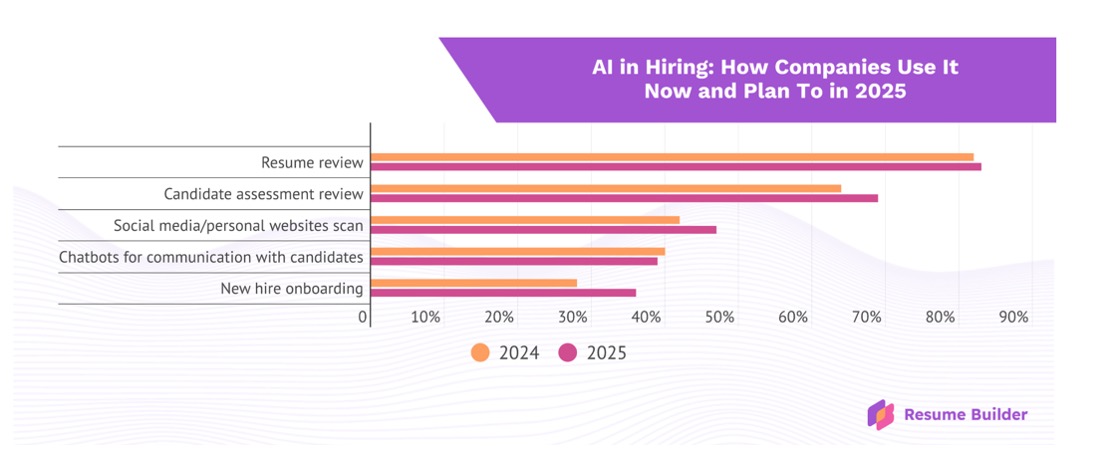
According to a recent Resume Builder survey, half of businesses surveyed are now using AI in hiring, and 68% plan to do so by year-end. Of those, 40% already use chatbots as part of the initial screening process.[8]
Areas Ripe for Automation
While some human-facing technologies still need refining, data-entry-heavy HR functions are ready now. Examples include:
- Recruitment and applicant tracking
- Employee onboarding
- Time and attendance tracking
- Safety and compliance training
- eSignature and digital document management
So, as the printing industry continues to grapple with labor shortages, high turnover, and rising operational costs, HR automation stands out as one of the most cost-effective levers companies can pull. It’s not just about eliminating paperwork or simplifying compliance. It’s about freeing up human capital to focus on growing the business.
From cutting onboarding time in half to reducing compliance risks and scaling staff during peak seasons, automation tools can deliver tangible results regardless of company size. In a field where efficiency drives profitability, automating repetitive HR tasks offers a rare win: better employee experiences and a stronger bottom line.
[1] https://www.gallup.com/workplace/247391/fixable-problem-costs-businesses-trillion.aspx
[2] https://blogs.psico-smart.com/blog-enhancing-employee-experience-through-automated-hr-services-12089
[3] https://www.hcltech.com/case-study/optimizing-hr-operations-for-a-global-print-manufacturers
[4] https://gusto.com/customers/case-studies/astute-communications
[5] https://www.businessinsider.com/how-ai-hiring-works-chipotle-burrito-season-application-job-seekers-2025-2
[6] https://www.fisherphillips.com/en/news-insights/ai-resume-screeners.html
[7] https://printcommunications.org/recruitment-retention-and-pathways-to-employment-in-the-printing-industry-overview-the-reality-and-the-response/
[8] https://www.nysscpa.org/article-content/survey-majority-of-firms-to-adopt-ai-in-their-hiring-processes-in-110124