Yesterday
Canon originally introduced its line of sheetfed inkjet presses with VarioPrint i300 in 2015, the i200 in 2017, and today with over 275 VarioPrint i-series (inkjet) machines installed around the world, the very successful sheetfed platform is the one that many of their competitors are constantly trying to emulate. The i-series evolved since its initial introduction in 2015 as a transactional and book press, with new inks, printheads, and “optional” ColorGrip (see below) which in aggregate raised the bar on the imaging quality, media compatibility, and overall performance. These updates have allowed many i-series owners to regularly produce direct mail and some general commercial work that would previously be produced with toner or offset presses. In fact, some of these same developments found their way into the ProStream, Canon’s premier production inkjet press.
Today
varioPRINT iX Series
In 2020 Canon introduced their new press on an updated platform. The varioPRINT iX series currently includes the varioPRINT iX3200 and the varioPRINT 1X2100, which builds on the experiences of Canon and their customers with the i-series platform. Since its introduction, Canon has placed over 300 iX series presses globally.
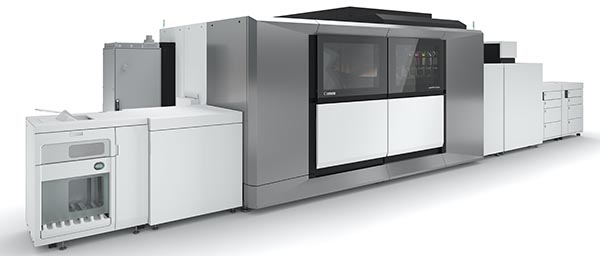
©Canon
The emphasis in the development of this new platform was to create a commercial printing press that could produce high quality printing with readily available untreated commercial substrates and produce it at a very competitive cost. In this new platform, there are four main technology innovation areas: paper transport, quality control, ink innovation, and drying technology.
Transport
Unlike webfed presses, paper feeding on a cut-sheet press requires significantly different design and control. On the iX, it is from a paper input module (PIM) with four trays that can each contain different media weights and sizes, holding a total of 4,500 80gsm/50# text sheets up to 350 x 50 mm (13.78 x 20 in). Up to three PIMs can be connected to increase the capacity to 13,500 sheets in 12 trays. Each PIM has a moisture control unit to maintain a constant humidity for the media condition. The paper transport uses a stainless-steel belt with vacuum suction. This provides the ability to keep all media from 60–350 gsm flat and maintain a small, automatically adjusted, print gap between the media and the printhead for better drop control. The transport also contains a “sentry” which scans every incoming sheet for deformities and automatically purges non-conforming media. Additionally, the sheets are measured when they are fed from the PIM, and again after printing to ensure that front to back registration is controlled by taking any shrinkage into account. The varioPRINT iX3200 can run at speeds up to 320 A4 ipm (images per minute), the iX2100 up to 210 A4 ipm, duplex 4/4, providing a 6% increase in speed over the current i-series.
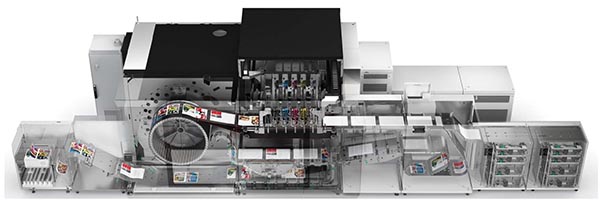
©Canon
Quality Control/Imaging
The press supports four ink colors—CMYK. The varioPRINT iX uses three Kyocera KJ4B 1200 dpi printheads per color, optimized for the series. In order to achieve offset quality and high reliability, the printheads are kept in a conditioned chamber in both the print module and the maintenance module to prevent moisture formation or ink drying at the nozzles. To further control the printing performance, the ink is cooled before entering the printhead and while in the printhead. It delivers 2pl and 5pl droplets to provide high color laydown as well as fine detail. Inline quality control includes nozzle activity control (NAC), in which the system prints a QA sheet which gets scanned for defects and ejected, with the check frequency set by the operator. This results in automatic correction for defects (nozzle outs) through the use of neighboring nozzles. The system also provides nozzle uniformity control (NUC) in which, a printed target gets scanned and adjusts any differences between nozzles, even during a run.
Nozzle maintenance is performed at the start of printing, after, and idle time, or every 3.5 hours during a long run. The process includes both a purge and dry wipe and then a wet wipe, automatically. When the heads are not in use they are automatically capped. No operator interaction is required for any of the above. The only operator replaced consumable in this process is replacement of a tissue cassette.
Inks and ColorGrip
The new press comes with new aqueous-based polymer inks that were developed and are manufactured by Canon. This allows them to control the imaging process, media choice, and printhead performance. The ink set provides a high color gamut and should exceed that of offset printing inks and support existing color imaging standards. The inks are environmentally friendly and produce odorless prints with excellent de-inking capabilities. ColorGrip, which has been optional on the i-series presses, is included in this new platform, and understandably so. It is a pre-coat that is jetted on only the imaged areas that will receive ink using a 600 dpi printhead, allowing the ink to sit high on the sheet and providing better print contrast. It also prevents pigments from bleeding together on coated media by helping to bind (pin) them to the surface.
Drying and Fixing
Drying in an inkjet press is always interesting and challenging. You are putting water on a sheet and now you need to get it out, while still preserving the image and the sheet integrity. We have seen many unique solutions to this problem, and Canon added a new one. It is actually a three-step process; drying the ink with a hot air heated drum to evaporate the water and dry the ink; fixing the ink, which actually melts the polymer particles to provide a firm layer (see image below); and finally cooling the sheet.
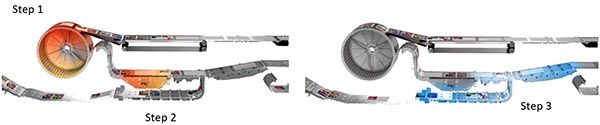
Drying, Fixing, and Cooling. ©Canon
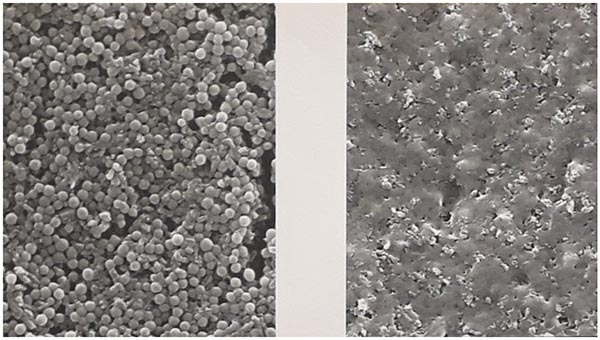
Fixing the image (before and after). ©Canon
A Canon Cut-Sheet Customer’s Inkjet Journey
It all started with two brothers that came from a much larger print company in the 1980s called Drake Printing that, on Christmas Eve, decided to put the sign up on the door and informed everybody that they were going out of business. One of the brothers was a salesman and their father was a pressman at that same printer. They quickly made some moves, bought a couple small presses, and “out of the ashes of Drake Printing formed Phoenix Press” according to Chris Dubach, Executive VP of Business Development. They subsequently bought a marketing company, changed their name, and today they are Phoenix Innovate, an omnichannel marketing company.They started their production inkjet journey with a B2 beta cut-sheet press from SCREEN, which for those who remember was an engineering marvel but never got traction in the market. They did have some digital EP presses, they knew they needed inkjet, so when the Canon varioPRINT i300 came out they became part of the beta program. As a beta customer, they did have some challenges but ultimately found the press to be what they needed and a valuable asset to the company. When the iX came out they traded their i300 and purchased 2 varioPRINT iX 3200 presses to add to their complement of cut sheet EP presses. They usually process 3–4 million pieces of mail a month with their “reliable” production platform. Chris thinks that there could be a B2 or B1 Inkjet press in their future and it always on the lookout.
Canon’s Cut-Sheet Inkjet Journey
It all started at Océ. “Production cut-sheet has been a focus area since the introduction of the monochrome toner-based varioPRINT 6000 series in the 1990s, which, by the way, is still selling,” according to Saskia Willems, Product Manager for Cut Sheet at Canon Production Printing. From there, the development focus was on producing a toner-based color press. There was a lot to learn about color and building a productive and reliable press, which they still do today with their imagePRESS line of production toner presses.
At drupa 2008, Canon introduced their JetStream continuous-feed color production inkjet press for which they contracted the engine from Miyakoshi, and were already working on the next version, the ColorStream, which was to be manufactured in-house. Their primary drivers were to create very fast and very cost effective technology. In 2015, they introduced the varioPRINT i series to great acclaim, and they realized that inkjet could be a great technology for cut sheet as well as continuous feed. They started with inkjet treated papers and realized that in order to move from books and transactional print to direct mail they would need to work on a lot of other issues, especially the ink.
It’s just the beginning…
More in the Production Inkjet Evolution series from David Zwang: HP Preprint Corrugated