When we talk about inkjet, there are more categories than meet the eye. In industrial inkjet modules we make distinctions between those designed to be integrated into page-printing systems, coding and marking, label and packaging content printing, and those designed to add variable content to shells printed with other technologies. When it comes to page-printing, what you might think of as transactional, direct mail, book, and some commercial printing, or what we bundle under “Production Inkjet” on Inkjet Insight, there are still segmentations. Not every press is right for every print environment.
Other articles in this series provide excellent insights for inkjet presses in the entry-level and crossover segments, but there are always caveats when you read these guides. Your needs, the substrates you require, turnaround time requirements, and even width requirements may be higher priorities than the volume bands we focus on. You may also find that multiple devices in a lower volume band give you flexibility in load balancing that a single, higher volume device would not allow. This is especially true if you support a wide variety of substrates for your clients. On the other hand, you might also find that you have high volume that enters your shop in a way that makes one of the printers in the high-speed, “big rigs” segment defined below to be an excellent fit.
We provide guidance, but you know your environment, so ask vendors questions, evaluate your capacity requirements, throughput needs, finishing connectivity, and remember that your mileage may vary.
The Big Rigs
When we talk about the big rigs, these are the largest, fastest, presses and typically command the highest investment cost in the stable of inkjet presses. These devices are so large that you do not see them at many shows, and vendors are likely to take you to one of their dedicated demonstration centers or to a customer location to see working presses.
To land in this category a press must deliver at least 2,500 US letter images per minute, though you will find presses that deliver much more. Investment will usually start at $2 million without consideration for any upgraded unwinders, rewinders, re-moisturizers, dryers, or inline finishing. Some of these devices do require venting and you will want to review power and plumbing requirements if this is your first foray into these high-productivity machines. All the big rigs included here are roll fed inkjet devices. Today’s sheetfed press can be highly productive, but still do not meet the throughput of the big roll fed inkjet web presses.
Since the last guide in 2019, some presses are no longer commercially available. There have also been have been upgrades and new introductions as the vendors continue to respond to customer feature requests, changing market requirements, and an overwhelming need for speed to increase capacity.
In the past, presses in this speed category primarily targeted transaction printing, mono books and direct mail. Today, several of these presses are moving into offset territory. Whether you print books, magazines, marketing collateral, newspapers, or you print and mail regulatory, transactional, or direct marketing, it’s likely there is a “big rig” to meet your needs.
|
Device Productivity, Format Sorted in order of images per minute |
Overview |
|
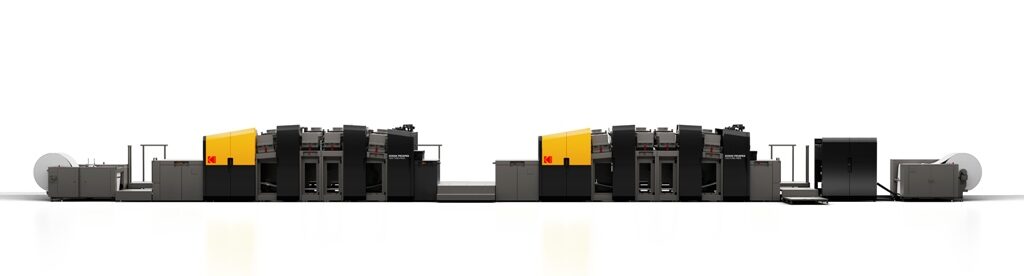
Kodak Prosper 7000 Turbo 5523 A4 IPM |
The Prosper 7000 Turbo is the newest and fastest platform using Kodak Stream technology. Proven in the market for several years, Kodak uses continuous stream inkjet technology rather than drop on demand. Heads jet aqueous pigment CMYK inks in three modes: Quality – 600 x 900 dpi, Performance – 600 x 600 dpi, Turbo – 600 x 450 dpi, all supporting 42–270 gsm media including uncoated free sheet groundwood and matte, glossy and silk coated papers. |
 |
|
|
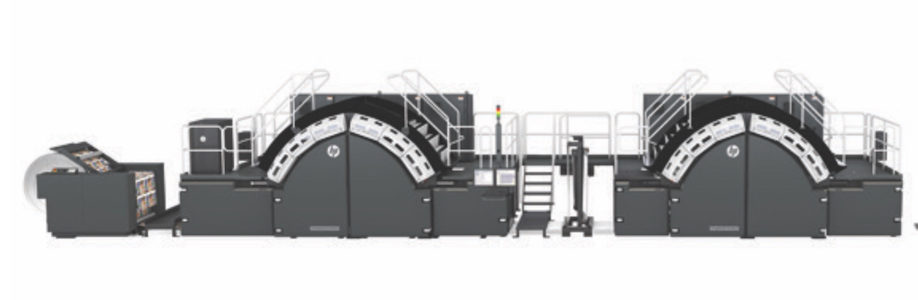
HP PageWide Web Press T490M HD and M(Mono) 4000 IPM Performance mode 1992 IPM in quality mode |
The T490M HD is the most productive of the HP T400 series of 42 inch wide printers and is available in mono and full color versions. It uses thermal drop-on-demand printhead technology at 1200 x 1200 dpi, aqueous pigment ink and optional bonding agent. The device can be configured for a range of segments including from transaction printing and books to high-color direct marketing, and commercial print. It will print on offset coated stocks with the use of HP priming solution. |
 |
|
|
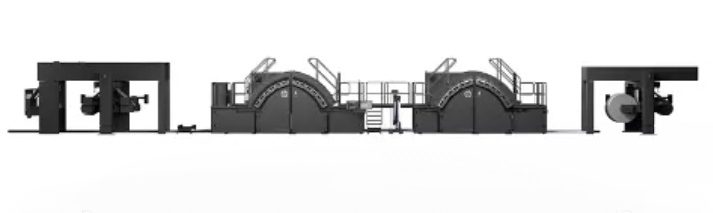
HP PageWide Web Press T485 HD 3200 IPM Performance mode 2000 IPM in quality mode |
The T485 HD with Brilliant Ink, launched this week, prints directly on coated and uncoated offset media in full color. The tight-web configurations use thermal drop-on-demand print head technology 2400 nozzles per inch. The device can be configured for a range of segments requiring a wide range of media with support for 40 to 350 gsm, 30-lb text to 130-lb cover. Printable width up to 41.7 inches and printable frame length from 8.5 to 108 inches. |
 |
|
|
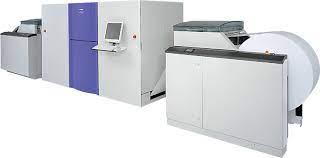
Screen Truepress Jet520ZZ 3,000 IPM |
The Jet520ZZ is available in both aqueous pigment and aqueous dye models with top resolution of 720 x 720 dpi and 4 gray levels. This model has efficiency enhancements such as the Equios Color Management System and an intelligent variable data processing RIP focused on high precision printing for transactional and mid-quality commercial applications on uncoated offset and inkjet optimized papers with basis weights up to 160 gsm. |
 |
|
|
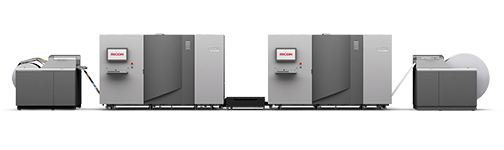
Ricoh Pro VC40000 2500 IPM |
The Pro VC40000 prints at 492 fpm in color and 590 fpm in mono. Unlike other presses in the Pro VC line, this one has a maximum resolution of 600 x 600 and prints on uncoated, inkjet treated, inkjet coated, pinless and pin-fed stocks. The VC40000 offers separate printhead arrays for black and full color with an optional fifth head array for MICR or security inks. While capable of producing an array of applications, it is best suited to transaction printing and transitional or transpromo communications in addition to direct letter mail. One other difference is price – the VC40000 is priced significantly lower than its siblings. |
 |
|
There are a few additional things to know, some of which are covered in other articles in our series.
We focused on the HP PageWide T490 HD and the new T485 HD because they are the most productive presses HP sells, supporting multi-up printing for a diverse set of applications, and stocks from lightweight to some of the heaviest papers. These are also presses commonly used in both book and newspaper production. HP also make the T390, with a print width up to 29.1 inches and resolution of 2400 x 2400 capable of up to 3000 IPM. It is commonly found in book production sites. Depending on your needs for speed and quality, all are worth considering.
The Kodak Prosper 7000 Turbo brings three modes that can help companies support a diverse range of applications from a single platform. Kodak also offers the Prosper 6000C and 6000P producing over 4,000 IPM on coated or uncoated offset stocks. The 6000C is intended for direct mail and other applications where heavier stock is used. The 6000P is tuned for publishing and applications using lighter weight media.
SCREEN sells many variations of their SCREEN Truepress Jet devices, each is built on a robust paper transport and features the Equios front end for file and color management. These machines have an attractive footprint. While the Truepress 520ZZ meets the speed bands of the big rigs, review your specifications against the entire family to zero in on the perfect solution for your environment.
As you review your print requirements against the specifications, it may not be the fastest machine that most closely matches your production needs. Perhaps you need less speed and more flexibility. If so, stay tuned for the next in our shopping series: Crossover presses.
This shopping guide is intended to help narrow the field for devices that meet specific criteria. A lot more details on the products can be found in the Inkjet Insight Device Finder and the other features in this series.