Inkjet printing has come a long way in the last 15 years. You can buy print heads and print systems that produce print quality and speed that meet your needs and you can select from substrates ranging from ultra-lightweight to ultra-heavyweight. There are paper merchants happy to sell you uncoated offset stock, inkjet prepared stock, and inkjet treated stock to bring designs to fruition. And there are solutions to prime and post-coat to bring more vibrance to the print.
Should you consider priming and post-coating to enhance inkjet print? Perhaps!
[caption id="attachment_4870" align="alignleft" width="325"]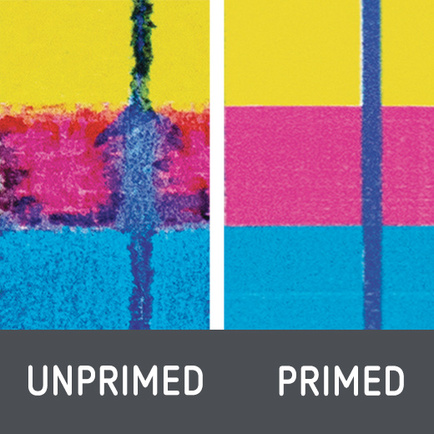 Image courtesy of Michelman[/caption]
Let’s start with priming. This happens before the print to prepare the surface for the ink that will be jetted. The goal is to improve the quality of the print, especially on substrates that might be either too absorbent or not absorbent enough to ensure print consistency. Priming wasn’t invented for inkjet production – it has been used with other print technologies for many years. However, the priming solutions and
Some printers look at the cost of priming and make an active decision to print some work on coated and uncoated stock without priming due to the cost/quality ratio. They look at the cost of the ink and the substrate as well as the client project and determine that it is unnecessary. For example, a transaction print provider printing on an uncoated offset stock might decide that to meet the needed print quality, primer is an extra cost that cuts into the margin. A book printer might make that same decision for text-only books but make a different decision for books with technical illustrations and images. For direct mail, commercial, and other graphically rich work there are different calculations. Color vibrance and ink adhesion are part of the quality equation, and a primer lays the infrastructure to meet those requirements.
Primers are used with both water-based pigmented ink and UV ink printing, but not all primers work in all environments. Primers used in toner presses or in offset print environments are formulated differently from those for digital inkjet. Because inks are formulated by each printhead manufacturer to meet the needs of their architectures, primers must be matched carefully.
In addition to priming the substrate ahead of print you could choose a paper that is pre-treated or pre-coated. There are many options on the market and the price difference between running your own coating and buying prepared substrates might be close enough to make it an easy decision. If you decide to use prepared stock you avoid the cost of the hardware, priming fluid, cleaning, and waste management that comes with the on-board solution.
The best guidance on whether to bring primers onboard comes down to how you run your shop, what you print, and how you make your calculations. Many vendors offer solutions with onboard priming built into the system and give you the option to turn it on and off as needed. If you have a device with this option, work with your vendor to understand what priming fluid options they offer and what substrates they recommend for the best results. If your device did not come with a priming solution built in, or you are looking at one without the option, do some research based on the work you do today and plan to do in the future to see if priming or buying pre-treated paper might work most economically for your business.
Now let’s talk about coating options because this is where you have many choices:
- Coatings to add gloss, matte, or silk features to print.
- Coatings to add durability.
- Coatings to add effects.
- Coatings to offset print to permit inkjet post-printing.
As with priming solutions, the chemistry must match between the inkjet inks and the coating. In this case, matching means that the chemistries must be compatible. Talking to your inkjet vendor is going to be the best way to identify what coating options will work best and avoid a lot of trial and error. Many of the hardware vendors have partnerships for coating that bring reliable options that have already been tested. Companies like Harris & Bruno, Contiweb and Epic have been supply coating solutions for inkjet for more than a decade and can be a good place to gain a deeper understanding of your options.
T
he best guidance on whether to bring coating solutions to your shop comes down to the customers you serve and opportunities that might open with the ability to bring durability, sheen, and coating effects to your product menu. The value in coating options is that they can not only protect the print, but they can become a value-added enhancement. And before you say “my customers won’t pay for enhancements” think carefully. If you print direct mail postcards, post-coating protects the print from the slings and arrows of outrageous postal machines. If you print brochures and other marketing collateral, post-coating extends the life of the print. With a bit of marketing, any PSP can find ways to use coatings to add value!
Do you have a favorite way to use priming and coating? Let me know!
Also, check out this previous post from Mary Schilling on profiling with primers and coatings.