Previously published as Premium Content on WhatTheyThink.com
Background
In
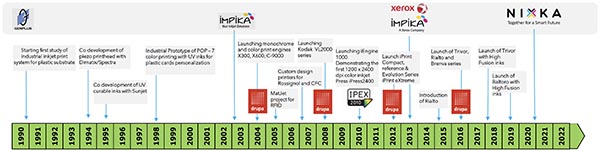
2012 at drupa, I was introduced to IMPIKA (Imprinted with Picoliters for Thousands of Applications), a French company that had been fully investigating and exploiting the manufacturing and marketing of printing and material jetting solutions since 1990 prior to the founding of IMPIKA in 2003. As I had been looking at the potential of production inkjet since the mid 1980s, this unique company caught my attention. So, it was not a surprise when they were subsequently acquired by Xerox in 2013 to help fast track Xerox into the production inkjet press race which was already heating up. The fruits of that acquisition started to become evident in 2015 with the introduction of the Rialto, and subsequently during
drupa 2016 with the introduction of the Trivor and Brenva. It peaked with the introduction of the Baltoro and High Fusion Ink which allowed printing on offset coated paper without any pretreatment in 2019.
After the Icahn-led “reorganization” of Xerox in 2018, in addition to the dissolution of an almost 60-year FujiXerox (FX) partnership, Xerox walked away from the IMPIKA acquisition in 2019. As a result, they also walked away from an impressive inkjet development team led by Paul Morgavi, the founder of IMPIKA. Considering the 30-year history and high level of expertise of the team, it wasn’t long before the word got out, interest rose, and NIXKA was founded.
Who is NIXKA?
The name tells the story;
New
Inkjet targeting (
X) thousands (
K) of
Applications. Led by Paul Morgavi, the founding team includes eight experienced professionals along with “currently” about 25 additional inkjet experts from the former organization that have hit the ground running. As of today, they already have a number of ongoing projects in textile, flexible packaging, and very-high-resolution printing, with a few more projects in the pipeline and lots of additional interest as the word has been getting out.

As was the case with IMPIKA, the NIXKA philosophy is to use the best tailored components for the ultimate solution. In fact, of the three projects mentioned, each will be using different printhead technologies and will probably include Dimatix, Kyocera, and Memjet. In their 30-year history, they have developed strategic partnerships with many of the premier companies in the industry, which enables them to understand and select what is best for the solution at hand. Their partnerships read like a who’s who of inkjet development.

Inkjet Facilitates Innovation
For quite a while, I have spoken about the inkjet revolution. By using component technologies, you can create almost any type of purpose-built solution like you would Legos, if you have the expertise and take a creative approach. An agnostic approach allows you to create the optimal solution in combination with the optimal ink to match the requirements of the substrate and application.
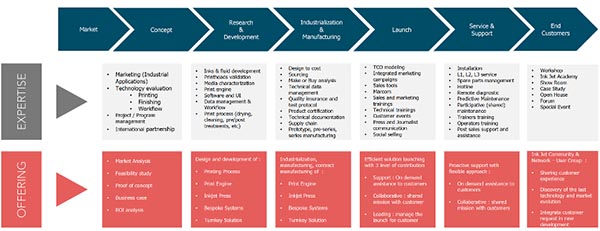
However, it doesn’t stop there, since the final solution could include printheads, ink, substrates, transports, coatings, electronics, software systems, etc. Of course, it could also include go to market and support once it is designed and produced. Ultimately, it is really about supporting the requirements of an application.
Inkjet is continuing to facilitate many new bespoke solutions that are moving print from a standalone process to become a part of the product manufacturing process. In packaging, direct object printing of bottles, cans, and other containers on the production line are replacing label applications and will continue to grow. The digital production of corrugated and flexible packaging allows FMCG (Fast Moving Consumer Good) manufacturers the content and time flexibility required to support the changing market requirements. While many commercial print applications are served by standalone presses, commercial print applications are also seeing the benefits of bespoke solutions, in the form of complete inline production systems. The needs of packaging print in a manufacturing line are going to be different than that of standalone commercial printing press, or imaging on ceramics, or the dispersion of biomedical materials or even printed electronics. This is why maintaining an agnostic, yet holistic view of the application use leads to the optimal solution.
When designed well, purpose-built solutions provide more cost effective and timely solutions with fewer setups and less handling. This is part of the core philosophy of NIXKA and ingrained in their birthright. While NIXKA is not the only company that is developing inkjet solutions for print applications, but they may be one of the more experienced. It will be interesting to see what they create in the future.
More to Come…
2021 is starting to move at an increased pace and I would like to address your interests and concerns in future articles as it relates to the manufacturing of Print, Packaging, and Labels, and how, if at all, it drives future workflows including “Industry 4.0.” If you have any interesting examples of hybrid and bespoke manufacturing, I am very anxious to hear about them. Please feel free to contact me at
[email protected] with any questions, suggestions or examples of interesting applications.
About WhatTheyThink
WhatTheyThink is the global printing industry's go-to information source with both print and digital offerings, including WhatTheyThink.com, WhatTheyThink Email Newsletters, and the WhatTheyThink magazine. Our mission is to inform, educate, and inspire the industry. We provide cogent news and analysis about trends, technologies, operations, and events in all the markets that comprise today's printing and sign industries including commercial, in-plant, mailing, finishing, sign, display, textile, industrial, finishing, labels, packaging, marketing technology, software and workflow.