
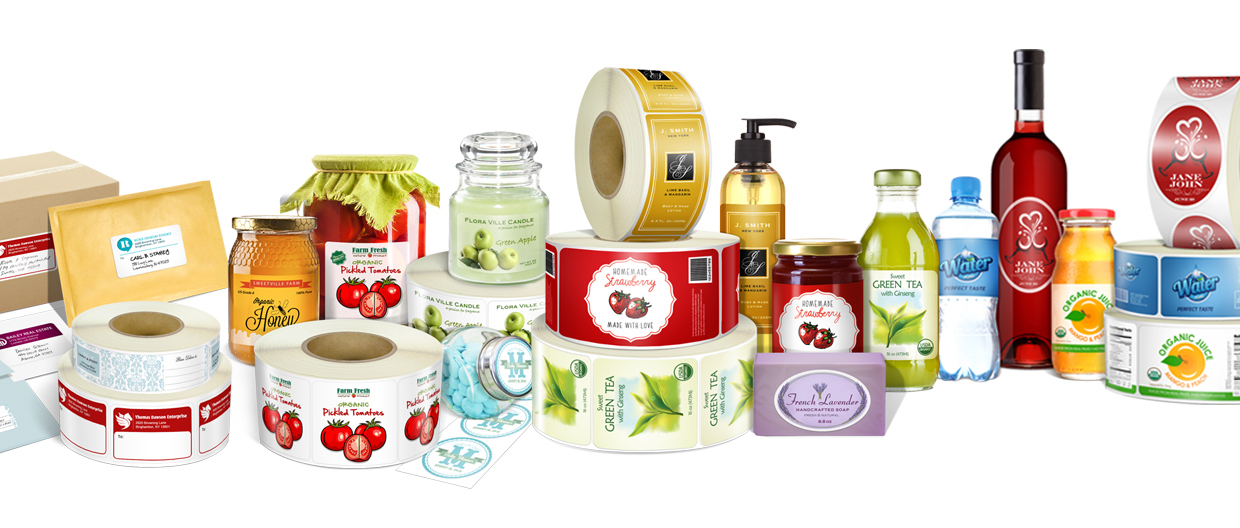
Background
Labels and tags have been around since about 3400–3200 BC in ancient Egypt, when small inventory tags made of ivory, bone, and stone were used in tombs to record quantities and origins of goods. Today, improved flexo, dominate new label press sales along with digital electrophotographic, inkjet and hybrid label presses enabling short runs, variable data, and on?demand color label production. Same purpose, different technologies.
Demand
At its core, labeling is considered package identification and decoration. Its growth is driven by e-commerce, food/beverage demand, and regulations, where the market has surpassed 1.2 trillion square meters in production volume per year. Demand is growing in food and beverage (60% of demand) and pharmaceuticals (18% of demand), driven in large part by strict regulations on product safety and transparency. The global label market is estimated at $55.2 billion in 2026 and projected to grow at a CAGR of 5.5% through 2036. Pressure-sensitive labels will continue to dominate at more than 55% of the market volume, and are projected to see the greatest growth to an estimated 5.15%, with glue applied to 5.05% and in-mold at 4.12% CAGR. Shrink sleeves, which have found a growing niche, are projected to see a 6.63% CAGR during the same period. The demand is there.
What Is Changing in Label Converting?
The market is moving toward high-mix, low-waste production rather than only high-volume throughput. In practical terms, the winning equipment is the kind that can switch jobs quickly, inspect automatically, and handle variable data without slowing the line.
Digital converting is no longer just about finishing labels faster but about compact, integrated production lines. There is growing demand for smaller, highly-connected systems that combine printing, inspection, slitting, rewinding, and finishing in one flow. It is becoming part of a broader production strategy that links printing, data, inventory, and compliance into one workflow. That is especially important for converters serving retail, pharma, logistics, and direct-to-consumer brands, where versioning and traceability matter most.
Attracting Attention
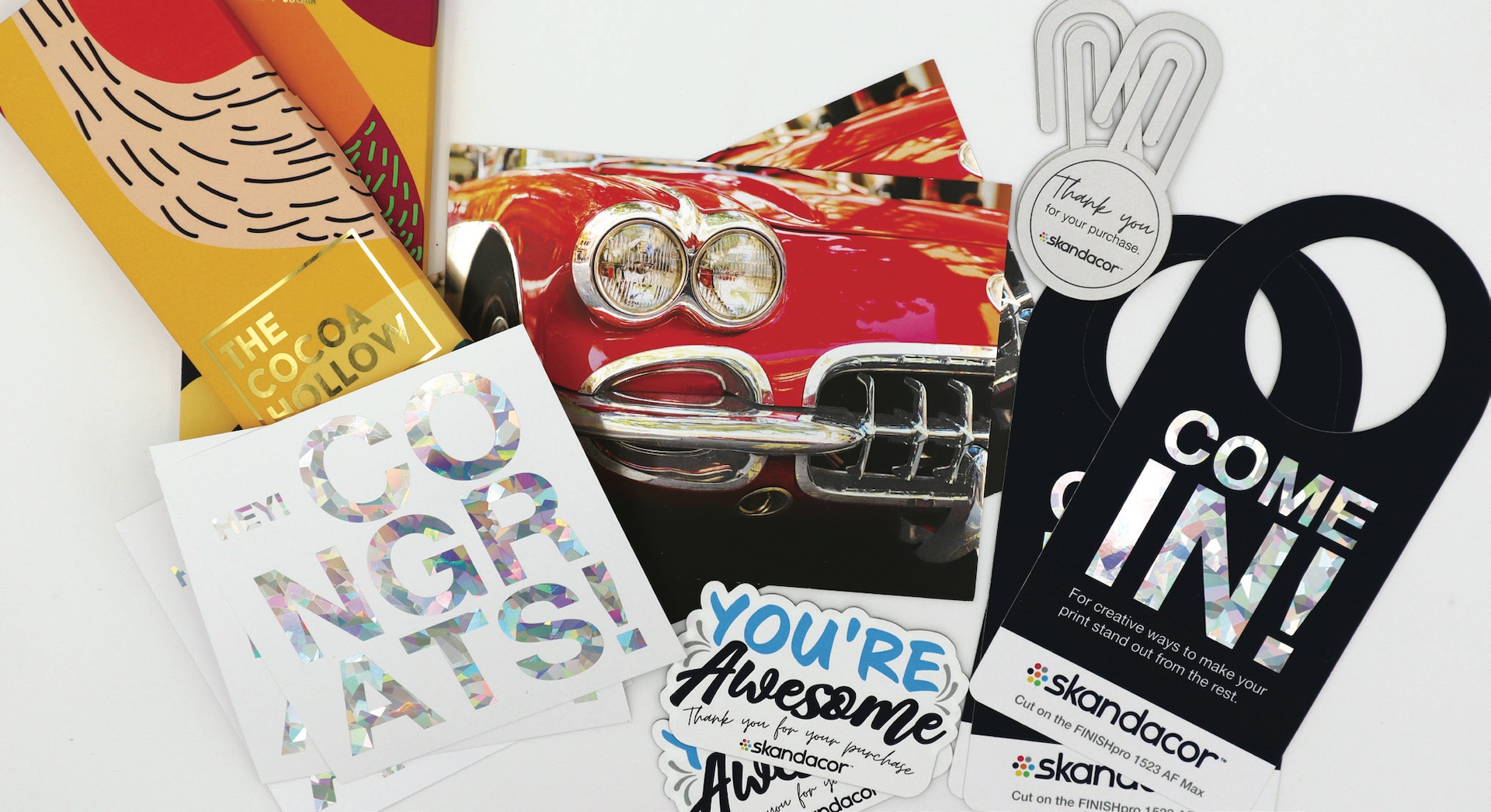
Label embellishments are experiencing rapid growth, driven by digital technology that offers cost-effective, high-impact tactile and visual enhancements like foiling and textured varnishes. This sector is expanding at 6–8% annually, projected to reach $45 billion by 2028, as brands use premium finishes to increase consumer engagement and perceived value.
Embossing has been used in premium labels for years. It creates a raised pattern or design on the substrate that is pressed onto a page instead of cutting it out. Debossing depresses the image into the substrate for a concave impression. This form of embellishment requires the manipulation of the substrate using a die and a mirror image counter. In addition, dies can be used in a similar fashion to digital decorative die-cutting, which could be as simple as a window in a page to see through. This type of die-cutting uses a similar principle to embossing and debossing, the difference being that with die-cutting, you are usually cutting through the substrate and not just making an impression in the substrate.
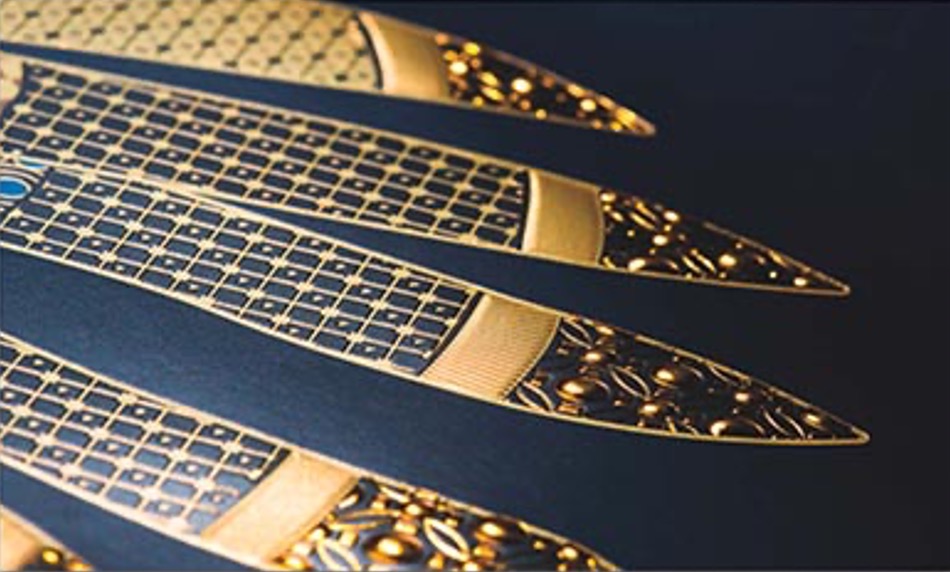
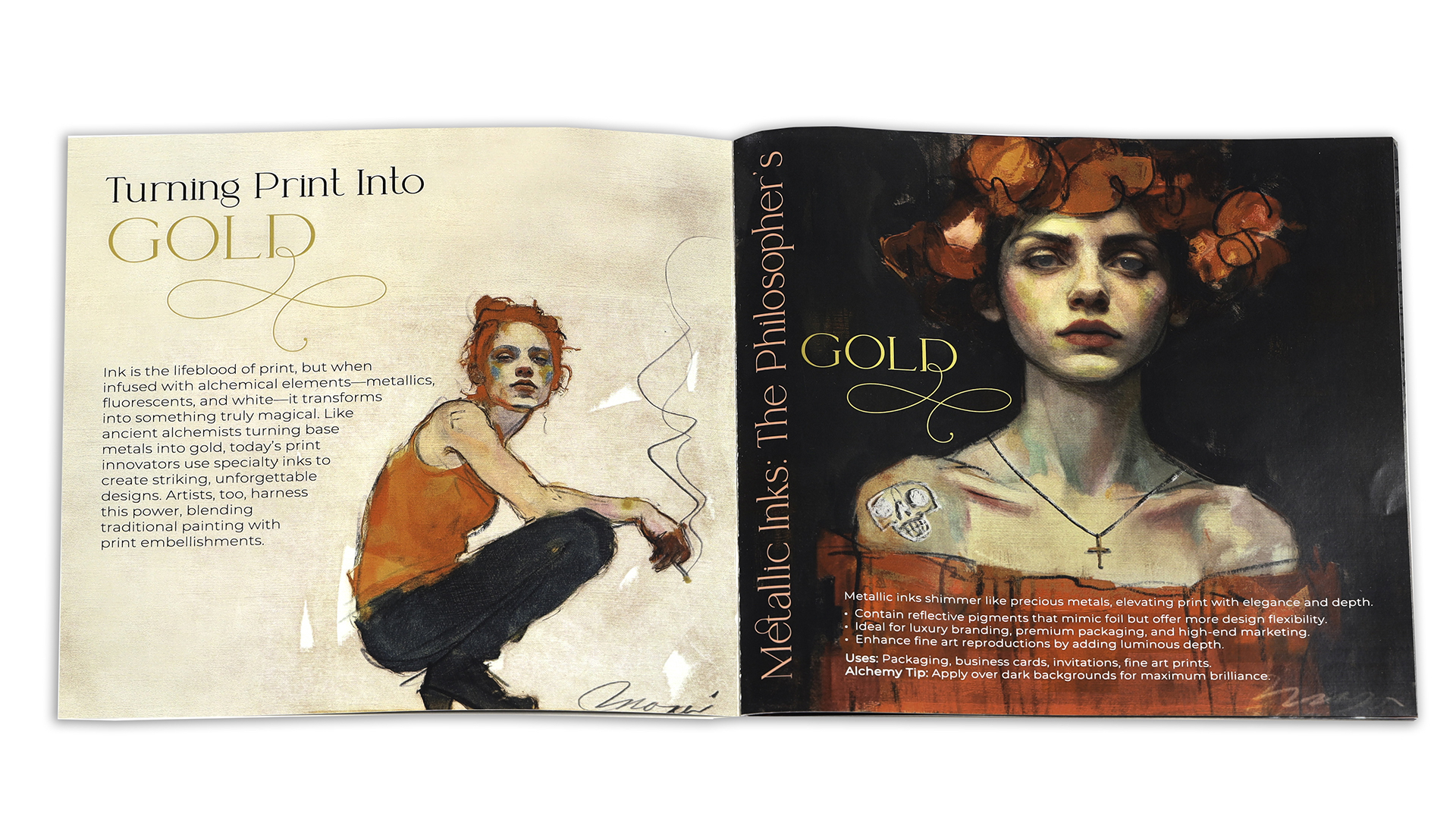
Foiling adds metallic finishes for an element of luxury and sophistication that catches the eye. For example, many wine and perfume labels use foiling techniques to add a touch of glamour and bling to the packaging. Foiling offers a wide array of metallic ink colors for a shiny, foil-like finish along with specialty elements for product decoration and/or security purposes. Foil can even be used in variable-data printing so the treatment and color change from page to page.
Hot foil stamping, uses a painted carrier sheet which when hot stamped with a die plate impresses on the receiving media. These carrier sheets are coated with different colors including metallics, a release layer, and an adhesive. In packaging, it is primarily used on folding cartons. The introduction of cold foil printing or stamping made it even easier. In this process, an adhesive is printed using a normal printing plate or cylinder and the coated carrier comes in contact with the adhesive and the metallic coating is pulled off the carrier and remains on the substrate.
Digital Embellishment
Digital embellishment has brought embellishments to wider use. Historically, coatings are applied that makes the printed images pop and protects them against fingerprints, scratches, or smudges. Coatings also protect labels and packaging as they work their way through the manufacturing chain to the store shelf and, ultimately, to your home. Coatings are either UV- or aqueous/water-based for maximum environmental friendliness, and are available in satin, gloss, or matte finishes as well as soft lamination which makes a printed piece feel like velvet. However, with the advent of digital technologies, embellishment has been taken to the next level.
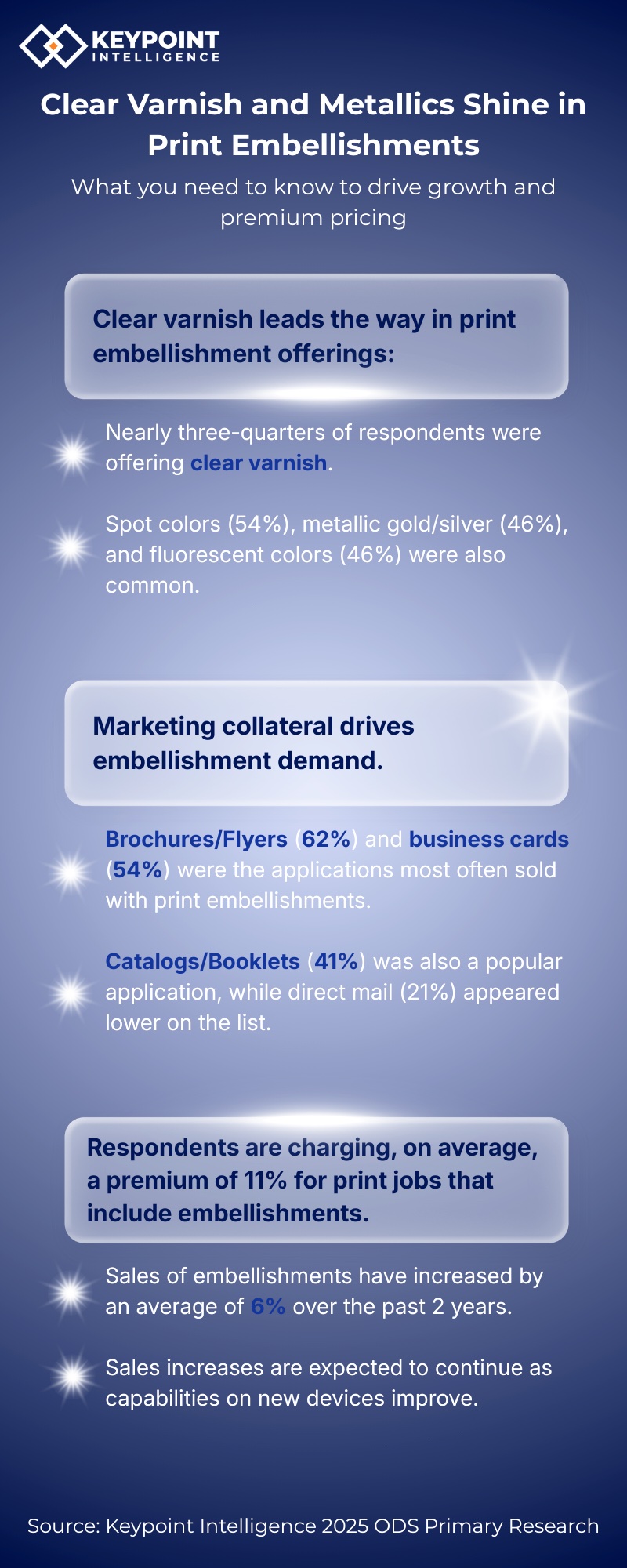
Digital embellishment enables faster, more precise, and shorter-run capabilities for customized labels compared to traditional methods. Techniques such as high-build varnish (raised textures), metallic cold foils, and spot coatings make products stand out on shelves. According to a recent Taktiful study, consumers are willing to pay up to 89% more for products with enhanced packaging. Embellishments serve as a psychological trigger for quality and luxury. Specialty print embellishments are growing at 6–8% annually, far outpacing general print segments. About 55% of brand owners actively seek out specialized print effects to differentiate their products and are willing to pay for the added value. Modern embellishment techniques are increasingly integrated with eco-friendly label materials and techniques that ensure recyclability. Popular applications are particularly high in the wine and spirits, craft beer, and premium food industries, where tactile engagement strongly influences buying behavior.
Specialty Inks and Toners
Inks have expanded beyond traditional CMYK and Pantone special color formulations. There are new options for flexo, toner, and inkjet solutions, such as fluorescent shades, scented inks, and metallics, all adding another way to affect the emotions. Security inks to identify and trace packaging as anti-piracy measures include biometric inks with DNA tags that verify if products are real, thermochromic inks that are visible or invisible at different temperatures, magnetic inks containing small iron oxide magnetic flakes so a number can be read by a machine, and infrared inks that can be viewed under an infrared light. Increased availability for inline embellishment in digital toner presses has been evolving to address these new requirements for a wide range of metallic embellishments for design and security printing on labels and packaging.
Modern printed labels are increasingly being influenced by developments in technology. Demands for in incorporating barcodes and, increasingly, UPCs for transactional, regulatory, and traceability information has become mainstream. While predicted for years, the use of NFC and RFID at the consumer retail level with many new types of active and intelligent packaging is growing. RFID/NFC and other smart features are turning labels into data exchange platforms with interactive elements supporting logistics and retail. This is facilitated by smartphone owners, approximately 80% of whom now have NFC readers in their hands. These technologies are currently being used to track product life cycles, identify if a package has been opened or tampered with, manage recycling efforts, and even connecting CPGs with customers. Smart “connected” labels (RFID/NFC) are projected to show the fastest growth at 11%, growing from an estimated $16.4 billion to $29.2 billion through 2030. It is anticipated that as new applications emerge, usage of smart packaging in retail will continue to increase and the costs will go down, triggering even more growth.
Converting
Die-cutting is used to cut the shape of a label or box—but it can also be used to introduce an intricate design like a filigree pattern. Traditional die-cutting is performed by creating dies, in specific shapes, that serve as cut or die plates that are pressed into the substrate to cut out the design. In labels and packaging, product- and production-based decisions determine whether the die-cutting should be done inline using rotary and semi-rotary die-cutting stations and laser technologies, or offline with flatbed conventional dies and die-cutters. Digital die-cutting is when a laser beam cuts out the desired shape. The availability of digital die-cutting solutions has been increasing and as adoption increases, the equipment costs should decline as well. Digital die-cutting provides a greater pattern intricacy and eliminates the cost and time of producing dies and plates, which makes it timely and an economical choice.
Challenges to Labels
Sustainability has placed increased demand for liner-less, recyclable, and eco-friendly labels due to regulatory pressures on plastic waste. This has led to growth in alternative product decorating solutions.
Eco-friendly packaging solutions dominate industry priorities, with most brands using or moving to recyclable, compostable, or biodegradable packaging. Plastics are still the dominant material in the packaging labels market, capturing a substantial 46.1% share. This dominance can be attributed to plastic’s versatility, durability, and cost-effectiveness, which make it a popular choice for a wide range of packaging applications. Plastics such as polyethylene, polypropylene, and PVC offer strong performance in both aesthetic appeal and functionality, providing resistance to environmental factors like moisture and temperature, which is crucial for products in industries such as food and beverage, cosmetics, and pharmaceuticals.
The global flexible packaging market is experiencing significant growth, projected to reach roughly $370 billion to $488 billion by the early 2030s, growing at a CAGR over 4%. It is rapidly displacing traditional, rigid packaging (glass, metal, rigid plastic) and conventional labels due to superior sustainability, lower transportation costs, and increased design flexibility for food, personal care, and retail brands. Even with that, the plastic vs. paper battles still exist, since recycling is still fragmented across the globe. There is currently a move to fiber and/or mono material solutions to ensure better compliance with both regulatory and consumer requirements. There’s also an increased focus on carbon footprint transparency and recyclability design to meet consumer demand for sustainability and to support corporate social responsibility goals, while still protecting the product.
Direct to Object
Today most of the packaging decoration (i.e., labels) that exist are handled through a supply chain that includes the designer, CPG, and label converter, and ultimately it makes its way to the product manufacturing line. As a CPG, surviving the changing markets could require that you need to plug in a special type of label, or another type of product or promotion that is required. The idea is that no matter what the changing demands are, your time to adjust to a new product is minimized as much as possible.
Label converting continues to offer a wide variety of growth opportunities. However, you need to be sure to understand and align your customer requirements to the right press and converting technologies to achieve good margins and higher growth. While digital label printing provides many opportunities for higher margins and growth and ease of operation, it still faces lower productivity, higher costs for traditional runs, and some substrate limitations compared with flexo and offset. On the other hand, digitalized analog print technologies including flexo, offset and hybrid solutions have evolved to counter some of those digital print advantages.
Technologies Will Continue to Meet and Drive Market Shifts
Flexography is still the dominant printing technology in label production. The global flexographic printing market size was estimated at $8.84 billion in 2023 and is projected to reach $11.50 billion by 2030, growing at a CAGR of 4.1% from 2024 to 2035. Digital printing accounts for an estimated $12.7 billion and projected to grow to $20.37 billion by 2035.
There is an increased demand for fast, cost-effective packaging solutions. Faster and wider digitalized flexo and offset presses are emerging as cost effective solutions for some smaller as well as mid to long runs. Automation and hybrid technologies in press and converting are developing to address those needs as well. These solutions can be seen driving automated and quicker makeready for printing, die cutting, folder gluers, pouch making, hybrid embellishment solutions, etc.
More to Come…
I would like to address your interests and concerns in future articles as it relates to the manufacturing of Print, Packaging, and Labels, and how, if at all, it drives future workflows including Industry 4.0 and 5.0. If you have any interesting examples of hybrid and bespoke manufacturing, I am very anxious to hear about them as well. Please feel free to contact me at [email protected] with any questions, suggestions, or examples of interesting applications.