Retail environments are designed to evolve. Seasonal promotions, product launches, and brand campaigns continually reshape window graphics, in-store signage, and interior displays, with many programs updated regularly throughout the year.
But as those refresh cycles accelerate, a new question is emerging across the industry: What materials are we using for graphics designed to last only weeks or months?
For Innomark Communications, a full-service visual marketing and production partner supporting national retail brands, those challenges are a daily reality. The company produces a wide range of large-format graphics, signage, and environmental display materials used in retail environments across the country, from large storefront windows to point-of-purchase displays to interior wall graphics.
As sustainability goals become more prominent across retail operations, more brands are looking beyond traditional vinyl and plastic-based substrates and asking their production partners to help them identify ways to reduce environmental impact across their operations.
“If a graphic is only intended to be up for a short period of time, brands are starting to question whether permanent plastic materials are really necessary,” said Josh Flohre, Senior Account Executive at Innomark Communications. “More customers are asking us to help them find alternatives that still perform from a print and installation standpoint.”
For printers and production partners, that conversation requires balancing several competing priorities: visual quality, durability, and sustainability. Increasingly, fiber-based materials are emerging as a viable solution for many retail graphics applications.
To support that shift, Innomark has increasingly turned to Monadnock Paper Mills’ portfolio of fiber-based materials to meet both performance and sustainability requirements.
Rethinking Materials for Retail Signage
Historically, many large-format retail graphics, particularly window displays and hanging banners, have relied on PVC vinyl or other synthetic materials. While those materials provide durability and opacity, they also introduce challenges for retailers seeking to reduce plastic use across store environments.
“Retail graphics programs move fast,” Flohre explained. “Our job is to deliver a consistent visual experience across hundreds of stores, often on very tight timelines. At the same time, brands are looking for ways to better align their in-store materials with internal sustainability goals. Having materials that support both without compromise is critical.”
Fiber-based substrates provide a practical alternative, particularly for applications where visual impact, print quality, and reliable in-store performance are essential.
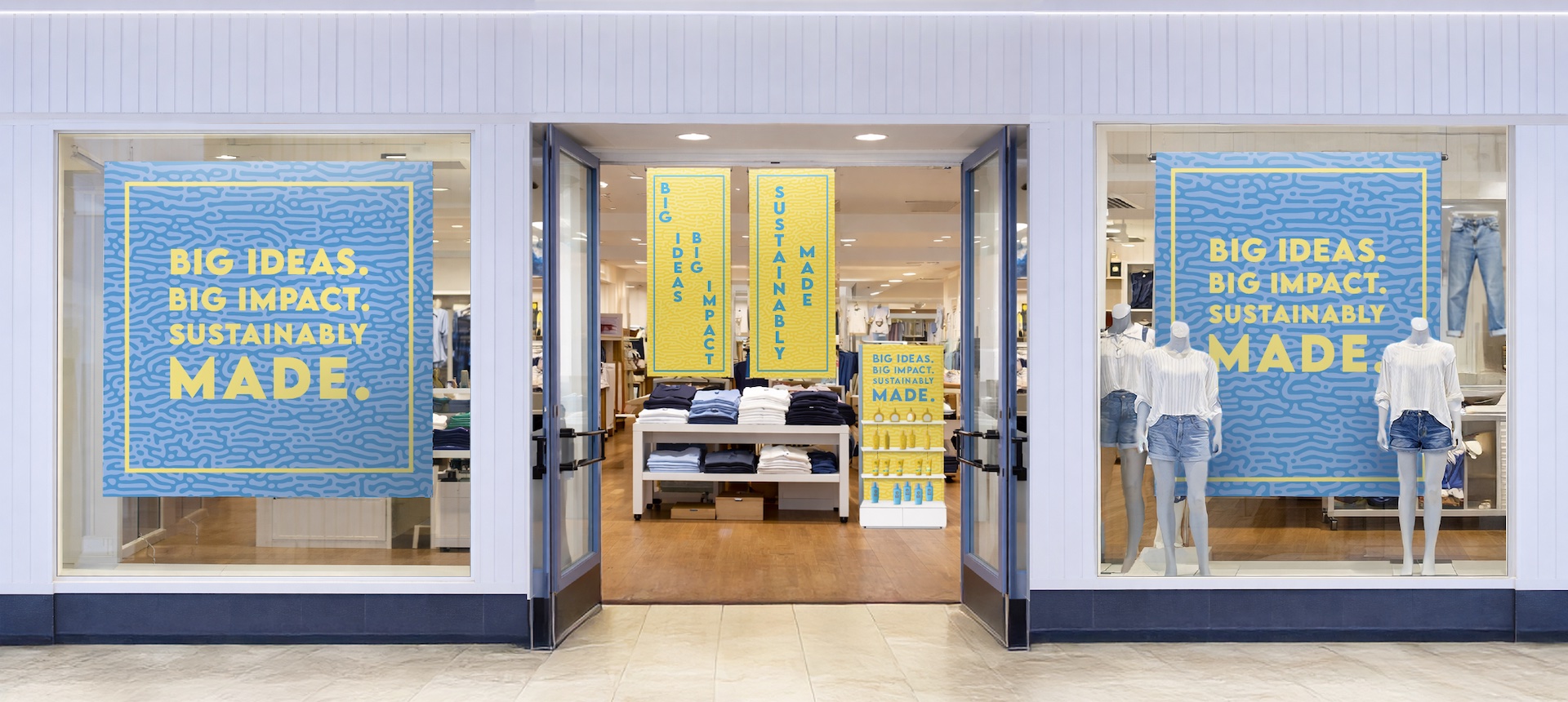
One of the most visible examples is storefront window graphics, which often serve as the focal point of a retail campaign.
Storefront installations often span nearly 8 feet tall and 8 feet wide, transforming the entire window into a single promotional display. Traditionally, graphics at this scale require multiple printed panels, a process that can introduce alignment challenges and visible seams.
Monadnock’s Ultrahide® PC 100 Blockout Poster allows printers to produce these grand format graphics as a single piece. Available in rolls up to 96.5 inches wide, Ultrahide provides a double-sided printable blockout surface designed specifically for large window applications.
“The biggest benefit is eliminating seams,” Flohre explained. “When printing a window graphic as one continuous piece, you don’t have to worry about lining up panels or having a seam run through the middle of the design. From a visual standpoint, it creates a much cleaner result.”
Because Ultrahide is manufactured using 100 percent post-consumer recycled fiber, it also enables retailers to transition away from PVC and other synthetic signage materials while maintaining the opacity and image quality required for high-impact window campaigns.
A Portfolio for Retail Applications
While Ultrahide is commonly used for window graphics and large-format hanging banners, Innomark works with several Monadnock substrates depending on the application.
For standard in-store signage and environmental graphics, Astrolite PC 100® provides a smooth, bright white uncoated surface that delivers strong color reproduction and photographic image quality
For dimensional signage and point-of-purchase displays, ENVIsual® Board offers a rigid, fiber-based alternative to plastic substrates such as styrene.
And for interior wall installations, ENVI® Wallgraphics provides a prepasted, removable wallcovering designed for both commercial and retail spaces. The product features a water-activated adhesive for easy installation and removal, along with durable print performance suitable for large-scale murals and branded environments.
“Flexibility is important,” Flohre said, “Retail environments evolve constantly. Materials that install easily and remove cleanly help stores update their spaces without adding unnecessary complexity.”
Bringing the Material into the Environment
That capability was recently demonstrated at Monadnock Paper Mills’ own headquarters, where Innomark helped produce and install a large-scale custom wall mural using ENVI PC100 Wallgraphics.
The installation served as a real-world example of how fiber-based graphics can transform interior spaces while supporting sustainability goals.
“Printing and installing the wall graphic at Monadnock was a great example of these materials performing in a real environment,” Flohre said. “The material printed beautifully, and the installation process was exactly what you’d expect from a professional wallcovering. It’s always rewarding when a product performs just as well in the field as it does during testing.”
Projects like this help demonstrate how fiber-based graphics can move beyond concept discussions and into practical applications.
The Future of Retail Graphics
As retailers continue exploring ways to reduce environmental impact across their operations, in-store signage and graphics are becoming a more practical place to make change.
“Retail signage is designed to change,” Flohre said. “If you can deliver the same visual quality and installation performance with a material that aligns better with a brand’s sustainability goals, that’s meaningful improvement.”
Through its portfolio of PC 100 substrates, including Ultrahide, Astrolite, ENVIsual Board, and ENVI Wallgraphics, Monadnock Paper Mills is helping retailers and print providers transition away from plastic-based signage without compromising performance.
For partners like Innomark, having those options makes it possible to meet both operational demands and evolving sustainability expectations at scale.