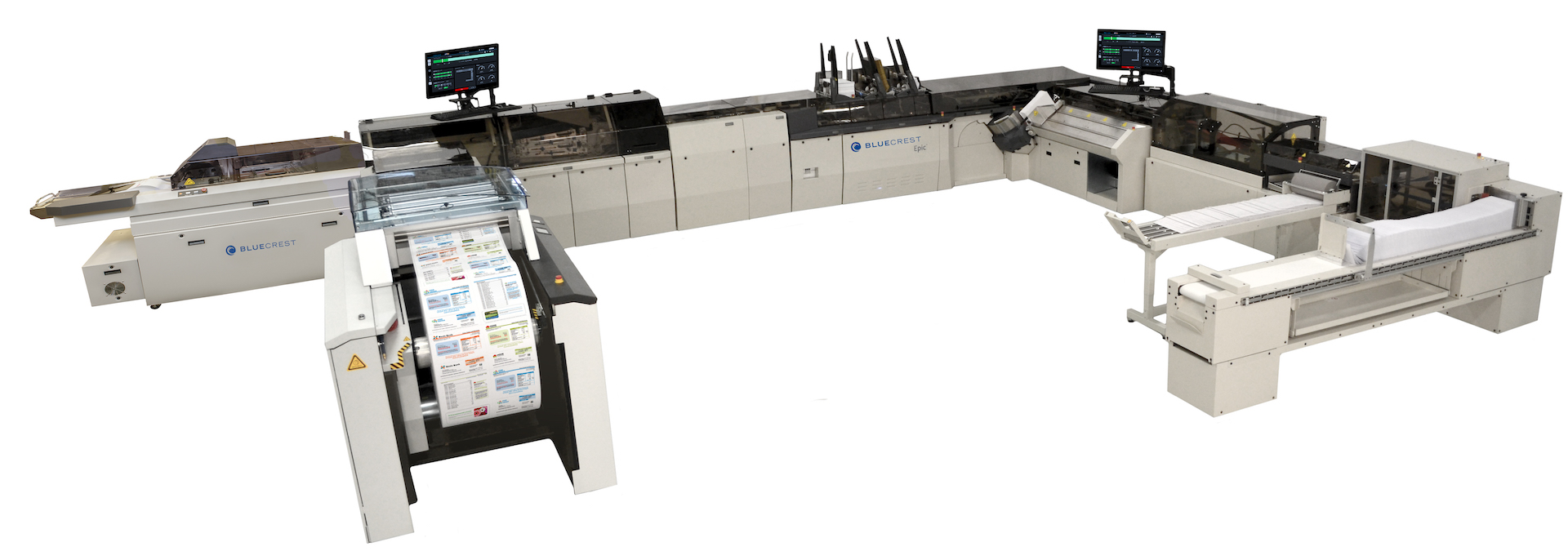
As transactional mail evolves, mail manufacturers are adopting inserter technology that can handle greater format variability, faster changeovers, and stricter production demands.
Secure and accurate transactional mail is crucial to business operations. Bills, statements, notices, checks, and other time-sensitive or account-specific documents must be accurate and secure. Because these communications often contain regulated or customer-specific information, even small production errors can cause misdelivery, compliance issues, customer confusion, reputational harm, and financial loss.
To maintain processing accuracy, transactional mail manufacturers use inserters to gather printed components, fold documents, insert them into envelopes, and verify that each mailpiece is correctly matched, assembled, and complete for proper delivery. In large-scale operations, this process can involve up to 400,000 pieces per day.
In transactional mail production, however, sheer insertion speed is only one of several important considerations. As envelope format requirements become more varied, mail manufacturers need inserter technology that can support fast changeovers between projects without slowing production or increasing the risk of errors.
“Modern inserter technology is changing how transactional mail manufacturers evaluate production equipment. The most efficient operations are the ones that can accommodate envelope format changes without creating bottlenecks, excessive manual intervention, or unnecessary setup delays,” says Jeff Betterton, CEO and President of BMS Direct.
BMS Direct, a Lynchburg, Virginia based print and mailing services provider, has witnessed the shift up close. Its varied client base spans multiple sectors, including municipalities, healthcare, financial services, and government organizations.
“For many years, we focused on traditional mail, but we do more transactional print work now than ever before, and that has really become a niche for us,” says Betterton.
As BMS Direct expanded its transactional mail business, the mix of jobs began to shift. Standard #10 and 6x9 envelopes remained popular, but more projects involved higher page counts and flat-sized mailpieces.
For mail manufacturers, flat work is not simply a scaled-up version of letter mail. Larger format mailpieces typically include bulkier contents, require different transport and handling, often involve more specialized sealing, and demand greater control at the exit stage. They also impose tighter tolerances on feeding accuracy and material control throughout the inserting process.
As a result, production speeds generally decline when shifting from tri-fold letters to flats. The format is inherently more complex to run at high volumes while maintaining consistency and mailpiece integrity.
For many years, BMS Direct utilized traditional swing-arm inserters that use pivoting mechanical arms and gripper jaws to pick inserts from feeder pockets, gather them, and place them into an envelope. However, as the envelope sizes increased, the need for quicker setup and smoother transitions between jobs was apparent.
To keep pace with demand, the company needed inserter technology that could maintain accuracy while adapting to a broader mix of formats. Its existing relationship with MCS Inc., a company that designs, manufactures, sells and supports industrial inkjet imaging systems, tracking systems, and inserting systems for mail manufacturing, provided access to automated systems designed for that kind of operational flexibility.
“We prefer to work with vendors that are staying on the forefront of new technologies, new software. MCS has done that and shown that it is progressive in an ever-changing direct mail industry,” says Betterton.
BMS Direct selected the MCS EPIC inserter, a fully automated, multi-format inserter for both direct mail and transactional work, with job tracking and intelligent processing data.
The EPIC is built for flexibility, with a wide range of feeder options and support for both letter and flat applications, allowing operators to process a broader mix of jobs without shifting work to another platform. Automated setup and rapid format changeovers help reduce labor requirements and make ready time, while precision material control and real-time corrections are designed to minimize jams, stoppages, spoilage, and rework.
For high-volume production environments, this inserter delivers rated cycling speeds of up to 24,000 inserts per hour. Features include automated setup, all-servo feeders, electronic double-detect, auto tray sorting, four programmable diverts, and optional cut-sheet or roll-fed input. The platform can produce up to 400,000 pieces per day.
For BMS Direct, higher production speed can play a direct role in meeting service commitments. When a provider is handling multiple jobs under strict delivery requirements, equipment that enables faster format changeovers helps make scheduling more predictable and dependable. Those operational efficiencies can translate directly into better customer service.
In addition to the Perfect Track system, BMS Direct has implemented other MCS technologies, including the FTS (Flexible Transactional System), a high-speed intelligent inserting platform designed to deliver greater integrity, verification, tracking, and operational efficiency for critical healthcare and statement mail and the MPS (MailStream Productivity Series), the ultra-high-speed inserter designed for 3rd party service bureaus, before implementing the EPIC system.
“The EPIC implementation has resulted in tremendous improvement with throughput and efficiency while reducing labor needs and cost,” says Betterton.
Looking ahead, Betterton says the company will continue investing in technology that strengthens operational flexibility. “Technology from partners like MCS helps us produce with a very high level of integrity.”
For more information on MCS and their inkjet printing solutions, visit www.mcspro.com, call 800-728-0154 or email [email protected].