WhatTheyThink

Premium Commentary & Analysis

Variable Data Printing: Salesmanship Is Only Half the Story

One of the fun things about market research is getting feedback on our reports and press releases from readers.

Wednesday, July 17, 2002

One of the fun things about market research is getting feedback on our reports and press releases from readers. (Well, okay, it’s not always fun, but it’s usually educational, if not occasionally cringe-inducing.) Sometimes we get a chance to correct misperceptions. Other times we learn even more about the subject at hand. Feedback is an extremely valuable tool for TrendWatch Graphic Arts, so for this month’s column, I thought I’d share one of the comments we received based on the release of our special report, Variable Data Printing: Where Are We in 2002?.

This comment came from a variable data printer with a proven track record in the marketplace. He was responding to our press release suggesting that, in part, commercial printers are not ready for variable data printing because they don’t have the proper digital and database-handling infrastructure.

This printer wrote:

I greatly disagree with your findings regarding the future of VDP. The problem [is not that our industry doesn’t have the proper infrastructure. It] is that our industry doesn't have many trained, qualified salespeople who understand how to sell value to their clients. Unfortunately, they are all glorified order-takers waiting for the phone to ring when the economy comes back to full strength. Consequently, these firms will never be true partners to their clients, helping them get their marketing messages out in the most effective manner, utilizing data to drive print, web, and e-mail — true one-to-one marketing!

This is a really great point and we agree with this variable data printer completely. But as we discuss in the report, salesmanship is only half the story. The other half is that the large majority of printers in the industry don’t have the infrastructure to do variable data printing. Moreover, printers don’t always understand the best applications for VDP or the right customers to target.

In fact, the latter is really the critical issue for the commercial printing industry. Even if every digital printer in this industry had the right infrastructure, customers, applications, and sales strategies for these applications, it would be a bit like a planetary convergence (when all the planets in the solar system align themselves in a more or less straight line). It’s not completely unheard of, but very, very rare. Very few printers will find the right combination.

As a result, most commercial printers aren’t going to be able to compete in the variable data printing market. We’re not saying this is a good thing. Nor is it necessarily a bad thing. It’s just how it is. Good, bad, or indifferent, few commercial printers are going to be able to make this technology work on a long-term, profitable level. So if this printer knows how to sell VDP and make money at it, he should enjoy the lack of competition!

Part of the problem experienced by the market is tunnel vision. Many digital printers may see one or two of the critical factors required for successful variable data printing, but few see them all. As a result, it’s a bit like the story of the three blind men describing an elephant. The first put his hand on the leg of the elephant and said, "The elephant is like a tree." The second put his hand on the elephant’s side and said, "No, the elephant is like a wall." The third put his hand on the elephant’s tail and said, "No, the elephant is like a rope." (You get the idea, but I suspect the elephant got rather annoyed by the whole thing.)

Variable data printing is a very complex process, and in order to be successful in this market, digital printers must see the whole elephant. That’s why Variable Data Printing: Where Are We in 2002? takes such a comprehensive and uncompromising look at the marketplace and what the right infrastructure, the right applications, the right sales focus, and the right customer types are based on long-term success stories in the field.

After all, it’s not any one of these aspects that makes a variable data printer a success. This is because just being able to "do" VDP and do it profitably and for the long-term are two entirely different things. It’s the ability to live in the intersection of all of the critical aspects of this market that makes the difference.


Continue reading your article
with a WhatTheyThink membership.

WhatTheyThink Annual Membership

Less than $4/week.

Get unlimited access to in-depth commentary and analysis covering the latest trends, emerging technologies, operational strategies, and key events across every segment of today's printing industry.

Stay informed. Stay competitive. Stay ahead.
WhatTheyThink Day Pass

$5 for 24 hours

Unlimited access to all of WhatTheyThink. Get your Day Pass

Already a member?
Sign In

About WhatTheyThink

WhatTheyThink is the global printing industry's go-to information source with both print and digital offerings, including WhatTheyThink.com, WhatTheyThink Email Newsletters, and the WhatTheyThink magazine. Our mission is to inform, educate, and inspire the industry. We provide cogent news and analysis about trends, technologies, operations, and events in all the markets that comprise today's printing and sign industries including commercial, in-plant, mailing, finishing, sign, display, textile, industrial, finishing, labels, packaging, marketing technology, software and workflow.

Recent Articles from WhatTheyThink

The Total Label Issue

The Total Label Issue

This issue of the WhatTheyThink Quarterly is all about labels, which are seen as a high-growth part of commercial printing, driven by e-commerce, food/beverage demand, and regulations. The market has surpassed 1.2 trillion square meters of label production volume per year, and is moving toward high-mix, low-waste production rather than only high-volume throughput. While flexo is still used for high-volume label production, digital label printing often complements it—or in some cases replaces it. But labels are about more than printing technology. Read More

The Unified Platform for Packaging Manufacturing Excellence

The Unified Platform for Packaging Manufacturing Excellence

Leverage 30+ years of plant-floor expertise. Trusted by 700+ packaging manufacturers globally to reduce waste, optimize scheduling, and drive digital transformation. One unified foundation. Eight packaging-native pillars. Zero fragmentation. Read More

Expand Your Opportunities with the Truepress JET 560HDX from SCREEN

Expand Your Opportunities with the Truepress JET 560HDX from SCREEN

Commercial, direct mail, and publishing printers accustomed to producing jobs over several weeks can now print them in days with the SCREEN Truepress JET 560HDX. The press can accommodate 120 lb. coated or uncoated paper up to 560 mm wide. Read More

Around the Web: Of Water and Winners

Around the Web: Of Water and Winners

A sign-writer created the visual style of music festivals. The “2026 Milky Way Photographer of the Year” winners. AI appears to be catching on among the Amish. Sony has upgraded its wearable air conditioner. How to easily reuse produce bags. A complex digital water clock. A Nobel Prize–winning technology is able to extract water from dry air. Yes, it is possible to be allergic to water. Laser-induced graphene on Kevlar enables multifunctional structural composites. The “most desired” place in each of the 50 states. “The rise in plastic surgeons asked to create ‘AI face.’” K-pop band BTS has teamed with Oreo to release limited edition OREO x BTS Cookies. Welcome to WhatTheyThink’s weekly miscellany. Read More
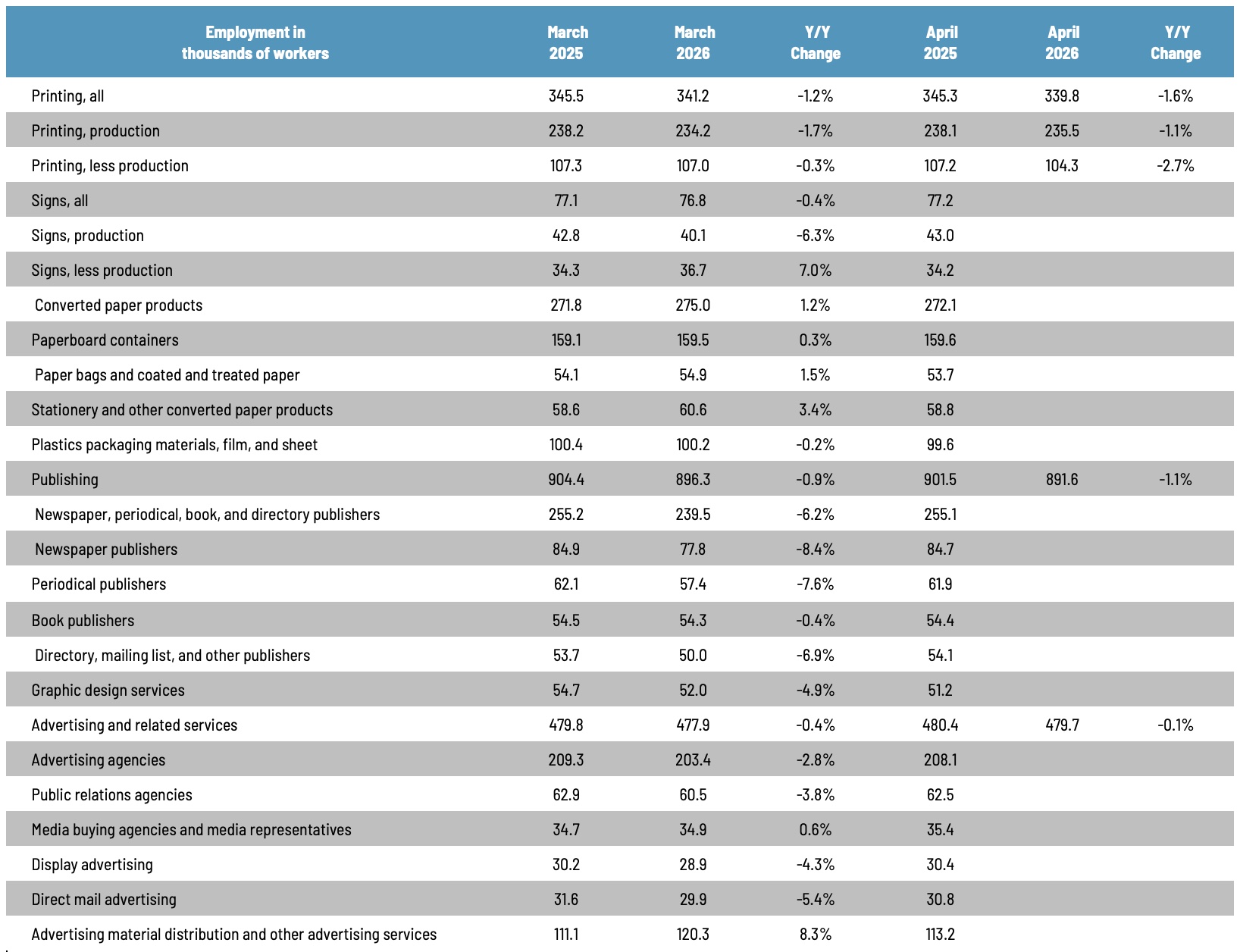
Graphic Arts Employment in April Down Overall—Substantially Among Non-Production

Graphic Arts Employment in April Down Overall—Substantially Among Non-Production

April 2026 saw printing industry employment overall generally flat, down 0.4% from March. And while production employment was up 0.6%, non-production employment was down by 2.5%—basically the reverse of what we saw in March. Read More

Recent Printing Industry News

Wednesday, June 03, 2026